01 August 2011

Rice vs. Lawrence Berkeley: Battle of the "Nanobatteries"

Rice University Nanowire Battery

Small batteries constructed of nano-scale components, such as Rice's nanowire battery pictured above, can only supply electricity in the micro-amp range. But that is all the energy you need to power ultra-small sensors and actuators. But for now, it is the marvelous fabrication technology which is noteworthy:
Researchers led by Rice professor Pulickel Ajayan built a hybrid energy storage device, which serves as a battery and a supercapacitor. The first version sandwiched an electrolyte between a nickel/tin anode and a cathode made of a polymer called polyaniline. The cathode also served as a supercapacitor, storing lithium ions in bulk, as this writeup by Rice University explains. The prototype proved that lithium ions would move through the electrolyte and into the cathode.


Then Ajayan and colleagues incorporated this structure into a single nanowire, through a complicated process of etching and chemical washing. The goal is to make nanowires with ultra-thin separation between electrodes, so the device can remain as small as possible.

The completed wire-batteries are about 50 microns tall, which is roughly the diameter of a human hair, according to Rice. _PopSci_via_Physorg
More details at Physorg.
Lawrence Berkeley Labs Graphene Nanobattery_via_NBF

The battery above is meant for bigger things -- to ultimately power an electric vehicle. Although constructed from materials with nanoscale thicknesses, by using thin sheets rather than tiny nanowires, the construction can be scaled up more easily. More from Brian Wang:
Berkeley Lab researchers assembled alternating layers of graphene and tin to create a nanoscale composite. First a thin film of tin is deposited onto graphene. Next, another sheet of graphene is transferred on top of the tin film. This process is repeated and the composite material is then heated to transform a tin film into a series of pillars. The change in height between graphene layers improves the electrode’s performance and allows the battery to be charged quickly and repeatedly without degrading. _NBF
More information from Lawrence Berkeley Labs (link via NBF)

Engineers must design production methods with the use of the final product in mind. That is just as true at the nano level as it is on the macro level. The two "nanobatteries" are not actually comparable, although the Lawrence Berkeley design could be scaled down more easily than the Rice design could be scaled up. But there are doubtless applications for which the Rice nanobattery approach will be used, which would not be suitable for the LBNL's graphene sandwich approach.

Labels: ,

Bookmark and Share

05 March 2008

Utility Scale Energy Storage

For electric powered automobiles, Lithium Ion batteries appear to be state of the art, for now. For large-scale energy storage, something "bigger" is necessary. While we are waiting for redox flow cell technology to mature, Sodium Sulfide (NaS) batteries appear ready to step in and provide enough heavy-duty electrical storage for utility load-leveling. Brian Westenhaus at New Energy and Fuel looks at NaS battery storage and comes away hopeful.
NaS is one of the oldest technologies in battery chemistry. By the 1960s, Ford Motor Company pioneered the modern design in hopes of powering early electric automobile designs. NGK and Tokyo Electric have refined it for power grid applications. NaS is actually a quite advanced technology. The anodes and cathodes are not vulnerable to the corrosive effects that plague lead (Pb) acid batteries, which makes the NaS battery very long lasting. The NaS is about 5 times more energy dense by volume than Pb acid.

Over the years, Tokyo Electric and NGK have installed enough battery storage in Japan for 155,000 homes. In the U.S. the latest installation is by AEP who installed a unit large enough to supply 260 homes with the idea that it would charge at night and discharge onto the grid by day during peaks, so leveling the demand and reducing costs.

...The ability to buy power off peak and use it during high peak offers large users a way to cut costs. Today the batteries are still quite expensive. At $2,500 per kilowatt they cost about 110% of a new coal plant per kw. Industry people say the one source and limited production of today replaced by mass production can greatly reduce the costs.

One of the more curious quotes comes from Imre Gyuk the head of the U.S. Department of Energy who said, “Stick it any place you can stick it.” I take that to mean that the biggest batteries ever can make a big difference in the total generating capacity required to run a modern economy.___NewEnergy
Large scale energy storage is important for several reasons:
  1. Demand is higher in the day and early evening than overnight. This makes night-time power cheaper, if you have the means to store it and use it during peak demand.
  2. Large scale storage helps to smooth out transient supply:demand mismatches in the grid.
  3. Large scale storage helps compensate for temporary grid power outages when located at hospitals, industrial plants, high rise buildings (elevators), city traffic light systems, etc.
  4. Large scale storage allows much greater scaling and utilisation of renewable energy power generation, such as wind and solar.
As time goes by, and large scale storge gets better and cheaper, we will find that the economics of power systems works out much better with large scale storage in the mix.

More information on NaS batteries at Energy Blog.

Labels:

Bookmark and Share

18 January 2008

Ultracapacitor -- Battery: Hybrid Electric Power

Combining the high energy density of batteries with the high power density of ultracapacitors, provides a better power profile than either alone. From Australia's CSIRO:
The UltraBattery combines a supercapacitor and a lead acid battery that, according to the CSIRO, creates a hybrid car battery that lasts longer, costs less and is more powerful than current technologies.

"Previous tests show the UltraBattery has a life cycle that is at least four times longer and produces 50 per cent more power than conventional battery systems," Mr Lamb said.

"It's also about 70 per cent cheaper than the batteries currently used in HEVs."
Australian Much more on CSIRO at Brian Wang's Blog

Or from the British Motor Show, a Mini-Coop conversion incorporated battery-ultracap hybrid power:
At the recent British Motor Show, PML Flightlink and its partner Synergy Innovations showed a MINI QED — an in-wheel, plug-in, series hybrid conversion of a MINI, which many would agree is a fun car to drive even before these developers achieved an ability to accelerate from 0-60 in 4.5 seconds.....PML Flightlink put 350V worth of 11 Farad ultra capacitors into its Mini QED prototype. The ultra capacitors accept power from regen braking and discharge when high current is required for acceleration.
Source

A Chinese hybrid car effort uses batteries with ultracaps:
For Maxwell Technologies and Tianjin Lishen Battery, hybrid describes a new sort of energy storage product that combines ultracapacitors with lithium-ion batteries. The two companies recently announced they would partner up to produce this hybrid power source, and samples should be available early next year, possibly in EVs....David Schramm, Maxwell's president and chief executive officer, said this hybrid tech "will give end-users the best of both worlds in terms of the long cycle life, rapid charge/discharge characteristics and low temperature performance of ultracapacitors and the large energy storage capacity of lithium-ion batteries."
Source

Secretive Texas startup EESTOR seems to be developing a combination battery/ultracapacitor that is attracting investment from Lockheed Martin, and intense investigation by GMC.
The combining of battery and capacitor attributes is quite exciting. Capacitors are very fast acting allowing very quick charge and discharge abilities that will dramatically improve the usefulness of devices that are self-storage powered. Whether a cell phone, laptop or automobile these attributes will have a strong positive impact in usefulness and consumer adoption.
New Energy

This is the basic idea behind the combination approach:
As a quick energy storage platform, a supercapacitor can charge or discharge in a time of mere microseconds to seconds, whereas batteries take minutes to hours. However, the energy density for batteries is much higher. Hence many believe that the ideal backup energy storage device would be a hybrid of battery and supercapacitor. To be useful in that role, however, supercapacitors must be easily made and integrated onto chips.
Source

Here is an interesting combination of fuel cell, supercapacitor, and battery (my favoured approach):
A fuel cell system that employs a super capacitor and battery electrically coupled in series with each other and in parallel with a fuel cell stack on a power bus line. As the voltage on the power bus line changes over the operating requirements of the system, the super capacitor is charged and discharged over a relatively large voltage swing, such as an 85% SOC swing. The super capacitor equalizes or voltage matches the voltage variation on the power bus line as set by the stack voltage to the voltage of the battery. Therefore, the battery, while providing the majority of the energy and power during charge and discharge, has a relatively small defined SOC swing, which acts to maintain the battery life.
Source

Here is a combo hybrid for delivery vans:
Azure Dynamics is perhaps the best example; they have built delivery vans with electric drives that included super capacitors. With the decreasing size of such energy storage, there even has been a “proof-of-concept” car. But, such an approach, sending “regen” from brakes and suspension into the “power-rich”,ultra capacitor module1, which then gets depleted before any additional charge is drawn from the battery module
Source

These are just a few examples of various attempts to achieve the electrodynamic "sweet spot" that will painlessly replace internal combustion engines with electric drive. We still need some breakthroughs in nano-materials, nano-assembly, and nano power electronics. But it is happening.

Labels: , ,

Bookmark and Share

16 January 2008

Step by Step to Ubiquitous Electric Automobiles

Two recent articles at New Energy and Fuel illustrate two of the incremental improvements needed to make electric vehicles the norm, rather than the exception. First:
What the researchers have done is explore the alloys of magnets usually used in these types of motors and design an alloy that offers much higher operating temperatures which can be produced at low cost and manufactured quickly and efficiently....The new alloy proposal adds yttrium and dysprosium to neodymium solve the heat gain – magnetic decline problem. With most neodymium-iron-boron magnets [ed: operating only] at half strength at 125 degrees C, the new alloy [operating] at near full strength at 200 degrees C offers a solution to production of electric motor magnets for vehicles....Now motors can be built lighter and more powerful within the specifications of a vehicular application. These kinds of background developments are significant to the move to electric drives.
New Energy

Next:
The EEStor technology is described across the board from battery to ultra capacitor, as having 10 times the capacity at one-tenth the weight than “traditional battery technology” and a big improvement in leak down over time. Those are three of the battery limiting issues of the day....The combining of battery and capacitor attributes is quite exciting. Capacitors are very fast acting allowing very quick charge and discharge abilities that will dramatically improve the usefulness of devices that are self-storage powered....
New Energy

Another vital need is for enough electrical power generating capacity to support a rapidly growing electric vehicle industry. Preferably clean energy such as advanced design nuclear. If renewables such as wind and solar are to be stepped up appreciably, a form of utility scale storage (such as flow cells) is mandatory.

Here is more about EEStor from GMVolt.com. (from New Energy)
Speaking of the GM Volt, this Wired interview with GM Vice Chairman Robert Lutz gives more information on the upcoming 2010 flex-fuel pluggable hybrid.

Labels: , ,

Bookmark and Share

04 January 2008

Electric Battery-Only Powered Aircraft Flies in France

This French kit-built plane goes a step beyond the self-launched electric powered glider from Slovenia. The French plane has made a 48 minute flight, and is preparing to fly the English Channel!
The 48-minute flight of the “Electra” covered more than 50 kilometers (31 miles)...The single-seater, based on a Sourciette kit aircraft, is the product of APAME (Association pour la Promotion des Aéronefs à Motorisation Électrique, Association to Promote Electrical Aircraft), with the support of a number of partners.

The wood and fabric Electra is 7m in length, with a wingspan of 9m. Weight of the aircraft without batteries is 134 kg. The battery pack weights 47 kg. Maximum takeoff weight is 265 kg. The aircraft has a cruise speed of 90 km/h.

APAME plans to cross the English Channel in July 2009 with the Electra...
Green Car Congress

Notice that the French Electra has very tight weight margins. Until electric storage batteries achieve a better energy density, Electra pilots must be petit.

Labels: , , ,

Bookmark and Share

17 December 2007

Saving The Planet--By Twike!

Westerners are addicted to their cars. And cars cause pollution. But what if you could create a "car" that created no pollution except the exhaust gases of the driver and passengers? I am referring to the Twike
The Twike is the world’s first pedal-powered human electric hybrid car.

The company says this car can get up to speeds of 15-45 mph, with a 5 speed electric motor.

The unique aspect about this car is that it can run only with the pedal power provided by your feet, much like the Flinstone mobile. If you team up to pedal with another passenger, the combined power could generate up to 500 watts, which can increase the range of the car by an astounding 50%.
TrendhuntersBefore long, you will be seeing creative solar panel add-ons.

This is like an enclosed, recumbent side-by-side moped--except with electric motor assist, not gasoline. With photovoltaics and advanced lightweight battery add-ons, the range on a sunny day might extend hundreds of miles.

Highway safety would be an issue, and dedicated twike-ways may be in the offing. Will bicyclists share space with Twikes?

The YouTube video below demonstrates the Twike in action:

Labels: , , , ,

Bookmark and Share

02 September 2006

Vanadium Redox Flow Cells and Other Energy Hopefuls


There has been a lot of talk of the potential of Vanadium Redox flow cells, but few working projects up until now. The Energy Blog reports on a sale of Vanadium Redox cells by Canadian company VRB Power, to an Irish wind farm. Redox flow cells are an ideal means of storing energy from renewable sources such as wind, due to the innate scaleability involved.

This sale is significant because the developlment of large energy storage systems is necessary before sun and wind power can become a truly integral part of our power generation system. Because of the intermittency of these sources, they, by themselves, are not dispacthable to meet the demands of the grid. Some means of storing the energy so that it can be used (dispatched) as needed is required. Llke a huge battery energy storage systems serve this need. Numerous types of systems are in use at a small scale, but very few at a large enough scale to be useful to a utility.

"This is a very important sale for the Company," stated Tim Hennessy, Chairman and CEO of VRB Power. "It is the largest sale we have made to date and it provides validation of the potential for our storage systems to be coupled to wind farms in the large, growing wind markets in Ireland, Europe and North America as well as a number of other countries worldwide. The VRB technology is the most advanced wind coupled storage system in the world with a very large system installed in Japan and a smaller one installed in Australia. The repeated deep cycling in wind applications makes it virtually impossible for conventional batteries or even advanced batteries to compete with the VRB - ESS"

The cost of electricity generation in Ireland has risen to amongst the highest in the world and this has led to a large focus on reducing dependence on natural gas imports, becoming more self-sufficient in terms of electricity generation and in maximizing its own natural resources.
Source.

The development of scaleable storage technologies such as the Vanadium Redox cell is vital to the rapid expansion of renewables.

Other energy technologies are receiving a lot of attention, including some that are reputable and some that are not. Peswiki reports on the New Energy Congress' Top 100 energy technologies. Look them over. Some will make you groan, and others may make you perk up and take notice. Just remember that every revolutionary technology has been viewed as worthless crackpottery at one time or another.

Labels: ,

Bookmark and Share

31 March 2006

Energy No-Brainer: Pluggable Hybrid Automobiles

First of all, what is a pluggable hybrid? Also called a Plug-in Hybrid, a pluggable hybrid is a car that can be powered by either internal combustion engine or electric motor--but it has larger batteries than conventional hybrids, and you can plug it in overnight to use inexpensive power grid energy for your daily commute. That constitutes a major shift in energy use from petrol to grid electricity. If the grid electricity comes from renewables (or nuclear), you can commute to work all week in a pluggable hybrid, without burning fossil fuel.

Among those who follow energy trends, the pluggable hybrid has become quite popular. Which makes many people wonder, why has Toyota gone to great lengths to distance itself from the pluggable hybrid concept?

On Tuesday, a Toyota representative wrote to an individual, "we do not currently have any announced plans to introduce a plug-in hybrid Toyota vehicle in the U.S." Find an expert who could say if that's intentionally evasive. (See our chronology of all automakers comments in the past year at http://www.calcars.org/carmakers.html .)

In a story broadcast today on NPR All Things Considered, you can hear spokeswoman Cindy Knight say, "You can certainly make a vehicle that will run, but you can't necessarily make a vehicle that people will buy.... Toyota went to great lengths to address the drawbacks of battery vehicles so that people do not have to plug our hybrids in, and our customers tell us that that is one of the features they like about the vehicle, they don't have to plug it in."


If the big carmakers distance themselves from this obviously winning concept, smaller players will rush in to fill the gap. Jim at the Energy Blog keeps close track of developments in pluggable hybrids, and he has a full array of energy links. Jim's place is an excellent site for following the progress in this war of the vehicular power plants.

Check out this Al Fin post for some of the underlying energy issues involved in the transition from internal combustion engines to fuel cell/supercapacitor/battery powered electric motor vehicles. The pluggable hybrid is a very useful intermediate step in the transition. No matter what the big auto manufacturers do, they cannot stop it from happening.

Labels: , , , ,

Bookmark and Share

25 February 2006

Energy Storage: Global Climate Change or Just Cleaner Air?


Hat tip to the Energy Blog for this post on a new book dealing with advances in energy storage technologies. Energy analyst Richard Baxter's "Energy Storage: A Non-Technical Guide", details several newer technologies and their likely impact on the energy industry's shift to cleaner energy generation. Global Warming (Climate Change) and Peak Oil enthusiasts should be following this issue very closely, since in the long run energy storage will have a far greater impact on greenhouse gases and petroleum use than any political movements such as Kyoto or Peak Oil conservation.
From the Energy Blog:

The 302 page book is divided into six sections with a major emphasis on the technologies as indicated by the following outline:

* How energy storage can benefit the electric power industries
* How energy is stored in the fossil fuel markets
* Energy storage technologies
o pumped hydroelectric storage (PHS)
o compressed air energy storage (CAES)
o flow batteries-vanadium redux, zinc bromine, polysulfide bromide and cerium zinc
o sodium sulfide battery
o lead-acid battery
o nickle cadmium battery
o flywheels
o electrochemical capacitors
o superconducting magnetic energy storage
o thermal energy storage
+ design and operation of each technology
+ history of each technology
+ cost issues for each technology
+ examples of installations for each technology
+ prospects and challenges of each technologies
+ major developers of each technologies
* Applications of energy storage
* The role energy storage can play in renewable energy
* How energy storage could effect future energy development

Forty illustrations make reading and understanding the text much easier. Numerous references in each section and a 12-page bibliography are included for those interested in digging deeper into these technologies.


Energy Blog also points to this article by Baxter in EnergyPulse.

The benefits of using wind energy can be quite high. A number of studies by US Government Laboratories (NREL, LLNL, etc.) have shown that adding wind to a diesel-powered local grid can reduce fuel consumption by 40%-50% and total costs by 30% to 50% for areas with plentiful wind resources.(1) However, because of the small size of these power grids (lack of system inertia, etc.) simply adding wind turbines to small power grids cannot be done haphazardly—a systematic review of the load and potential additional wind turbines must be undertaken to ascertain potential benefits, and to determine what level of wind penetration is best. For many of these power grids, the opportunity exists to have wind resources well in excess of 50% of the peak load.

The same studies that showed that increasing the wind penetration can lower the diesel fuel costs on these systems also showed that adding a storage component can gain an additional 10%-20% in system cost reductions. Although wind turbines provide power with no fuel cost, they bring with them operational characteristics that cause the overall system to operate at sub-optimal conditions many times due to the variability of the wind energy, the non-dispatchability of the wind energy, and the additional system stabilization requirements (frequency and voltage) required. By alleviating some of the stress on the system by operating as a dynamic source and sink for power (a shock absorber), energy storage can be a beneficial additional to these island grids for three general reasons: reducing diesel starts/runtime, providing system stability, and improving the reliability of supply from increasing the level of wind penetration for the system.

The value of energy storage to the system increases as the wind penetration increases, as there will be an increasing amount of time that the available wind power exceeds the total system loads. According to one NREL study(2), at 50% wind penetration, storage can provide 20% greater fuel saving and 20% fewer diesel run-tine than non-storage wind/diesel systems alone.


Here is a website from the Engineering Department of SDSU in San Diego giving a general introduction to the topic of energy storage.
Here is an excellent introduction to large scale energy storage from Imperial College London.


Whether one believes in catastrophic anthropogenic global climate change, or merely wants cleaner air to breathe for the indefinite future, integrating storage technologies into the energy infrastructure is excellent news.

Labels: ,

Bookmark and Share

22 January 2006

Flow Batteries are a new and Revolutionary Storage Technology

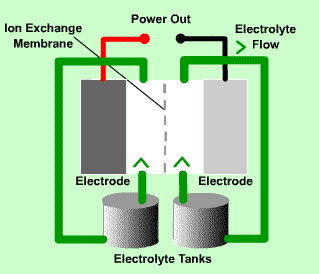
The Energy Blog reported a while back on a new energy storage technology, Vanadium redox flow batteries. Flow batteries are called that because the electrolytes flow through the cells, giving up electrons to an external circuit. The redox reaction is reversible, so the cells can be charged or discharged. The significant fact about flow batteries is the potential to scale to very large storage sizes into the megawatt and multi-megawatt ranges. This is the type of storage capacity utilities have been looking for.

Performance

*
The VRB has an availability of greater than 98%. Designed for unattended operation with very low maintenance costs.
*
No degradation from repeated deep charges and discharges. The system can be discharged and charged greater than 13,000 times (20% to 80% SOC) without deterioration in system efficiencies.
*
System round-trip efficiencies between 70% - 78%.
*
The VRB-ESS has a charge/discharge window of 1:1 - allowing off-peak charging for on-peak dispatch - a fraction of the time required by other battery systems and ideal for wind generation applications.
*
Cross mixing of electrolytes does not lead to contamination of electrolytes
*
indefinite life of electrolyte (no disposal or contamination issues).
*
Once charged, the electrolyte remains fully charged with low self-discharge.


Flow batteries are not generators, like regular fuel cells. Most fuel cells use up their fuel sources in an irreversible reaction. Flow batteries do not use up their electrolytes. The electrolytes are fully reusable, with recharging. And flow cells are not like regular batteries, since you recharge them by replacing the electrolyte. They are a new, hybrid form of chemical battery/fuel cell.

The best use for these cells will probably be as load levelers for utilities, and as backup power for large industrial facilities.

Here are more links:

Sandia
Wiki
ME
Geo

Labels: ,

Bookmark and Share

03 January 2006

Supercapacitors vs. Batteries: An Electrifying Race

The Energy Blog scores another homerun, with its post on supercapacitors. Supercapacitors are fast. They charge fast and they discharge fast. Think of the supercapacitor as the hare, and the storage battery as the tortoise, and you will get the picture.

The third component of the electrical triumvirate is the fuel cell, which acts as the power generator, slow and sure. Oh, and the properly sized electric motor as an actuator. The combination may be a bit too heavy for a regular commuter automobile, but with advances in all three technologies in the pipeline, it may not be long.

Supercapacitors have many uses besides acting as a power boost and regenerative brake for vehicles. Read the article and follow the links.

Labels: , ,

Bookmark and Share

21 December 2005

Turning Lovely Trees into "Battrees"?


Can you turn one of these lovely natural objects, . . . .


. . . . . into one of these?

This article
discusses the work of an engineering group in Canton Mass., in collaboration with an inventor from Illinois. They claim that soon they will be able to tap the "energy in trees" to charge batteries up to 12 Volts or higher.

The concept comes from the natural potential differences that develop in nature. Such potential differences help to shape animal embryo growth and development. Such naturally occurring potential differences also create lightning, and other natural electrical phenomena.

Currently the researchers can only generate enough voltage/current to keep an LED burning indefinitely. They promise more, much more, in the near future--if provided with funding. Take that for what it is worth. Food for thought, at least for termites.

Labels: ,

Bookmark and Share
Older Posts
Al Fin Main Page
Enter your Email


Powered by FeedBlitz
Google
WWW AL FIN

Powered by
Blogger

``