30 April 2010

Emergency Fuel Cell Power Supply: Just Add Urine

South Korean battery makers have created the MetalCell, a magnesium battery based on 2,000-year-old technology that can be charged with saltwater or, barring that, urine....MetalCell can sit in the back of a Humvee, in a remote bunker, or in a locker at a forward operating base for years, waiting to power up electrical devices in a pinch. _PopSci
These fuel cells can serve as backup emergency power for electronic devices, should your main power fail in an emergency. Capable of sitting dormant for years, it can be activated with a few quick squirts of urine or salt water. (yet another use for urine)
South Korean developers have adapted 2,000-year-old battery technology for modern warfare.

The device, known as MetalCell, is a backup power source that runs on sodium and can keep a laptop charged for more than four hours, its maker says. The design is relatively simple: a small, ruggedized box with magnesium plates inside. If an electrical gadget — anything from a computer to a flashlight — runs out of energy, a soldier on the battlefield could pour saltwater into the MetalCell and use the device as an emergency power source.

Soldiers in the field have salt in their Meal, Ready-to-Eat packages. Urine could also be used to power the device, says Art Morgan, CEO of the Northern Virginia-based company SEG Inc., which represents the product in the United States.

The sodium reacts with the magnesium to produce low-voltage power.

“You can pack away the device and let it sit for years until you need it,” Morgan says.

...The standard MetalCell model costs about $200 and can be recharged with salt water until the magnesium plates deteriorate. The company is also marketing disposable models that are cheaper — about $120 — and come with salt tablets. _NationalDefense_via_PopSci

Labels: , ,

Bookmark and Share

07 June 2009

Natural Gas Is a Very Big Deal

The map of the proposed Nabucco natural gas pipeline suggests the scope of Europe's need for natural gas. With the global climate showing signs of reversing a recent warming trend, Europe risks freezing in the dark cold winter unless she finds a way to break her uneasy dependency on Russian fuels. North America and Australia already have plenty of natural gas (and coal).
Natural gas is a cleaner fossil fuel than coal or oil. Just as important, natural gas works well for fuel cells -- a form of power generation that is growing in importance. In fact, in Japan, in the UK, in the US, and in Australia, home fuel cells for combined residential provision of hot water, space heat, and electricity (CHP) is slowly becoming an important player in the overall power utility scheme.

Of course almost anyone with access to natural gas can provide home CHP (combined heat and power) using a gas-powered combustion generator. But with fuel cells, combined efficiency can reach almost 90%. With a combustion engine, combined CHP efficiencies are closer to 60%.

Regular Al Fin readers will recognise the theme of "independence" and "decentralisation" in the trend toward home generation of power. Being able to produce your own methane or methanol to power your own CHP fuel cell would be even better. Off the grid for power, hot water, heat, cooking, etc. makes you less vulnerable to the Obama / Pelosi reich energy starvation policies.

Labels: ,

Bookmark and Share

21 June 2008

90% Biomass to Electricity Efficiencies in the Pipe

UK researchers have combined two types of fuel cells, and made some important discoveries about the use of solid carbon--including biomass carbon--in efficient fuel cell power production.
Direct carbon fuel cells run on solid carbon fuel and typically use solid oxide or molten carbonate electrolytes to transport ions between the electrodes. John Irvine at the University of St Andrews and colleagues made a hybrid direct carbon fuel cell containing both types of electrolyte. They found that the binary electrolyte system enhanced carbon oxidation because carbon was oxidised not only on the electrode surface but also in the carbon-electrolyte slurry...

Solid carbon, which comes from various sources such as coal or plants, packs a lot of energy into a small volume, making it an attractive fuel. Irvine states that coal will be a major energy source in the future but, unless it can be converted into electricity more efficiently, will lead to an increase in carbon dioxide emissions. Fuel cells could be the answer, he says. 'Carbon fuel cells offer very high efficiency of conversion and, if implemented in the correct way, can yield two to three times the amount of energy for a given amount of coal compared to conventional thermal generation,' he explains. __Source_via_fuelcellworks
The carbon fuel cell appears to be an even more efficient means to produce cellulosic electricity than using the gasification to turbine (steam or gas) routes. Thermal generation from coal or torrefied biomass may achieve 30% to 40% electric generation efficiency (above 50% in combined cycle operation). Fuel cell generation efficiencies might reach above 80% combined cycle, eventually higher.

The promise of 90% or higher efficiencies from biomass electricity production is a potent goal. Keep in mind that combined heat and power (CHP) is the way of the future. Whether capturing waste heat from heat engine generators such as steam or gas turbines, or capturing waste heat from fuel cells, that added power generated from waste heat of power production can make the difference between an energy-rich "power to spare" society, and a brown-out society like Caw-lee-forn-ya.

Excerpted and modified from a previously published article at Al Fin Energy.

Labels: ,

Bookmark and Share

13 March 2008

New Fuel Cell Technologies

A UK company, Acal Energy Limited, has demonstrated a new fuel cell approach that replaces expensive platinum cathodes with a liquid metal "flow" cathode.
The FlowCath system replaces the standard—and expensive—platinum cathode found in conventional fuel cells with a liquid, non-precious metal catalyst system. This not only reduces the cost of the cell, but also humidifies the membrane naturally, eliminating the need for additional hydration systems, and better manages the heat which is generated....ACAL’s core technology is the liquid catalyst chemistry. The company currently uses a polyoxometallate inorganic association complex that is very stable and robust, and offers the same power density as platinum (unpressurized), with an additional 100% performance improvement possible.

For its next-generation system, the company is developing a transition metal-ligand complex. This is a higher potential catalyst, capable of delivering 2-3x the performance of platinum, according to ACAL. ___GCC

Fuel cells appear particularly promising for stationary applications--such as home combined-heat-power (CHP), plus for industrial and commercial CHP and backup power applications.

No matter how reliable electrical power grids are made to be, grid failure is always a possibility. By decentralising power generation, and by providing backup power supplies to critical industries and services, society is made more resistant to accidents and terror strikes that cripple the power supply.

More about ACAL technology PDF

Labels: ,

Bookmark and Share

28 February 2008

Home Fuel Cells: Dutch Nuon Makes a Move

image source
Dutch energy and utility, Nuon, plans to install home boilers incorporating ceramic fuel cells, for its residential customers. The Dutch company expects to begin supplying this combined heat and power approach to residential customers by 2014.
The deal is contingent on Ceramic Fuel, which is dual-listed on London's Alternative Investment Market, meeting commercial requirements set by Nuon. Ceramic Fuel's legal and commercial manager, Andrew Neilsen, said it needed to improve the durability of the fuel cells, from the current two years to four, to meet Nuon's targets, but was confident this would be met and that production would begin by June 2009.

Ceramic Fuel also announced the construction of a €12.4 million factory in Heinsberg, Germany, with an initial production capacity of 10,000 units per year. The cells emit around 60% less carbon dioxide than traditional combustion generators.

Ceramic Fuel has partnerships with several utilities and power appliance manufacturers, but this is its first major sales agreement. Nuon will distribute the cell, which will be integrated into boilers to allow residential customers to generate electricity and heating in their homes, the company said.

Mr Dow said the technology would enable utilities such as Nuon to lease out the boilers — reducing installation and servicing costs for consumers — in return for fixed-price contracts. This will improve customer retention, a major bugbear for European energy providers.___Source__via_NextEnergy_

Expect to see more such creative energy options provided to residential utility customers as time goes on. Combined heat and power (CHP) is more efficient than providing the services separately. With the efficiencies of fuel cells for generating both heat and power fitted to the residential scale, significant savings for the utility are possible. If you consider the load-leveling capability of home CHP as well, utilities have a lot to gain from such an approach.

On a related note, check out this Forbes.com article looking at the state of the art in battery technology.

Labels: ,

Bookmark and Share

13 February 2008

Fuel Cell Revolution: DCFC's Run On Biomass!?!

Biomass can easily be turned to "bio-coal" carbon. Now, that biomass carbon can be used to drive fuel cells. The only output is pure CO2--the favoured food for plants!
Last year, the director of the Department of Colloid Chemistry at the Max Planck Institute of Colloids and Interfaces, Prof Dr Markus Antonietti, developed an innovative technique with which any type of biomass can be converted into renewable and climate friendly 'designer coal'. Uses for the carbon are plenty, but professor Antonietti confessed that he and his researchers are part of a growing group of scientists who dream of a Direct Carbon Fuel Cell (DCFC) and a green carbon economy. As its name implies, a DCFC converts elemental carbon into electricity directly, and in a hyper-efficient way - the cells have almost twice the efficiency of most other types of fuel cells and double that of fossil fuel power plants.

...The reaction yields 80 percent of the carbon–oxygen combustion energy as electricity, yet no burning of the carbon takes place. DCFCs for stationary applications provide up to 1 kilowatt of power per square meter of cell surface area — a rate sufficiently high for practical applications. Some developers are designing DCFCs for mobile applications that can deliver energy densities in the range of 1,000–2,000 Wh/kg, far higher than any advanced battery.

...DCFC technology has several potential benefits over other fuel cells. First, it can use a wide variety of very abundant low cost carbonaceous fuels including coal, coke, tar, biomass and organic waste. Conventional fuel cells typically operate on gaseous fuels. The fuel (natural gas, propane, ethanol, etc.) is reformed to a hydrogen syngas, which is fed into the fuel cell stack. The DCFC, however, can operate directly on solid carbon fuel, which is stable, easy to store, handle and transport. DCFCs don't require the construction of an entirely new and expensive infrastructure - which is the case for hydrogen - nor do they lose the energy needed to turn fuel into gas.

Secondly, unlike hydrogen or methanol fuel cells, DCFC use no catalyst or costly noble metals like platinum. This cuts costs, and should increase reliability.___Biopact

This development has all the makings of a fuel cell revolution. Hydrogen has always been a bad bet for mobile and de-centralised fuel cell applications. It is time to grow out of that childish hydrogen fantasy.

Labels: , ,

Bookmark and Share

23 September 2006

The Ammonia Economy Tries to Displace the Hydrogen Economy

Everyone has heard about the hydrogen economy. Even US President Bush has promoted the hydrogen economy from time to time. But hydrogen is not a practical storage medium/fuel at this time, and will not be for many years. Some people are tired of waiting, and have begun to promote the ammonia economy.

The Hydrogen Engine Center (HEC) of Iowa has made some bold moves in the direction of the ammonia economy. The HEC is making internal combustion engines that run on anhydrous ammonia. Anhydrous ammonia contains more hydrogen by volume than liquid H2, which makes ammonia a potential fuel for fuel cells, once the corrosion problems are solved. Here is a Wired news story describing one recent project using HEC ammonia engines.

Ammonia comes from processing of natural gas and coal, so at this time it is not a renewable form of energy. Nevertheless, for those concerned about carbon emissions, it should be noted that ammonia contains no carbon whatsoever.

Labels:

Bookmark and Share

09 July 2006

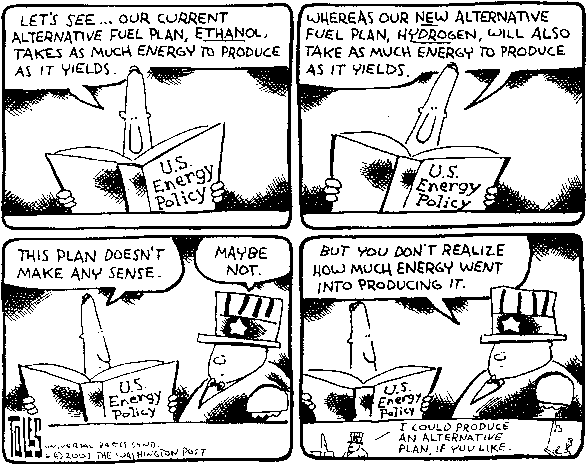
Hydrogen Not Efficient for Energy Storage

The annual fuel cell conference of the European Fuel Cell Forum was held in Lucerne, Switzerland, last week. Much of the sentiment from the conference in regard to hydrogen energy storage was compiled in this Reuters newsreport:

When environmentally friendly wind electricity is used to generate hydrogen, only one-quarter of the energy generated by the wind turbine is eventually used to move a car. The rest is lost during transport and energy conversion, said Ulf Bossel of the European Fuel Cell Forum, which held its annual fuel cell conference in Lucerne, Switzerland, last week.

"With hydrogen energy you only have 25 per cent efficiency to turn wind power to [car] wheel power," he said. It's much more efficient to transport that electricity directly into a car battery, via the grid, and use 90 per cent of its power."

Hydrogen is being discussed at the conference because it is one of the fuels for cells that can generate electricity and heat in an electrochemical conversion.

....Bossel said most renewable energy will be harvested as electricity through wind and solar power and should be used directly.

But he accepted that today's economy is based on fuels and cars will need some liquid fuel for long journeys, rather than recharging batteries every few hundred kilometres.

Even when this liquid energy is made from biomass, it makes sense to turn it into a biodiesel rather than hydrogen, said Wim van Swaaij, professor of thermo-chemical conversion at Netherlands' Twente University.

Biofuels are easy to handle, like today's fuels. Hydrogen, in its pure form, needs to be stored under high pressure which also consumes energy. Biofuels themselves contain hydrogen but in a much more stable form.

"Through steam reforming technology we can turn 40 to 50 per cent of the original fuel content in biomass into biofuel. The percentage is even higher for hydrogen, 50 to 60 per cent, but we will also have to store it and biofuels are the easiest and most efficient way to store it," Van Swaiij said.

The carbon particles in the biofuel will not make a net contribution to heating up the Earth through the greenhouse effect if the fuel is harvested from biomass, because the plants consume carbon dioxide as they grow, Van Swaaij added.

Bossel also said that producing hydrogen, either through electrolysis using nuclear or renewable electricity, or refined from biomass or fossil fuels, requires massive amounts of water. One kilogram of hydrogen requires nine litres of water.

In capitalist countries, the market will decide efficiencies based upon pricing--supply and demand--within the context of government regulation. We should all hope that government does not chase the wild albatross of hydrogen storage too much farther. Eventually nanotechnology and materials technologies may make hydrogen viable, economically. At present it would be smarter to bank on alternatives, such as batteries, supercapacitors, and biofuels such as bio-butanol and biodiesel.

Labels: , ,

Bookmark and Share

14 May 2006

Sugar to Hydrogen Conversion Promises Renewable Hydrogen Energy At Low Cost

Everyone knows that fuel is more expensive. It is important to turn to alternative, renewable energies, to substitute for non-renewable petrochemicals. Jim from the Energy Blog has provided an intriguing report on a new catalytic energy process for creating renewable hydrogen from sugar, glycerine, glycols, and sugar alcohols. This new process promises to reduce the cost of hydrogen production by up to two thirds.

The process (US. Patent No. 6,699,457) will enable localized production of hydrogen using readily available sugar-based feedstocks effectively eliminating hydrogen transport, storage and safety roadblocks that impede adoption of hydrogen fueled power systems. Due to the low temperature operation of APR, the economics are scalable to small home and office use applications. Depending on the feedstock, the process is capable of producing green hydrogen at a total cost of between $1.80-$4.00/kg. This is dramatically less than alternative renewable sources, such as wind and solar, and very competitive with mature, capital intensive hydrogen production methods such as natural gas reformation, coal gasification or electrolysis.

For comparison the energy contained in a kg of hydrogen is comparable to the energy in a gallon of gasoline, thus the cost to operate an internal combustion engine (ICE) on this hydrogen, produced from a distributed production system would be competitive to an ICE running on gasoline and the cost of operating a fuel cell would be about one-third that of an ICE.

....Dumesic and his team tested more than 300 catalysts to find a nickel-tin-aluminum combination that reacts with biomass-derived oxygenated hydrocarbons to produce hydrogen and carbon dioxide without producing large amounts of unwanted methane.

When the sugar or alcohol molecules touch the surface of the catalyst, chemical reactions break and rearrange many of the carbon bonds, causing the atoms to be “reformed” into new configurations and liberating hydrogen in the process. In fact, about half the product is hydrogen gas. The researchers estimate that, if the system is fully developed, it will be able to turn a liter of biomass into about 1,000 watts of power.

....Because of the tremendous cost and energy advantages that the APR process has shown, Virent is targeting smaller [operations due to fast payback potential].


Much more information at the source.

These diagrams show all the hydrogen atoms contained within a few typical small organic molecules. Of course, if you can make hydrogen from glycerol---a major byproduct of biodiesel production---you can make biodiesel production that much more efficient. And if you can then produce cellulosic ethanol from the cellulose of the plant, efficiencies go up further, for total plant use.
This means of producing energy is relatively kosher, in comparison with the energy source profiled in yesterday's post.

Labels: , ,

Bookmark and Share

03 January 2006

Supercapacitors vs. Batteries: An Electrifying Race

The Energy Blog scores another homerun, with its post on supercapacitors. Supercapacitors are fast. They charge fast and they discharge fast. Think of the supercapacitor as the hare, and the storage battery as the tortoise, and you will get the picture.

The third component of the electrical triumvirate is the fuel cell, which acts as the power generator, slow and sure. Oh, and the properly sized electric motor as an actuator. The combination may be a bit too heavy for a regular commuter automobile, but with advances in all three technologies in the pipeline, it may not be long.

Supercapacitors have many uses besides acting as a power boost and regenerative brake for vehicles. Read the article and follow the links.

Labels: , ,

Bookmark and Share

01 January 2006

Molten Carbonate Fuel Cells Are Very Efficient

The Energy Blog has an article dealing with molten carbonate fuel cells. The company whose product is described, is Fuel Cell Energy, Inc. of Danbury, CT, USA.


These molten carbonate fuel cells operate at temperatures near 650 C. Present products produce 0.5 MW, 1.0 MW, and 2.0 MW. They operate on methane type fuel without reformation to hydrogen, and can achieve efficiencies up to 70% and above. There are several industries in the market for such power supplies, from hotels, manufacturing plants, and government installations, to wastewater treatment plants. This type of product contributes to the decentralisation of power supplies, making the power supply of a society more resilient and resistant to widespread shutdowns.

Labels:

Bookmark and Share
Older Posts
Al Fin Main Page
Enter your Email


Powered by FeedBlitz
Google
WWW AL FIN

Powered by
Blogger

``