17 October 2012

Germany Screws the Energy Pooch Bigtime

German Consumers Pay Big Price for Government's Energy Mistakes


Germany is attempting the impossible: It is attempting to replace safe and reliable nuclear power with exorbitantly expensive intermittent unreliable energy sources such as big wind and big solar. German consumers of electric power are already paying the price of this ill-advised policy of quasi energy suicide.

Oddly for a so-called green government, the Germans are rapidly building up their coal generation capacity, in an effort to avert total energy disaster from the intermittent unreliables.
Germany’s foray into renewables has not converted most of its neighbors and a number of them are planning to construct nuclear power plants of their own, just as Germany is getting rid of hers. _Germans Pay the Price
Of course most intelligent leaders would not follow Germany's path to energy suicide. It is easy to understand what happens to industrial economies when their power grids can no longer supply high quality, reliable electric power: They lose their industries to other countries that are still capable of supplying industrial quality power.
Despite technological advances, wind, solar, hydro and other green energy sources still remain an unprofitable investment in a fair market. The way to encourage their exploitation is through a set of feed-in tariffs, a policy where energy companies are forced to buy electricity from green generators at a price set by the government (which is usually legislated to remain the same for two decades).

The German government has passed the cost of the payment from the energy companies to the consumer. Every German on the grid pays something called Umlage, a special surcharge for supporting green fuels that covers all the green energy subsidies, however much energy is produced.

_RT
Germany is one of the worst conceivable places to build solar power infrastructure. Constantly cloudy, at relatively high latitude -- with almost no useful sun over large parts of the year.

Wind is even worse, with an erratic unpredictability that is said to be more threatening to power grids than throwing live hand grenades into grid control centres.

Industries are already leaving Germany, and more will soon follow. The loss of energy and jobs will damage the German economy almost as much as the exploding cost of new infrastructure required to deal with the intermittent unreliables. And the cost -- THE COST!!! Hundreds of thousands of lower class workers in Germany already cannot afford to pay their skyrocketing power bills. That number will only grow larger.

In an effort to stay in power just a few years longer, Germany's leadership has made one of the worst decisions that a modern government can make.

Germany was unlikely to be destroyed by outsiders, in the absence of another provocateur such as Hitler. But in this case, it is the Germans who are doing it to themselves.

With Germany as the pivot point for the European power grid and the European economy, what does this tell you about the future of Europe?

h/t The GWPF

More:

Germany faces power blackouts this winter

More energy price explosions confronting German rate payers

One may wonder, "what is the point of all this, if global warming stopped 15 years ago?"

Political left crucifies itself on a great green cross

Labels: , , ,

Bookmark and Share

13 August 2012

China: The Biggest Loser in Green Energy?

This article is cross-posted to Al Fin Energy blog

China is losing a lot of money on solar -- even more than Obama lost betting on the intermittent unreliable form of energy!
China’s top ten photovoltaic makers have accumulated a combined debt of 17.5 billion U.S. dollars so far, leading the whole industry to the brink of bankruptcy, data from U.S. investment agency Maxim Group showed.
Goodness. That’s 35 Solyndras!

LDK Solar, the world’s second-largest maker of solar wafers, and Suntech Power, the world’s largest solar panels producer, are the mostly likely to be headed for bankruptcy, Maxim noted. LDK reported a net profit loss of 1.08 billion yuan in the first half of this year, with a total liability of 26.7 billion yuan, about 88 percent of its total assets. 2.42 billion yuan of debts will come due in 2013, compared with a cash pile of only 830 million yuan. With its debt-to-equity ratio at 7.4, the Jiangxi-based LDK has already been in insolvency based on corporate accounting standards in the Europe and the United States, according to Maxim. A bankruptcy filing or restructuring could be needed for LDK, it added. _Reason

Unfortunately for the Chinese people, solar companies in China are devastating the landscape with toxic waste on a monumental scale.

And more than half of China's installed wind power lies fallow -- disconnected from the power grid! Imagine all the wasted resources, just to be able to claim a large installed wind power base.

But knowledge of the grand green charade of China's wind and solar industries has not reduced the fervour of US green political activists such as Barack Obama or Senator Harry Reid of Nevada. In fact, Senator Reid is indulging in a grand corrupt and nepotistic scheme in his home state of Nevada, involving a public lands give-away to a Chinese solar company and an associated US company involving his own son!

Of course this type of insider political deal is not unusual for either Nevada - style or Chicago - style political operators.

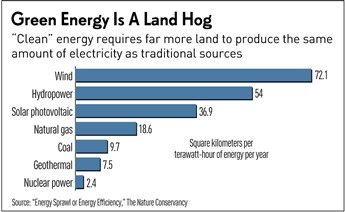
Energy Producer Land Requirements


China's grand scheme of infrastructure buildup -- including green infrastructure -- is proving to be something of a big bomb. China has been spending money hand over fist, stalling for time in hope that its big export customers -- Europe and North America -- would pull out of their economic doldrums, and start to buy Chinese products on a grand scale, once again.

China is getting a bit desperate, and cannot help but be relieved every time a foreign sucker -- in Germany, the US, Australia ect. -- gets sucked into another green energy scam.

Yes, China is poisoning itself to build and sell intermittent unreliable products such as big wind and big solar energy generation equipment. But if foreign devils like Harry Reid, Barack Obama, Angela Merkel, etc. are stupid enough to buy this junk at high prices, why not? It's not as if China's people can do anything about it.

Labels: , , , ,

Bookmark and Share

24 March 2012

Inflatable Death Star? Space Mirrors Beaming Down from Above

Next Big Future
Inflatable Reflector Development at L’Gaarde. Inflatable antenna design matures in the form of this new 7 meter rigidifiable inflatable antenna structure. The torus and struts on this spectacular configuration rigidify shortly after deployment. The resulting reflector is thermally stable, stiff, and well damped, with a low error for high gain space applications. The entire reflector assembly stows in the small round structure visible above the simulated hexagonal spacecraft. It inflates and rigidifies to the configuration seen. _NBF
Brian Wang discusses proposals for orbiting large arrays of orbiting mirrors in a polar sun synchronous orbit, 1000 km above Earth. The idea as stated in the document embedded below, is to extend the time of insolation for particular land areas, which could convert the extra sunlight into electricity or heat.
Such a scheme could also be used to extend the growing season for crops, or to provide glacier-free living space in the event of an unforeseen ice age ;-).

As mentioned here previously, such solar-beaming arrays could also be used to damage crops, or to concentrate light and heat in damaging and deadly ways. Think of them as inflatable death stars, on the cheap. What evil galactic emperor could possibly complain about the cost of these bargain basement death stars?

All the more reason why space should be open to all, rather than limited to just a few powerful national governments. The greater variety of nationalities and peoples in space, the less chance that any would be space dictator could get away with such death star shenanigans.

Labels: ,

Bookmark and Share

19 February 2012

Germany's Sunshine Fairy Fantasy

Germans have paid about $130 billion for a climate-change policy that has no impact on global warming. They have subsidized Chinese jobs and other European countries’ reliance on dirty energy sources. And they have needlessly burdened their economy. As even many German officials would probably attest, governments elsewhere cannot afford to repeat the same mistake. _GWPF
Germany has been caught up in a dreamy fantasy of a golden shiny green future, full of sunshine fairies and wind sprites. But artificial, made-up euphorias have a way of turning into despair, eventually. Bjorn Lomborg has more:

Sunshine Fairy Image Source

Germany once prided itself on being the “photovoltaic world champion”, doling out generous subsidies – totaling more than $130 billion, according to research from Germany’s Ruhr University – to citizens to invest in solar energy. But now the German government is vowing to cut the subsidies sooner than planned, and to phase out support over the next five years. What went wrong?

There is a fundamental problem with subsidizing inefficient green technology: it is affordable only if it is done in tiny, tokenistic amounts. Using the government’s generous subsidies, Germans installed 7.5 gigawatts of photovoltaic (PV) capacity last year, more than double what the government had deemed “acceptable.” It is estimated that this increase alone will lead to a $260 hike in the average consumer’s annual power bill.

According to Der Spiegel, even members of Chancellor Angela Merkel’s staff are now describing the policy as a massive money pit. Philipp Rösler, Germany’s minister of economics and technology, has called the spiraling solar subsidies a “threat to the economy.”

...Germany – like most of the world – is not as sunny as the Sahara. And, while sunlight is free, panels and installation are not. Solar power is at least four times more costly than energy produced by fossil fuels. It also has the distinct disadvantage of not working at night, when much electricity is consumed.

In the words of the German Association of Physicists, “solar energy cannot replace any additional power plants.” On short, overcast winter days, Germany’s 1.1 million solar-power systems can generate no electricity at all. The country is then forced to import considerable amounts of electricity from nuclear power plants in France and the Czech Republic. When the sun failed to shine last winter, one emergency back-up plan powered up an Austrian oil-fired plant to fill the supply gap.

Indeed, despite the massive investment, solar power accounts for only about 0.3% of Germany’s total energy. This is one of the key reasons why Germans now pay the second-highest price for electricity in the developed world (exceeded only by Denmark, which aims to be the “world wind-energy champion”). Germans pay three times more than their American counterparts. _Bjorn Lomborg_via_GWPF
Even if photovoltaic panels were 100% efficient and given away free of charge, utility-scale solar power would be a hugely wasteful and exorbitantly expensive mistake. Remember that every time you read a headline trumpeting "dramatic gains in photovoltaic efficiency" or "huge reductions in solar panel costs." Solar power is okay for off-grid applications of relatively small scale. But the intermittency of solar power (and wind power) is a deal-killer in terms of large scale grid power.

Germany would have known that if not for its green euphoric fantasy facade. What is the facade obscuring? You probably do not want to know.

Labels: , ,

Bookmark and Share

11 January 2012

Big Wind and Solar Power: When Al Fin Changed His Mind

Actually, Al Fin has changed his mind on many things over the years. But this is one topic that you can check for yourselves. Do a topic search on "Renewable Energy" on either alfin2100 (Al Fin) or alfin2300 (Al Fin Energy). You can trace the progression of Dr. Fin's attitude toward big wind and big solar from "very favourable" all the way to "very unfavourable." What happened? No money changed hands to prompt the transformation. It was merely a question of looking at verifiable facts over time, and being compelled logically to change.

But in the larger world, big wind and big solar still have their champions -- from the US White House to the big money green activist groups to the EU bureaucratic apparatus to big money investors who benefit from government subsidies and tax breaks, such as Warren Buffett.

Now we are being told that "renewable energy" has surpassed nuclear power in terms of "energy generation." Does this mean that big wind and big solar are delivering on their promises? Well, no, not really. Look at the chart below, which breaks down the categories of "renewable energy."
RealClearEnergy
The recent reports that renewable energy has overtaken nuclear power as a source of primary energy for the nation have created the mistaken impression that all the windmill and solar panel construction is having a decisive impact. In fact, as the Energy Information Administration's December Monthly Report reveals, 80 percent of "renewable energy" is still supplied by hydroelectricity, wood and biofuels. Twelve percent comes from wind and 1.2 percent from solar. An additional 6 percent comes from burning waste - which not everyone regards as "renewable" - and 2.5 percent comes from geothermal energy.

...Under this set of definitions, the consumption of renewables actually exceeded nuclear power before 1987, until nuclear gained ground as more reactors were completed. Renewables declined after 2000 while nuclear continued to expand from improved performance by existing reactors, even though no new reactors have been built. The slight ascent in renewables over the last few years has come from the expansion of wood, biomass and wind. _RealClearEnergy
It is important to emphasise that no matter how much big wind "capacity" is built, that is not the same thing as power production. And just as important, one must point out that the wind tends not to blow at the time the power is needed. This is a fatal flaw in the big wind scheme. Not only must expensive backup power capacity be built and kept on constant standby to supply any wind deficits, but if wind power output should happen to be excessive in relation to demand, the utility must find a way to dump significant power. In the US Pacific northwest, federal judges have forced utilities to pay wind developers for power, even if the utility could not use it!

This moment-to-moment unreliability of wind generation has been likened to "throwing a live grenade into the power grid control booth." Wind farms are also harmful to the health of people living nearby, and to birds and bats -- for what that is worth to your tender hearts.

Big solar power has many of the same problems, except it is even more expensive than wind. Mr. Obama invested billions of dollars in US taxpayer dollars into already failed or soon-to-fail big wind and big solar projects. But since the backers of these projects were political backers of Mr. Obama, a few $billion wasted here or there doesn't amount to much.

The Obama administration -- for reasons of its own -- is rather slow at catching on to the ruinous effects of the mad pursuit of big wind and big solar, on the national power system and economy. But the governments of Spain and Japan have already been forced to drop their most of their generous government subsidies for these green wastrels, out of a return to basic economic common sense.

Sharp contraction ahead for solar power industry

Vestas Wind Systems shares lost 92% of value since 2008

General problems with wind power ... articles from Master Resource blog

This slideshare presentation on wind power started the shift in Al Fin's opinion of big wind power

It should be noted that Al Fin took a sabbatical from his day job a number of years ago, in order to get involved in one of his greatest enthusiasms -- renewable energy, esp. wind and solar power. He expanded his knowledge of power systems, electrical engineering, and residential, commercial, and industrial electricity, in order to be able to participate in the installation of renewable power systems. He had a great deal of fun in the process, and felt he was accomplishing some good things.

He had to return to his day job, but he retained his warm feeling toward wind and solar power. But along the way, Dr. Fin learned that there is a tremendous difference in justifiability between a small, off-grid wind or solar installation and a giant wind farm or solar plant. With a small installation, one keeps a close watch on his power usage, power generation, and battery storage state. With large wind or solar installations, there is no way to control for intermittency, unreliability, the huge cost of power standby, and many other problems.

And thus was a mind changed. And a voice that had once promoted big renewables changed to one that criticises them quite harshly.

Minds that are incapable of changing, are minds that have passed their due date -- regardless of the age of the individual. The most fruitful way of understanding a controversial field where the opponents are closely matched, is to study the arguments of those who have changed their minds. Sometimes the arguments justify the change, and sometimes not, but they are typically informative and educational both for what they include and for what they leave out.

Trillions of dollars are on the line in connection with the catastrophic anthropogenic global warming argument. If you want to study a high stakes disagreement, that would be an excellent place to start. BTW, Al Fin changed his mind on that topic as well.

Labels: , , ,

Bookmark and Share

31 August 2009

Spain's Solar Suicide a Warning to the Wise

Spain's economy is crashing, in part due a burst housing balloon and in part due to the Spanish government's insane overcommitment to solar energy. The Spanish treasury is being sucked dry by well-intentioned subsidies for solar installations -- $26.4 billion in commitments for one year alone. And they will get only about 450 MW of power for all that. Compare with what they could have gotten from the same investment in nuclear:
Incidentally, $26 billion is also the very infamous, much-maligned bid cost for two (2) ACR-1000 CANDUs in Ontario (recent discussion). That is, likewise, a lifetime cost, including all fuel and operations over 60 years. So let's compare: $26 billion for an average output of 450 MW over a 20-25 year lifespan, vs. $26 billion for (2 * 1,200 MWe * 0.95 capacity factor) = 2,280 MW over 60 years, plus some new highway exits (how did that get into the AECL bid anyway). That is, 80-100 TWh (over 20-25 years) vs. 1,200 TWh (over 60 years). Same cost (modulo interest rates and related financial quirks.) _CapacityFactor
Green insanity disease swept over Europe, and has crossed the pond to North America with the election of the Obama / Pelosi reich. As the energy starvation regime tightens its chokehold on American energy via Cap 'N Trade and thousands of other green-insanity regulations, America's overburdened economy will reel.

Until Spain's abrupt collapse, the Iberian nation had been held up as a model for imitating. As it becomes more clear how Spain's energy fanaticism helped bring about its economic downfall, wise analysts will shift focus to other nations that are at risk of repeating Spain's mistakes.

Wind and solar are expensive and unreliable. And yet Obama is willing to push the US economy to the edge by favouring wind and solar over more reliable nuclear and coal. The green objections to nuclear have been largely answered by startling new technologies that improve safety and allow for nuclear waste recycling, conversion, and destruction. Even newer technologies are coming that will be even safer, more economical, quicker to market, and less prone to nuclear weapons proliferation.

So why is the US jumping off the cliff? Because Spain did?

There are many niches where solar energy makes sense. Mostly for small scale applications where connecting to the grid is too expensive or inconvenient. Better batteries would create even more niches for solar energy. But for large and intermediate scale utility power, nuclear (and clean coal IGCC CHP) is the technology of the future.

For small scale power (under 100 MW) cellulosic electricity is beginning to make sense. See Al Fin Energy for more.

Labels: , ,

Bookmark and Share

16 April 2009

Still Waiting for Space Solar Power, 40 Years On

Back in 1968 Peter Glaser detailed an ambitious plan for energy independence, using solar power from orbiting photovoltaic arrays. The technology for large-scale solar panel manufacture wasn't ready for anthing that ambitious back then, although heavy space launch infrastructure was in much better shape. Regardless, the idea is being resurrected by a startup company:
Now Solaren Corporation, a startup based in Manhattan Beach, CA, is trying to get the idea off the ground. It's working with the California utility Pacific Gas and Electric (PG&E), which intends to enter into a power-purchase agreement with the company. If the agreement is approved by regulators, starting in 2016, the utility will purchase 200 megawatts of power from Solaren at an undisclosed price--that is, if the startup can get a system into space and working by then. The company has already selected a site in California for the receiving station; it hasn't said exactly where, but it will be close to a PG&E substation and won't require long-distance transmission lines.

Solaren hasn't released many details about the system. CEO Gary Spirnak says that it's conceptually the same as communications satellite technology: it uses solar panels to generate electricity, which gets sent to Earth in the form of radio waves, which are received by antennas on Earth. In a Q & A published by PG&E, he said that the design is "a significant departure from past efforts," so it will be economically feasible. The first system will reportedly be able to generate 1,000 megawatts--about the size of many conventional power plants. The company will need to raise billions of dollars to construct the plant. Right now, it only has 10 employees. _TechReview
More information at Next Big Future, and at New Energy and Fuel

From Al Fin Energy

Labels: ,

Bookmark and Share

04 September 2008

Glasgow Scientists Aim to Make Fuel from Sunlight

The Solar and Bioenergy Research Centre at the University of Glasgow is targetting research in biofuel crops and various biological processes that could see sunlight and atmospheric carbon dioxide turned into liquid biofuels.....

Scientists at the University of Glasgow are researching several different approaches to turning sunlight into liquid fuels. From artificial photosynthesis, to sun-energised conversion of CO2 to fuel, to the development of microbes and crops for converting solar energy to liquid fuel--Glasgow researchers are on the job.
The four main areas of the new centre's research will be:

*Biofuel Crops - Development of BioFuel crops for high biomass production on marginal land.
*Biomimetic Systems - Application of biological principles to designing efficient artificial systems for converting sunlight into liquid biofuels.
*Catalysis - Development of catalysts for generating liquid biofuels from carbon dioxide and complex biopolymers such as lignocellulose.
*Microbial Fuel Cells - Development of microbial fuel cells for generating electricity, and liquid and gaseous biofuels from organic waste and sunlight.

... _NewEnergyFocus_via_Bioenergy
The one potential problem for all solar energy approaches including bioenergy, is that the sun seems to be slowing down temporarily. Less intensity of sunlight, more cloud cover and rain, shorter growing seasons, and cooler temperatures are all expected from the quieter sun. Sunspot activity is the lowest in 100 years.

If the Earth's current cooling trend accelerates due to less solar energy reaching Earth, Luddites such as Nancy Pelosi, Barbara Boxer, Ken Salazar etc. who try to block access to life-saving fuels such as coal and oil shale and vital electric power from nuclear energy, will be treated most unkindly.

Much more coverage of energy topics at Al Fin Energy

Labels: ,

Bookmark and Share

05 June 2008

A Tale of Two Nano-Arrays

The nano-array pictured above is described as a perfect absorber of light--it reflects none of the incident light, instead turning all radiant energy into heat.
"Three things can happen to light when it hits a material," says Boston College Physicist Willie J. Padilla. "It can be reflected, as in a mirror. It can be transmitted, as with window glass. Or it can be absorbed and turned into heat. This metamaterial has been engineered to ensure that all light is neither reflected nor transmitted, but is turned completely into heat and absorbed. It shows we can design a metamaterial so that at a specific frequency it can absorb all of the photons that fall onto its surface."

...Because its elements can separately absorb the electric and magnetic components of an electromagnetic wave, the "perfect metamaterial absorber" created by the researchers can be highly absorptive over a narrow frequency range.

The metamaterial is the first to demonstrate perfect absorption and unlike conventional absorbers it is constructed solely out of metallic elements, giving the material greater flexibility for applications related to the collection and detection of light, such as imaging, says Padilla, an assistant professor of physics.

Metamaterial designs give them new properties beyond the limits of their actual physical components and allow them to produce "tailored" responses to radiation. Because their construction makes them geometrically scalable, metamaterials are able to operate across a significant portion of the electromagnetic spectrum. __RDMag__via_NEN

The nano-array above was previously discussed here at Al Fin and at New Energy and Fuel. This second array was designed to capture the radiative energy of light and turn it into electrical energy. Compare the two arrays at your leisure and note the similarities and differences. Both nano-arrays can be optimised for particular ranges of photon wavelength.

The potential range of applications for these arrays, and similar "metamaterials" made from precise nano-configuration of ordinary matter, is immense. These nano-arrays are something new under the sun, and worth considering.

Our planet is constantly bathed by showers of photons, and other particles from the sun. Until recently, humans have used the sun for agriculture, tanning, and heating, and inadvertently for Vitamin D production. It is long past time for us to begin using the sun, and other sources of infrared radiation, more thoroughly.

Labels: ,

Bookmark and Share

02 June 2008

Solar Powered Biomass Gasification

Biomass gasification is currently the most promising bioenergy approach, in terms of both small scale and medium/large scale power and fuel production. Bio-syngas can be used to fuel steam turbine power generators, can be converted into liquid fuels such as diesel/gasoline/jet fuel, or it can be used as a heat source (as in CHP).

In order to make the process of biomass gasification more efficient, scientists at the University of Colorado, Colorado State University, and the National Renewable Energy Lab have collaborated to devise ways of using solar energy to achieve bio-gasification.
The large, 32-square meter (38-square yard) heliostat reflects sunlight onto the primary concentrator, which focuses the sun to a single point. “It’s basically similar to using a magnifying glass to concentrate sunlight to a point, although we use mirrors instead of lenses,” explains Carl Bingham, staff engineer at NREL. This concentrated sunlight, which has been reduced to a beam measuring 10 centimeters (4 inches) in diameter, is reflected a second time at a target area inside the test building where researchers run their experiments.

“The original intent was to see what we could do with highly concentrated solar radiation,” Bingham says. By tightening the focus of the sunlight or increasing its concentration, temperatures pushing greater than 2,000 degrees Celsius (3,632 degrees Fahrenheit) can be reached. “The idea is that heating things with concentrated sunlight gets things very hot, very quickly,” he says. In addition to scorching temperatures, the furnace allows for the selective heating of the sample surfaces.

...“What we discovered was that at temperatures of about 1,200 degrees C (2,192 degrees F) the short, rapid pyrolysis or gasification in the presence of steam of the biomass, produced syngas with usage in excess of 90 percent of the biomass,” he says. This is significant, Weimer explains, because conventional gasification processes require a partial oxidation of the feedstock, which leads to yield loss. In addition, the very rapid heating for a very short time prevented the formation of tars. This eliminates the need for cleaning the syngas before it’s reformulated to fuel, which is a pricey capital cost for a biomass plant, Weimer says.

...As biomass flows through the tube, either by itself or with some inert gas or steam, the feedstock is heated to high temperatures for only a few seconds. The kinetics of this reaction are closely monitored for various feedstocks and used to develop mathematical models that predict how the solar reactors at NREL should behave. These models are then used to design the reactors that will be used for on-sun demonstrations.

This includes a secondary concentrator, which is a cone-shaped device that essentially wraps the sunlight around the reaction tube. The biomass is gasified as the tube absorbs the heat. “Our students build these reactors here in the shop in our department. They mount them on skids. They put the skids in the back of a pickup truck and drive up to NREL where they locate the reactors in the corner of the test building,” Weimer explains.

“With the biomass we’re really in the sweet spot,” Weimer explains. “The materials issues associated with the water splitting go away.” But there are other challenges. The biggest of these is finding biomass feedstocks independent of the food chain. “At the conditions that we operate, however, we can handle huge variability in feedstocks,” he says. Weimer’s team has gasified grasses, sorghum and even lignin. “Our feedstock could be lignin, sawdust, forestry waste, spent grains from a brewery, switchgrass, corn stover, sorghum,” he says. “It could also be municipal solid waste or paper. It could even be glycerin.” __Source
As the technologies for bioenergy conversions improve, the chorus of naysayers are looking more and more cut off from reality. Maize ethanol has provided some early benefits, but is only the beginning. Energy from grain is a first generation, nearly obsolete method for producing energy. Profit margins for corn ethanol are being constantly trimmed as commodities prices rise. Cellulosic biomass forms of energy production will come online slowly, beginning this year.

The various bioenergy production methods will experience a constant shakeout for the next decade or two as each new method tries to displace the currently reigning method.

Labels: ,

Bookmark and Share

30 April 2008

Solar Breakthroughs: Promises from the Sun God

Silicon Valley researchers have developed a promising new "Xtreme Concentrating Photovoltaics (XCPV) system that can generate electricity at 5 cents/KWH--as cheaply as coal!
Sunrgi, based in Hollywood with a research office in Silicon Valley, says it can produce devices that magnify sunlight and produce electricity at 5 cents a kilowatt-hour, or about the cost of coal-generated electricity.

At the National Energy Marketers Association conference in Washington, D.C., today, Sunrgi will make its presence known with an announcement that it plans to start selling its Xtreme Concentrated Photovoltaics, or XCPV, product in 2009. MercuryNews


Meanwhile at the University of Tel Aviv, researchers have announced a way to produce highly efficient solar cells at a cost only 1/100ths of current PV production costs!
The scientists applied genetic engineering and nanotechnology for the construction of a hybrid nano -- bio, solid state device. According to the researchers, although using photosynthesis for photovoltaic application is not new, their specific technique is the first to enable the production of useful photosynthesis-based photovoltaic cells.

...The researchers suggest existing silicon based photovoltaic cells offer low average energy conversion efficiency of 12-14 percent, while their system is capable of efficiencies of about 25 percent. They based their photovoltaic device on genetically engineered dry proteins photosystem I (PS I), encapsulated in solid state substrate bottom metal and a top transparent electrode.

...Larry Loev, director of business development for high technologies at Ramot told EETimes the low cost of the proposed device is based on the low cost of PS I in comparison to silicon. While one square meter of PS I should cost around $1, a similar area made of silicon should cost around $200. __More Details at CheckBiotech
The U. Tel Aviv approach incorporates a number of unique approaches to the light-to-electricity problem. Time will tell how well the approach will scale up, and hold up under harsh real world conditions.

Finally, far from the jealous eyes of the Sun God, deep within the bowels of the Earth, other scientists are devising ways of stealing more energy from heavy/solid oils, and from abandoned coal deposits. British and Canadian scientists are proposing to infuse heavy oil and coal deposits with an aqueous mix containing special microbes that over time will convert coal and heavy oil to methane--releasing the epochs-old energy as a free gas to be tapped nearer to the surface.

H/T NextEnergyNews
More at Al Fin Energy
More at NextBigFuture

Labels: ,

Bookmark and Share

07 April 2008

Off the Grid? Use Your Imagination

This novel house provides its own power, even after the sun has set. The "wing-like" structure on top is covered by banks of photovoltaic cells. The PV feeds DC power to a bank of batteries large enough to provide power for a week--with no sun at all!
The robust components enable the building to be used in a variety of remote and hostile locations: places unsuitable for more conventional structures, such as in 10 feet of water of slopes of up to 35 degrees. The house’s tubular steel frame means it can withstand winds of up to 140 mph, despite having foundations that only touch the ground at four points to offer minimum site disturbance. __Inhabitat__via__Ecogeek
The house is a pre-fab design, which allows for minimal construction time on-site. It also has a rain catchment system that holds up to 2700 gallons of water. Plumbing is gravity-fed, and all organic waste is digested in a bioreactor beneath the house.

If you are going off the grid, you may as well go smart. Check out more images of the house here.

Labels: ,

Bookmark and Share

15 March 2008

China: Poisoning its Way to Riches, Power, and Responsible Solar Energy?

Polysilicon is a popular material for building photovoltaic (PV) panels, but has been in short supply. Consequently, the price of polysilicon has gone up from US $20 per kg to over US $300 per kg in 5 years. Chinese industrialists intend to cash in on the production of this newly valuable commodity. Chinese polysilicon factories are poised to produce double the polysilicon currently being produced around the world. Is there a downside to this Chinese boom in solar energy?
In China, a country buckling with the breakneck pace of its industrial growth,...stories of environmental pollution are not uncommon. But the Luoyang Zhonggui High-Technology Co., here in the central plains of Henan Province near the Yellow River, stands out for one reason: It's a green energy company, producing polysilicon destined for solar energy panels sold around the world. But the byproduct of polysilicon production -- silicon tetrachloride -- is a highly toxic substance that poses environmental hazards.

...

Because of the environmental hazard, polysilicon companies in the developed world recycle the compound, putting it back into the production process. But the high investment costs and time, not to mention the enormous energy consumption required for heating the substance to more than 1800 degrees Fahrenheit for the recycling, have discouraged many factories in China from doing the same. Like Luoyang Zhonggui, other solar plants in China have not installed technology to prevent pollutants from getting into the environment or have not brought those systems fully online, industry sources say.

"The recycling technology is of course being thought about, but currently it's still not mature," said Shi Jun, a former photovoltaic technology researcher at the Chinese Academy of Sciences.

Shi, chief executive of Pro-EnerTech, a start-up polysilicon research firm in Shanghai, said that there's such a severe shortage of polysilicon that the government is willing to overlook this issue for now.

"If this happened in the United States, you'd probably be arrested," he said.__WaPo

On the one hand, Chinese suppliers are making an important material in solar energy production more available. On the other hand, these Chinese factories are ignoring common rules of toxic waste disposal, while paying Chinese government officials to look the other way.

Apparently the news media considers this situation remarkable because the pollution is being done in the name of green energy. But honestly, the monstrous pollution spewed into China's air, onto its soil, and into its waters should be reported as important news every day--until something is done to stop it.

False, invented crises such as "climate change catastrophe" take up far too much of the media's (and the public's) attention, while serious and genuine environmental catastrophes go looking for interested parties.

China is poisoning itself in the name of wealth, power, and world clout. It is also poisoning the rest of the world through its pollution, and its poisoned toys, medicines, toiletries, and unsafe parts for critical machines.

How fascinating that the media cannot be bothered, and the public cannot be concerned over that.

Hat tip Earth2Tech

Labels: ,

Bookmark and Share

10 March 2008

Making Photovoltaics Cheaper and Easier

Three different approaches to speeding up the production of photovoltaic surfaces--print-on PV , paint-on PV, and quantum PV--may provide product designers and architects with novel energy solutions. First, "print-on PV" uses ink-jet printer technology to rapidly print out PV surfaces.
Konarka Technologies, the Massachusetts-based company we first recognized with a 2005 Breakthrough Award for its affordable Power Plastic solar film, said this week that it has successfully manufactured those thin solar cells using an inkjet printer. In addition to decreasing production costs because it relies on existing inkjet technology, the printable Power Plastic cells can be applied to a range of small-scale, highly variable power opportunities, from indoor sensors to small RFID installations. ___PopMech__via__BayouRenaissanceMan
Next, paint-on PV
The University of Swansea said it would now begin working with Bangor University, the University of Bath and Imperial College London on the project....Dr Dave Worsley, a reader in the Materials Research Centre at the University's School of Engineering, who led the first phase of research said that the breakthrough could have enormous implications for the way new buildings are powered.

"[Corus' pre-finished steel division] Corus Colours produces around 100 million square metres of steel building cladding a year," he observed. "If this was treated with the photovoltaic material, and assuming a conservative five per cent energy conversion rate, then we could be looking at generating 4,500Gw of electricity through the solar cells annually. That's the equivalent output of roughly 50 wind farms."

It is also hoped that the solar cell material could be applied to steel using existing paint rollers used during steel manufacturing processes. The researchers said they hoped to develop a way of applying layers of solar cells to a flexible steel service at a rate of 30-40m sq per minute, potentially making the process relatively cost effective.___Source
Eventually, every conceivable (non-living) surface could be generating electricity while the sun is shining. As engineers provide more flexible methods of adding PV to virtually any product, it is up to designers to incorporate the technology in such a way as to be unobtrusive, safe, and reliable.The third new PV approach is custom-sized quantum dot PV for catching solar energy across the solar spectrum.
The researchers used four different sizes of quantum dots (between 2.3 and 3.7 nm in diameter) which exhibited absorbent peaks at different wavelengths (between 505 and 580 nm). The group observed a trade-off in performance corresponding with quantum dot size: smaller quantum dots could convert photons to electrons at a faster rate than larger quantum dots, but larger quantum dots absorbed a greater percentage of incoming photons than smaller dots. The 3-nm quantum dots offered the best compromise, but the researchers plan to improve both the conversion and absorption performances in future prototypes.

Besides investigating the quantum dots’ size quantization effect, the researchers also experimented with two different nano architectures – particle films and nanotubes – that act as scaffolds for transporting electrons from the quantum dots to the electrodes. The group found that the hollow 8000-nm-long nanotubes, where both the inner and outer surfaces were accessible to quantum dots, could transport electrons more efficiently than films. ___NextBigFuture
Solar energy is available in quantities too large for humans to use. By incorporating PV into more products and installations, we can use ever more of the plentiful resource.

Of course, the real solar revolution happens when we can store as much energy as we can collect.

Labels: , ,

Bookmark and Share

31 January 2008

Venture Capital Discovers Solar Energy $1 Billion

The very rapid rise in venture capital funding for solar startups suggests a bright future for solar energy. Read more at EcoGeek

Labels: ,

Bookmark and Share

22 January 2008

General Electric Silicon Nano-Wire PV

General Electric is much better known for its utility grid products, its gas and steam turbines, and its nuclear reactors, than for its photovoltaic research. Yet it is General Electric that is announcing the potential for cheap, 18% efficient nanowire photovoltaics, from its ongoing research into silicon nanowires.
GE Global Research, the centralized research organization of the General Electric Company, announced that scientists on their Nano Photovoltaics (PV) team have demonstrated a scalable silicon nanowire-based solar cell, which has the potential to achieve up to 18% efficiency and be produced at a dramatically lower cost than conventional solar cells. This demonstration represents a promising development in the effort to make PV systems more economically viable for consumers.

GE reported its development recently in the journal Applied Physics Letters, which can be accessed online. The paper also was featured in the Virtual Journal of Nanoscale Science and Technology, which highlights the latest research in nanotechnology from various science journals. NextEnergy
Given General Electric's prominent position in the conventional power industry, its substantial investment in renewable energies should cause many investors and venture capitalists to pay even more attention than previously.
The cells were fabricated on a metal foil substrate, thus showing potential for future roll-to-roll manufacturing of such devices. We used standard, scaleable processes to grow the nanowires and to fabricate p-n junctions conformally around the nanowires. The use of conformal p-n junctions allows for de-coupling light absorption from charge transport. In a standard solar cell the active material must be thick enough to absorb all the sunlight (for silicon this is > 125 micrometers), however, as charge carriers diffuse back to the p-n junction many are lost due to non-radiative recombination. In these nanowire-based devices the minority carriers must only diffuse a few hundred nanometers to reach the charge-separating junction. The nanowire cells also showed the expected improvements in their optical properties. While the power conversion efficiency in these devices is still low, and much work remains to improve the performance, this nanoscale solar cell architecture and processing approach has promise to create a new paradigm in solar cell manufacturing and device design in the future. Source
GE has an ongoing collaboration with the U.S. Department of Energy (DOE) and is managing a three-year, $46.7 million project that is looking across the entire value chain to make solar energy more cost effective and more readily available in the marketplace. The program is evaluating three different technologies for the solar cell: high efficiency silicon-based cells, molded silicon wafers, and flexible thin films. DOE’s Solar America Initiative is designed to make solar energy cost-competitive with conventional forms of electricity by 2015. Of its own accord, GE has committed to more than doubling its level of investment in environmentally friendly technologies like solar from $700 million to $1.5 billion by the year 2010. GE is well on track to meet its commitment, surpassing the $1 billion mark in R+D spending this year.Gizmag

Other companies involved in nanowire PV include Cleanfield Alternative Energy Inc.

Brian Wang discusses more nanowire PV projects here.

Labels: ,

Bookmark and Share

08 January 2008

Fuller Spectrum Solar Energy Harvesting: Transparent Window Collectors Capture Ultraviolet End of Spectrum

Full spectrum sunlight ranges from the longer infrared wavelengths to the shorter wavelength ultraviolet. While nano-antennas can capture up to 70% of infrared radiation, a new nano-silicon technology from Octillion (OCTL) can capture between 50% and 60% of ultraviolet energy. When incorporated into windows, such "solar collectors" allow most visible light through, while capturing the energy from the shorter wavelength photons.
Octillion’s NanoPower Window(TM) technology uses silicon nanoparticles that have the potential to convert conventional home, office and industrial glass windows into those capable of converting solar energy into electricity. The silicon nanoparticles are created through a unique electrochemical and ultrasound process that produces identically sized (1 to 4 nanometers in diameter) highly luminescent nanoparticles of silicon that provide varying wavelengths of photoluminescence with high quantum down-conversion efficiency of short wavelengths (50% to 60%).

“Our silicon nanoparticles are the foundation of our NanoPower Windows,” states Mr. Nicholas S. Cucinelli, President and CEO of Octillion Corp. “In fact, independent tests have shown that the same silicon nanoparticles used in Octillion’s NanoPower Window(TM) are also able to enhance the power output of conventional solar cells by up to 70% in the ultraviolet light range and 10% in the visible.

... When thin films of silicon nanoparticles are deposited (sprayed) onto silicon substrates, ultraviolet light is absorbed and converted into electrical current. With appropriate connections, the films act as nanosilicon photovoltaic solar cells that convert solar radiation to electrical energy.
Source

H/T and Image Credit to Next Energy News

One can easily see how the Octillion technology would complement both conventional PV and nano-antenna solar energy. Clearly, the convergence of nano-technology and solar energy is creating a huge opportunity for renewable energy.

Update: Click on "Read More" below for information about another nano-solar approach to extend the spectrum of PV.

Combining doped thin film metal oxide nano-particles with nano quantum dot crystals, gives a potentially much more efficient PV system.
Two nanotech methods for engineering solar cell materials have shown particular promise. One uses thin films of metal oxide nanoparticles, such as titanium dioxide, doped with other elements, such as nitrogen. Another strategy employs quantum dots--nanosize crystals--that strongly absorb visible light. These tiny semiconductors inject electrons into a metal oxide film, or "sensitize" it, to increase solar energy conversion. Both doping and quantum dot sensitization extend the visible light absorption of the metal oxide materials.

Combining these two approaches appears to yield better solar cell materials than either one alone does, according to Jin Zhang, professor of chemistry at the University of California, Santa Cruz. Zhang led a team of researchers from California, Mexico, and China that created a thin film doped with nitrogen and sensitized with quantum dots. When tested, the new nanocomposite material performed better than predicted--as if the functioning of the whole material was greater than the sum of its two individual components. ... The resulting hybrid material offered a combination of advantages. Nitrogen doping allowed the material to absorb a broad range of light energy, including energy from the visible region of the electromagnetic spectrum. The quantum dots also enhanced visible light absorption and boosted the photocurrent and power conversion of the material.

When compared with materials that were just doped with nitrogen or just embedded with cadmium selenide quantum dots, the nanocomposite showed higher performance, as measured by the "incident photon to current conversion efficiency" (IPCE), the team reported. The nanocomposite's IPCE was as much as three times greater than the sum of the IPCEs for the two other materials, Zhang said.
Physorg

Labels: , , , ,

Bookmark and Share

06 January 2008

Revolutionary, Unique Solar Energy Nano-Antenna: 10 Trillion Hz AC! No Silicon!

Infrared radiation from the sun has a frequency of roughly 0.3 to 400 THz. Researchers from three labs: Idaho National Laboratory, Microcontinuum Inc. of Cambridge Mass, and University of Missouri, have developed a novel approach to harvesting infrared solar energy: stamped or printed gold nano-antennas that absorb EM radiation in the THz range! That means the energy is at a frequency much too high to be utilised, but crafty nano-circuits should be able to reduce the frequency of the harvested power to a manageable range.
Because of their size, the nanoantennas absorb energy in the infrared part of the spectrum, just outside the range of what is visible to the eye. The sun radiates a lot of infrared energy, some of which is soaked up by the earth and later released as radiation for hours after sunset. Nanoantennas can take in energy from both sunlight and the earth's heat, with higher efficiency than conventional solar cells.

"I think these antennas really have the potential to replace traditional solar panels," says physicist Steven Novack, who spoke about the technology in November at the National Nano Engineering Conference in Boston.

The miniscule circuits absorb energy just like the antenna on your television or in your cell phone. All antennas work by resonance, the same self-reinforcing physical phenomenon that allows a high note to shatter glass. Radio and television antennas must be large because of the wavelength of energy they need to pick up. In theory, making antennas that can absorb electromagnetic radiation closer to what we can see is simple: just engineer a smaller antenna.

But finding an efficient way to stamp out arrays of atom-scale spirals took a number of years. "It's not that this concept is new," Novack says, "but the boom in nanotechnology is what has really made this possible." The INL team envisions the antennas might one day be produced like foil or plastic wrap on roll-to-roll machinery.

The team estimates individual nanoantennas can absorb close to 80 percent of the available energy. The circuits themselves can be made of a number of different conducting metals, and the nanoantennas can be printed on thin, flexible materials like polyethylene, a plastic that's commonly used in bags and plastic wrap. In fact, the team first printed antennas on plastic bags used to deliver the Wall Street Journal, because they had just the right thickness.

By focusing on readily available materials and rapid manufacturing from inception, Novack says, the aim is to make nanoantenna arrays as cheap as inexpensive carpet.

...Although infrared rays create an alternating current in the nanoantenna, the frequency of the current switches back and forth ten thousand billion times a second. That's much too fast for electrical appliances, which operate on currents that oscillate only 60 times a second. So the team is exploring ways to slow that cycling down, possibly by embedding energy conversion devices like tiny capacitors directly into the antenna structure as part of the nanoantenna imprinting process.

"At this point, these antennas are good at capturing energy, but they're not very good at converting it," says INL engineer Dale Kotter, "but we have very promising exploratory research under way." Kotter and Novack are also exploring ways to transform the high-frequency alternating current (AC) to direct current (DC) that can be stored in batteries. One potential candidate is high-speed rectifiers, special diodes that would sit at the center of each spiral antenna and convert the electricity from AC to DC.
Idaho National Lab

80% efficient capture of solar energy, able to generate power both day and night! It sounds like an energy revolution to me. Particularly since these nano-antennas can be produced so much cheaper than even the cheapest photovoltaic DC panels. This approach may take 5-10 years to fully develop, but when it is ready for commercial production, you may as well sell your stock in silicon PV.I have long predicted that the most likely "peak oil" scenario to play out, is the collapse of oil production resulting from cleaner and more economical energy alternatives. People will naturally move away from fossil fuels for the same reason they moved away from gas streetlights and whale oil lamps. Because a better alternative came along.

The idea of designing resonating nano-antennas to harvest solar energy was a good idea waiting for the technology to be developed. We are almost there.

Via Brian Wang

Labels: , ,

Bookmark and Share
Older Posts
Al Fin Main Page
Enter your Email


Powered by FeedBlitz
Google
WWW AL FIN

Powered by
Blogger

``