20 June 2010

Stella, We Can Save 90% On Air Conditioning Bills!

When it comes to home comforts, few inventions can beat the air conditioner for its ability to help us tolerate the dog days of summer. The problem is, when it comes to energy-guzzlers, few inventions can beat the air conditioner.

But the National Renewable Energy Laboratory has invented a new air conditioning system that uses 50 to 90 percent less energy than the best available units. The Desiccant-Enhanced eVaporative air conditioner -- DEVap -- combines membranes, evaporative cooling and liquid desiccants in a way that has never been done before.

NREL mechanical engineer Eric Kozubal, who co-invented the system, says the goal is to revolutionize cooling while removing millions of metric tons of carbon from the air. It cools and dries the air in one step. Evaporative cooling, blowing air across a wet surface to promote evaporation, has long been used in swamp coolers, as Technology Review notes. The DEVap takes it a step further, dividing air into two streams that are separated by a polymer membrane.

Water passes through one airstream, making it cooler and wetter. The cooler air cools the membrane, which cools the air on the other side, without making that side any more humid.
Another process dries the air, making the system effective even in humid locales -- a big step toward reducing refrigeration-based air conditioning, which is used in most of the country and is responsible for about 5 percent of the nation's energy consumption. _Popsci
If you live in the hot, humid "big easy" otherwise known as N'wollens, staying cool through the muggy warmth of sprummerautumn can be expensive. But scientists at the US National Renewable Energy Lab have updated an old idea and brought it into the modern age -- by combining dehumidification with a "swamp-cooler" style evaporative cooler. By updating the technology, NREL researchers promise to cut 90% off the cost of cooling for New Orleans and other similar sweltering tropical and quasi-tropical warm spots.
What's new, Kozubal says, is a design that manages to merge evaporative cooling and desiccant drying into a cost-effective system. "It makes this type of air conditioning viable for commercial and residential processes for cooling," he says.

The industry is working on a variety of methods to improve the efficiency of air conditioning, Jacobi says, from the use of heat exchangers to improvements in the compression systems of traditional machines. "It's an area of great importance to the nation, because about a third of our nation's energy use is in buildings."

The U.S. uses about 100 quadrillion British Thermal Units each year, according to the U.S. Energy Information Administration. Up to 40 percent of that is used in buildings, with about 5 percent going to air conditioning. Kozubal says his system could cut that in half in less-humid areas and by up to 90 percent where humidity is high. "When you talk about a technology that can save 2 to 3 percent of the nation's entire energy supply, that's quite a lot," he says.

The desiccant used in the system is relatively harmless (calcium chloride is used in road salt), though its corrosiveness requires that metal be eliminated from the hardware. What's particularly attractive is that it replaces the chlorofluorocarbons that are used as the refrigerant in traditional air conditioners. Those CFCs can easily leak, and every kilogram of them provides the same greenhouse gas effect as about 2,000 kilograms of carbon dioxide.

Kozubal says it might take about five years to develop the system to a point where NREL can hand it off to industry for commercialization. The system is designed to replace existing systems without many changes, so it could be phased in as people upgrade their old air conditioners.

The desiccant can be reused simply by heating it up to boil off the water it's absorbed. In an industrial setting, that might be done using waste heat from another industrial process. In the home, natural gas or solar energy would work. In fact, Kozubal says, the setup could make solar thermal energy systems, which absorb sunlight to heat a home and its water, more cost effective. During hot summer days, solar energy that might otherwise go to waste could therefore actually help keep a building cool. _TechnologyReview

It is not the combination of evaporative cooling and dehumidification that is new. It is the way in which the two processes are combined into one integrated system.

Air conditioning has always been a huge obstacle to comfortable living off-the-grid for those living in the Eastern part of the United States. Too much power is required to cool a home in a hot humid environment, to expect a small solar or wind off-grid system to be able to keep up. But cut that power requirement by 90% and suddenly a lot of people who thought they'd never be able to comfortably declare independence from the power utility are suddenly emancipated.

Just let him in, Stella. He can explain. Everything.

Labels:

Bookmark and Share

24 April 2010

Another Refrigeration Cycle -- Sorption Energy

GCC

Sorption Energy is a UK company aiming to commercialise vehicle air conditioning systems based upon adsorption heat pump technology. The Sorption units will operate on the waste heat from normal engine operation, rather than parasitising mechanical power from the actual engine output. Sorption aims to save 10% or more of fuel costs during warm weather by this method.
The operation of adsorption heat pumps and refrigerators is based on the ability of porous solids (the adsorbent) to adsorb vapor (the adsorbate or refrigerant) when at low temperature and to desorb it when heated. Adsorption heat pumps thus use an adsorbent chemical rather than a mechanical compressor, and are driven by heat rather than mechanical work.

The systems often use natural refrigerants such as water, ammonia or methanol; Dr. Critoph and Sorption Energy prefer ammonia as a refrigerant and active carbons as the adsorbent.

Adsorption heat pumps are cyclic in operation and require a condenser, expansion valve and evaporator similar to those used in conventional compressor-driven systems. However, the compressor is replaced by the adsorption system.

The basic system consists of two linked containers, one of which contains the solid adsorbent (the generator). The other is the combined evaporator and condenser or receiver in which the refrigerant is evaporated and condensed.

At low temperature and pressure, the adsorbent contains a high concentration of refrigerant, while the receiver contains only refrigerant gas. When the generator is heated, the refrigerant is desorbed, raising the system pressure. Refrigerant condenses in the receiver, rejecting heat and producing a useful heat output if the system is to be used as a heat pump. Here, the evaporator is located outside the building and extracts energy from the surrounding air, transferring it back to the system and eventually to the condenser and generators for use in the dwelling.

Cooling the generator back down to its initial temperature completes the cycle and causes the adsorbent to readsorb the refrigerant. The system pressure is reduced and the liquid refrigerant in the receiver evaporates, absorbing heat. This produces the useful cooling effect if the system is to be used as a refrigerator. Here, the evaporator is used to extract heat from the space to be cooled. The heat from the condenser and the generator cooling is typically dumped outside.

Although the heating and cooling provided by a single generator is discontinuous, it can be made continuous by operating two or more generators out of phase. _GCC
Sorption is a spinoff from University of Warwick, UK, and utilises some significant breakthroughs in adsorption heat pump technology developed at Warwick which improve the efficiency of the system appreciably, and makes the actual devices much smaller and more manageable for small vehicles such as cars. The Sorption devices are based upon an activated carbon / ammonia pairing using a highly compact plate heat exchanger using nickel brazed shims and spacers.

Here is an analysis from USC / CSULB looking at the use of adsorption heat pumps in mass transit vehicles in the Los Angeles area.

This type of heat pump has been used on board satellites, and on shipping containers. They can be driven by any type of heat source, including solar heat. For automobiles, the use of waste engine heat to drive the heat pump is reasonable, and could result in significant savings during summer months. The heat pump could be used for heating the vehicle during cold weather, of course, but conventional automobile heating systems already utilise waste engine heat to keep car occupants warm.

The possibility of using this technology for domestic home and apartment heating purposes is being considered as well -- contingent upon finding an economical and reliable heat source to drive the system, and absolute proof that any system using ammonia as a refrigerant would be safe for household use. Methanol is an alternative coolant.

Cross-posted to Al Fin Energy

Labels:

Bookmark and Share

21 April 2010

Three Distinctly Different Refrigeration Cycles

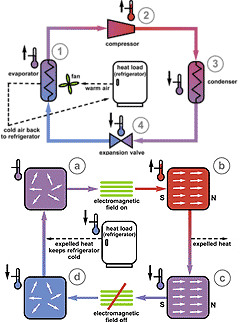
The cycle shown on top is the conventional refrigeration cycle used by household refrigerators and air conditioners. Such a cycle utilises the phase changes of a refrigerant such as "freon" to move heat from one volume to another.

The cycle just below the conventional refrigerant cycle, is an electromagnetic refrigerant cycle, which uses switched electromagnetic fields to chill a magnetocaloric material. The electrogmagnetic cycle is supposed to save at least 20% of the energy used in refrigeration, compared to the conventional cycle.

The cooling cycle shown below is based upon the compression and de-compression of a special solid material, a Nickel Manganese Indium, or Ni-Mn-In alloy developed by a team of Spanish researchers.
Until recently, the most promising materials for applications in this field were giant magnetocaloric materials, which change temperature under the influence of an external magnetic field. The authors of this new study show that application of a moderate hydrostatic pressure to a nickel-manganese-indium alloy (Ni-Mn-In) produces results comparable to those achieved with the most effective magnetocaloric materials.
According to Lluís Mañosa, a professor with the Department of Structure and Constituents of Matter at the UB and principal investigator of the study, "the aim of this field of research is to identify materials that are efficient, economic and environmentally respectful, and the advantages of the alloy used in this study is that all of the component materials meet these requirements."
In addition, Antoni Planes, a professor with the same UN department, explains that, "this type of material can produce much greater caloric effects with only slight variations in pressure, which makes it ideal for domestic refrigeration systems (refrigerators, air conditioning, etc.)." When these alloys are submitted to an external field, either magnetic or pressure, the material undergoes a solid-state phase transition, and Lluís Mañosa explains that, "this phase change generates a considerable latent heat exchange." _ScienceDaily

The "phase change principle" is analogous to that used for conventional refrigerants, but occurs in a solid state material, and is called a solid-state phase transition. According to the authors, the Ni-Mn-In alloy can undergo a solid-state phase transition in response to either pressure or a magnetic field.

This method of refrigeration could offer multiple advantages over conventional refrigeration and air conditioning:
  1. At 20 to 30% more efficient, it will save power costs.
  2. The "refrigerant" is not likely to leak or become contaminated or incorrectly mixed.
  3. There will be no danger to the ozone layer or of "global warming" from solid state refrigerants.
  4. Design, installation, and servicing of systems should be much simpler.
  5. The systems should last longer with fewer maintenance problems.
  6. Disposal of obsolete systems will be simpler and less costly.
We are still looking for the perfect form of cooling and refrigerating, but the new solid-state approaches appear to be in the right direction.

Labels:

Bookmark and Share

01 June 2009

New Magnetic Refrigeration Cycle More Efficient

Image Source


Here is a clever way of saving energy, from New Energy and Fuel. The magnetic refrigeration cycle (left and above a-b-c-d) is analogous to the conventional refrigeration cycle using compressed refrigerant, seen in the 1-2-3-4 image at left. But it is more efficient.
“ Magnetic cooling and refrigeration is 20 to 30 percent more energy efficient than conventional vapor-compression refrigeration. The magnetic refrigerants are solids, so the hazardous, ozone-depleting and greenhouse chemicals are completely eliminated, making magnetic refrigeration one of the few, positively clean technologies.”

....Refrigeration and air conditioning units pose a major load to the planet’s energy consumption - in the U.S. in the summer months they account for approximately 50 percent of the country’s energy use. _NewEnergyandFuel
The basic concept is simple. A magnetocaloric material heats up when magnetized ; if cooled and then demagnetized , its temperature drops dramatically. [The material is then re-magnetised to repeat the cycle. AF]

Credit: Talbott, National Institute of Standards and Technology. via NewEnergyandFuel
Not only is the process more efficient, but it is simpler and less prone to breakdowns and leaks. You will still need thermostats, fans, blowers, and heat-exchange apparatus, but there will be no expensive compressors and refrigerant, no long liquid and vapour refrigerant lines prone to leaks.

Few people understand the huge impending financial impact of Montreal Protocol rules as implemented by the US EPA and other national environmental agencies. Based upon extremely questionable science, reliable and safe refrigerants are soon to be replaced by much more expensive refrigerants that require much more expensive and delicate mechanical systems -- more prone to break down and much harder to repair.

The cost of keeping cool is just about the shoot through the roof, thanks to the EPA and its buddies. That is why more efficient alternatives such as the magnetic refrigeration cycle are so welcome. Technology to the rescue, to save us from our own bureaucratic idiocy.

Labels: , ,

Bookmark and Share

26 May 2008

Seasteading on Pykrete, and Other Novel Uses

I first learned about the material called Pykrete while reading the blog "Colonize Antarctica." Pykrete is a mixture of wood fibre and ice, a combination that is very hard, very tough, floats, and is very slow to melt. Structures built of Pykrete would be ideal in a polar environment, such as a polar city pictured above.

2 Million Ton Pykrete Aircraft Carrier In WW2
More exotic uses of Pykrete would be to build a large ship, a floating island city, or floating arcology. Pykrete was made famous by wealthy industrialist and financier eccentric, Geoffrey Pike. Sir Winston Churchill was one of the earliest promoters of using Pykrete for building large ships in WWII. The hull for a giant Pykrete aircraft carrier would have been 40 feet thick or more, and almost impossible to penetrate with the torpedoes of the day. Even without refrigeration, such thick Pykrete walls would have taken years to melt in a temperate climate. The video below demonstrates the ballistic resistance of a 14% wood fibre Pykrete. A 50% fibre Pykrete would be much tougher, and slower to melt.

A modern Pykrete seastead would incorporate built-in refrigeration to keep the walls frozen even in tropical seas. A floating breakwater made of Pykrete would keep a more fragile inner-seastead safe from rogue waves and the pounding of normal storm swell. Besides the interior refrigeration tubing, the exterior walls of the Pykrete would need to be insulated via highly reflective/insulating coating materials.

The walls could be built hundreds of feet thick, if necessary, and in any conceivable shape. The fibre content could vary from as little as 14% to as much as 50% or more, for greater toughness. It would be necessary to experiment with coating materials for maximum longevity and minimum energy cost for refrigeration--even in tropical waters.

What we are talking about, is a custom-built, reinforced iceberg, of incredible strength and toughness. In a polar environment, the structure should last almost indefinitely, with minimal loss to melting and sublimation. In a temperate environment, a large Pykrete structure could last for decades or more, with minimal shading, insulation, and interior refrigeration.

A large Pykrete castle on land--with battlements, turrets, an inner keep, and drawbridge, could be quite affordable if built during a very cold winter. Pykrete structures with foundations that extended down into permafrost should also enjoy good longevity.

Labels: , , , , ,

Bookmark and Share
Older Posts
Al Fin Main Page
Enter your Email


Powered by FeedBlitz
Google
WWW AL FIN

Powered by
Blogger

``