16 November 2012

How to Bring Down the US Power Grid: A Detailed Primer

Terrorists could black out large segments of the United States for weeks or months by attacking the power grid and damaging hard-to-replace components that are crucial to making it work, the National Academy of Sciences said in a report released Wednesday.

While the report is the most authoritative yet on the subject, the grid’s vulnerability has long been obvious to independent engineers and to the electric industry itself, which has intermittently tried, in collaboration with the Department of Homeland Security, to rehearse responses.

Of particular concern are giant custom-built transformers that increase the voltage of electricity to levels suited for bulk transmission and then reduce voltage for distribution to customers. Very few of those transformers are manufactured in the United States, and replacing them can take many months.

...The notion of a looming attack on the grid has recently gained a... following, with Newt Gingrich [promoting] a novel that imagines the crippling of the nation and the starvation of millions by unidentified enemies using high-tech methods to fry components of the grid with an electromagnetic pulse. The report does not discuss that possibility, but the appendix does include “electromagnetic pulse” among other technical terms.

The National Academy of Sciences report mainly refers to less sophisticated attacks but also warns of cyberattacks or infiltration of the grid’s transmission operators. “Even a few pernicious people in the wrong place are a potential source of vulnerability,” it said.

The report was completed in 2007, and after reviewing it, the Department of Homeland Security decided to classify its contents. The version released on Wednesday is redacted to avoid handing terrorists a “cookbook” on how to disrupt the grid, the report said. _NYT
As we have seen after Hurricane Sandy and any number of other natural disasters, when the power grid goes down in a modern multicultural society, all manner of mayhem is apt to break out.

Most people are unaware of how easily modern power grids can be brought down.

One of the many ironies of this fragile situation, is that one of the solutions most often proposed by greens and leftists -- the "smart grid" -- would actually make power grids more vulnerable to cyberattack and catastrophic failure.

The recently declassified and redacted document suggests ways in which societies can make their power grids less vulnerable and more resilient. But the NAS is not only a scientific body, it is also a politicised body which maintains a very politically correct posture. Many of the solutions are apt to be non-solutions, and many of the true solutions were certainly omitted or redacted.

The best approach for individuals, families, and small cooperative groups, is to maintain your own backups and lifelines.

At the blog, Al Fin, the Next Level, educational and developmental theorists are creating a new approach to the raising of resilient children, dubbed "The Dangerous Child Method." But it is never too late to have a dangerous childhood. Think about it.

Hope for the best, plan for the worst.

Labels: , , ,

Bookmark and Share

04 August 2012

Doombama: Accelerating the Death Spiral of Civilisation?

An atmosphere of general uneasiness and malaise has been growing across the leading military and economic power of the globe, since the election of US President Obama. The level of US government debt over the past few years has been growing at unprecedented -- and unsustainable -- rates. This turbo-boost of debt has apparently not helped the US or global economies. And it appears that Mr. Obama has just begun to boost public indebtedness. Are there any potential dangers when the world's most powerful nation must borrow trillions of dollars just to pay for routine operation and political payoffs?

Even if the US were not the world's most powerful nation, the rapid decline in its financial position would be of concern to global investors and global powers. But the fact that the US is the strongest and richest nation makes the decline far more serious, and in need of good solutions.

Unfortunately, we find the public ways being inundated by a veritable scattershot of doom theories -- from peak oil doom to climate hysteria catastrophe to religious armageddon to overpopulation doom to eco-collapse. In such an environment of diffuse hyper-vigilance, workable solutions to genuinely serious problems are less likely to be devised and implemented.

The following discussion is based upon ideas introduced in the article: The Death Spiral theory of civilisational collapse, and expanded upon in this video discussion. Caveat: The above "news stories" and "information videos" -- as informative and intriguing as they may be -- are disguised promotional materials for paid newsletters and more."

Why should we understand this theory? Because this doom theory is gaining in popularity among general populations and members of many other doomer groups -- including faux environmental green doomers, peak oil doomers, climate change doomers, anti-capitalist lefty-Luddite doomers, anti-government doomers, and even religious doomer groups. This "meta-doom" theory is likely to influence someone you know, before long. You will likely be forced to face it, one way or another.

One of the basic concepts underlying this "death spiral" doom theory, is that private and public debt are expanding so rapidly that the economic system which supports modern civilisation cannot help but collapse.

The theory looks at ideas of exponential growth in the public and private financial sectors, as well as theories of exponential growth in demand for food, energy, and a wide range of materials and services.

More economically aware persons, will already be familiar with the ideas of Peter G. Peterson, and will recognise the arguments dealing with the dangers of exponential growth of government debt.

Anyone who has looked at websites such as dieoff.org or limitstogrowth.org will recognise overpopulation and resource scarcity arguments as dating back close to 50 years, or more. In fact, the "death spiral doom theory" can fit into a wide range of pre-existing doom cults and hypotheses.

The "death spiral theory of doom" borrows from all of these older doom theories, and creates an emotional atmosphere of fear which is contagious, inflaming the fears in anyone who is already susceptible, due to pre-existing beliefs, superstitions, and worries.

As you can see, there is doom enough for doomers of every persuasion in the death spiral doom theory. Regardless of their political, religious, or ideological persuasion, most doomers can find something to cling to here.

What is the problem? Whenever a movement contains roughly 5% of truth and 95% of garbage, the truth is not likely to receive the proper attention it needs in order to solve the genuinely serious problems that exist. The mass of garbage tends to overwhelm every other concern, and to lead adherents willy-nilly across the conceptual landscape of doom.

The resulting de-cerebrate mass hysteria is useful to those who simultaneously create and ride the waves of hysteria. The skankstream media, powerful political lobbies, complicit government officials, politically correct academics, doomer cult leaders, etc. But for ordinary people who wish nothing more than to live ordinary lives, this mass distortion of reality is an ongoing disaster which tends to grow worse with every generation -- as exponential debt and demographic decline proceed along.

Doombama happens. Debt and demographic decline happen. There are answers and solutions to each problem. But not if one is caught up in the mass hysteria and short attention span groupthink. The only preventative to being drowned by the mass delusion is to become dangerous.

Dangerous people breed and raise dangerous children. Enough dangerous children will create a dangerous community. Enough dangerous communities together will evolve into a dangerous society and a ultimately into a dangerous civilisation.

Inconceivable? "You keep using that word. I do not think it means what you think it means." .... src

Labels: , ,

Bookmark and Share

02 November 2011

Country Club Survivalists: Do They Have What it Takes?

As I talked to people about survival bunkers, one name kept popping up: Tom Cruise. Now, I don’t know if Tom Cruise does or doesn’t have a bunker under one of his houses, but it does seem possible. Possible enough, at least, for people in this business to cite him as one example of a growing trend towards self-preservation among the wealthy in this society. Another oft-repeated anecdote, which is more telling, is that one constant fact for companies building and supplying bunkers for private individuals is that their supply orders are being delayed: it seems that the United States government is in the midst of a massive bunker-building orgy, presumably in preparation for some kind of 2012-related catastrophe, and it’s snatching up all the freeze-dried food and the good building materials. "We’ve ordered food before," says Larry Hall when asked about this, "and gotten a phone call that said ‘hey, your order’s been circumvented, FEMA stepped in or somebody and they’ve ordered everything we can produce for the next three months." And it’s not only food that is in short supply. He claims to have ordered equipment specific to nuclear bomb shelters, such as blast valves (hardware attached to air intake and exhaust pipes that close when a shockwave occurs), only to find that the government has already bought all the available supplies. "Sometimes you can get those things," he says, "and sometimes you can’t." _TheVerge
There is a newer, richer breed of survivalist who thinks that money will buy him the ability to survive when the world around him is crumbling to the ground. They are preparing secure underground bunkers, missile silos, and other highly secure and costly shelters. A number of people are getting wealthy themselves, pandering to these country club survivalists.
Dan Hotes is a commercial real estate broker based in Seattle and San Diego that bills himself as an expert in the resale of Cold War-era missile bases and communication bunkers — specifically "those designed to withstand the effects of a nearby nuclear detonation." I’ve spoken with him a couple times, and his enthusiasm for this obscure topic is infectious. During one of those conversations I remarked on how hard it is to determine just how big this industry really is. So many people, I’ve discovered, want to talk off the record, or sell you on projects that might not exist at all.

"It's a real niche," he laughed. "Welcome to the club, okay? The bunker industry itself, if you look at it as a totality, there's a lot of money because the government's building them as fast as they can. We don't have access to that data. We're left with the scraps and handouts. There's a lot of people that want them, but a lot of people that won't pay for them. The interest level is high, the dedication level is medium, medium low." True to his career in real estate, he made sure that I plugged a Titan 1 missile base that he’s trying to unload, a facility situated at the former Larson Air Force Base in Grant County, Washington. "It's a really nice intact relic of the Cold War." And it can be yours for a cool $4 million. Would he ever live in one? "The missile silos are deep holes in the ground," he pointed out. "I wouldn't want to be down in one of those. I would never do that." I asked him about his plans for the immanent collapse of civilization. His answer was off the record, but I can sum it up in two words: "no comment."

...The president of the Vivos Group is Robert Vicino.... These days, he has moved on from the balloon business to monetize a moment of "inspiration, not a vision" that also occurred to him in the early 1980s. "For some reason," he told me, "I just had an inspiration that I needed a shelter for 1,000 people to survive something that was coming. I can't remember if it came in my sleep, but it was vivid and it was powerful." At the time, he says, he floated this idea past his employees and friends, who all evidently thought this was crazy. About three years ago he brought it up again, he says, and "everybody got extremely excited and said ‘Wow. You should have told us that. Now is the time. The world needs this, stuff is happening and stuff is coming.’ In other words, it's gone from thirty years ago, you know you're crazy, to now it's kind of a mainstream belief that yeah, something may be coming. People feel it in their gut." _theverge
It is easy to believe that "the end of the world as we know it" (TEOTWAWKI) may be coming, given the monstrous levels of debt + the shrinking core demographic of most modern, advanced nations. But more and more people are doing more than just believing it -- they are doing something about it.
Currently, the announced Vivos product line includes an 80 person shelter in Indiana "built to withstand a 20 megaton blast" (units start at $35,000), a 137,000 square foot, 900 person shelter in Nebraska ("above the subsided earth changes envisioned by many prophets") for a mere $25,000 per person; and other "economy" shelters that start at $9,950.

According to Vivos, each shelter includes fully furnished living quarters, deluxe bathroom, kitchen and dining areas, computers, theater electronics, exercise equipment, security facilities with a detention area, vaults for valuables and munitions, a communications center, laundry facilities, "and abundant storage areas for food, fuel, water, medicine, supplies and a wardrobe inventory with a large selection of comfortable clothing and footwear in all sizes." _TheVerge
Vivos claims to provide its members with enough supplies and shelter to allow them to survive for a full year, after a catastrophic TEOTWAWKI. But will one year be enough? Maybe not.
The Survival Condo Project is a nearly 200 foot deep, nuclear blast-hardened hole in which contractors recently built a steel frame, not unlike that of a skyscraper. Once complete, the facility — located somewhere in the middle of Kansas — will offer half and full-floor residential units designed to withstand floods, electromagnetic pulses, and indirect nuclear strikes (among other things) for $2 million or $4 million, respectively. Features include "redundant infrastructure for power, water, air, and food; as well as ‘shared or common’ facilities for extended off-grid survival."
...Brian Camden has worked as a consultant on the Survival Condo project. His company, Hardened Structures, calls itself the "world leader in underground shelter systems." While I can’t attest to that, I do know that the company is highly regarded by everyone I’ve talked to while researching this story. The construction management firm builds everything from prisons to schools to shopping malls. "We do it all," says Camden. "I work for the Army Corps of Engineers, we did a few hundred person shelter under the hospital in Kuwait last year. We've done work for the Jordanian government. We've done work for the Army Corps of Engineers, we do work for U.S. corporations and private individuals. We do work for the Air Force."

...Aside from nukes, common threat event scenarios include tidal waves or global flooding. These are fears that go back to the Epic of Gilgamesh and the Book of Genesis, which might point to their universality (and might suggest the psychological foundation of the 2012 meme). In the event of a massive flood, the bunker engineer has to account for things like the shelter’s occupant load and the amount of time the occupants plan on spending there. "[W]e have to put in CO2 scrubbers and oxygen machines. You calculate, with a thousand foot wave going over top, at 500 feet, how long will it take that water to reside. Is it 100 hours, 200 hours, 300 hours? Whatever the case is, and we calculate that, then we double for a safety factor. But even with that you still have to include self-rescue supplies in the shelter. If they believe you're going to be completely underwater, you must assume that the tidal wave may never reside. In other words, you're going to be underwater constantly. If that's the case, how do you get out? And there's design secrets, proprietary stuff that we do, that get the clients out.

...A home like [Ed Peden's] is an anomaly. In 1960, taxpayers paid $3.3 million to construct a facility with floors that were three feet thick, walls eighteen inches thick, and ceilings consisting of 18 inches of heavily reinforced concrete, three feet below ground. As he points out, "some of these missile sites are some of the strongest structures ever built on the planet." While a handful of these structures were sold off by the government after being decommissioned in the 1960s and 1970s, current arms control treaties with Russia mandate that decommissioned missile sites are to be destroyed. This means that, as demand for nuclear hardened structures increases, the supply never will. These are relics from a time when government money paid for engineering marvels that were sold a few years later for pennies on the dollar.

"We see these sorts of structures as the twentieth century's counterpart of the European castle: built by the government for defense of the realm at tremendous cost to the royal treasury, and now they've been turned over to a peasant and we're really happy to be here."

Ed’s company is called, fittingly, 20th Century Castles, LLC. So far he has sold 55 properties over the last 17 years, and as time goes on, it seems likely that demand will continue to rise. "Especially in the last couple of years," Ed says, "our email and telephone have been busier than usual, because people are seeking the strength of a hardened underground structure."

... _TheVerge

The problem with many of the country club survivalists is that they are not likely to have the level of common sense and practical skills which allow them to compensate for their expensive technology -- when it inevitably breaks down.

Once the design engineers and construction contractors are gone, it is up to the owner to keep all those expensive gadgets from breaking down and leaving him vulnerable to the elements and the unfriendlies. Gold, food, and practical trade goods might attract competent helpers, of course. But the smart survivalist will try to make his survival plans in conjunction with a competent community of widely skilled, practical minded persons -- and not try to go it alone, no matter how much money he can put into the project.

When TEOTWAWKI does come along, early survival may have more to do with luck than anything else. But long term survival will be another matter. Hope for the best. Prepare for the worst.

Labels: ,

Bookmark and Share

14 May 2011

The Search for the Safest Place in US and World

NYT via Lifehacker via Keelynet
Looking for a safe place to live? You are not alone. First, it is important to separate dangers into natural disasters and man-made disaster. Looking at natural disasters in the US, we can see the approximate risk of US cities from tornado, hurricane, and earthquake in the map above. Notice that flood risk is not specifically covered -- although it is one of the most important periodic natural disasters. Wildfire is yet another devastating periodic natural disaster that is ignored by the map. Volcanoes are an extreme hazard, but relatively rare, so are not considered in the above list. That is fortunate for most of the cities considered the "safest," since they are sitting in the middle of volcano country.

The map below merely lists standardised mortality ratios from disasters of all types in the US. The emphasis for the lower map is on weather, ignoring earthquakes, fires, and apparently floods. Here is an example of a top 10 US safest city list, which attempts to take crime AND natural risks into account.
NewScientist

But if you are only looking at natural disaster risk, you may be ignoring the far more important risks which come from humans. Crime and traffic accidents would rank highest, but industrial and infrastructural accidents may also be fatal -- eg exploding gas pipelines, collapsing bridges and buildings, dam failure, flying ice and blade debris from exploding wind turbines, etc. (It is not commonly known, but nuclear power plants are the safest form of power production)

If you focus on safety from crime and disorder, the safest cities in the world are to be found in Switzerland and Japan, according to Mercer Human Resource Consulting. According to Expatify's list, Switzerland sits on top, and Japan isn't even in the top 10 safest -- presumably due to Japan's proximity to age-old enemies China and Russia.

Some persons are concerned with mitigating a possible increased risk of global disaster connected with the year 2012. Another website deals specifically with an anticipated (by some) 2012 "pole shift," and the search for the safest place in the world for dealing with such a disaster.

Al Fin disaster forecasters expect the year 2012 to be no more catastrophic than Y2K was, and only slightly more disastrous than carbon climate catastrophe and peak oil doom. Standard precautions for unanticipated events -- solar flare, EMP, NBC terrorist attack, Obama government debt default etc. -- remain in effect for the foreseeable future. Other recommendations: Do not build your house on the flood plain. Do not build your house in an avalanche zone. Do not be the first one to inhabit a newly opened gentrification zone. More advice to come.
US Crime Rates

Labels:

Bookmark and Share

24 January 2011

A Deep Surge of Magma Shakes Yellowstone, Lifts Ground 10 Inches

More: Brian Wang at NextBigFuture has more information and some reassurances
Yellowstone National Park sits atop a subterranean chamber of molten rock and gasses so vast that the region, known for its geysers and grizzlies, is arguably one of the largest active volcanoes in the world.

Granted, it's not your typical volcano, either in scale (it's huge), appearance (it's a vast depression, not a single mountain) or frequency of eruption (at least hundreds of thousands of years apart).

But it is active, and the evidence is everywhere. _Discovery


One of the world's great supervolcanoes sits and waits beneath Yellowstone National Park in Wyoming. It has erupted before and it will erupt again, someday. Recent quaking of the ground in Yellowstone, combined with ground surges as high as 10 inches, have caused some geologists to wonder if the clock may be ticking down to another big blow.
"Clearly some deep source of magma feeds Yellowstone, and since Yellowstone has erupted in the recent geological past, we know that there is magma at shallower depths too," said Dan Dzurisin, a Yellowstone expert with the USGS Cascades Volcano Observatory in Washington State.

"There has to be magma in the crust, or we wouldn't have all the hydrothermal activity that we have," Dzurisin added. "There is so much heat coming out of Yellowstone right now that if it wasn't being reheated by magma, the whole system would have gone stone cold since the time of the last eruption 70,000 years ago."

The large hydrothermal system just below Yellowstone's surface, which produces many of the park's top tourist attractions, may also play a role in ground swelling, Dzurisin said, though no one is sure to what extent.

..."Big quakes [can have] a relationship to uplift and deformations caused by the intrusion of magma," he said. "How those intrusions stress the adjacent faults, or how the faults might transmit stress to the magma system, is a really important new area of study."

Overall, USGS's Dzurisin added, "the story of Yellowstone deformation has gotten more complex as we've had better and better technologies to study it." _NatGeo
It is not easy to predict a volcanic eruption. Supervolcanoes may be even more difficult to predict -- no one knows. It will take time to acquire enough experience with the immense geological processes taking place beneath our feet. The video below provides a sobering look at the aftermath of a Yellowstone super-eruption.

Labels: , ,

Bookmark and Share

01 March 2010

Sudden US Collapse Syndrome: When Complexity Fails

To understand complexity, it is helpful to examine how natural scientists use the concept. Think of the spontaneous organization of termites, which allows them to construct complex hills and nests, or the fractal geometry of water molecules as they form intricate snowflakes. Human intelligence itself is a complex system, a product of the interaction of billions of neurons in the central nervous system. _NiallFerguson_LATimes_via_ImpactLab
The government of the United States has lasted a relatively long time, compared to other governments. It was based upon a resilient foundation -- the US Constitution. But power-hungry politicians and judges have clawed away at the limitations imposed upon them by the constitution to the point that the great document is a shadow of its former self.

The clumsy and cracking megalith calling itself the US government is just a well-placed hammer blow or two away from outright fracture and dismemberment. The massive bureaucracy is too top-heavy, too complex, too labyrinthine, too lazy, incompetent and self-serving.
Most great empires have a nominal central authority -- either a hereditary emperor or an elected president -- but in practice the power of any individual ruler is a function of the network of economic, social and political relations over which he or she presides. As such, empires exhibit many of the characteristics of other complex adaptive systems -- including the tendency to move from stability to instability quite suddenly.

The most recent and familiar example of precipitous decline is the collapse of the Soviet Union. With the benefit of hindsight, historians have traced all kinds of rot within the Soviet system back to the Brezhnev era and beyond. Perhaps, as the historian and political scientist Stephen Kotkin has argued, it was only the high oil prices of the 1970s that "averted Armageddon." But this did not seem to be the case at the time. The Soviet nuclear arsenal was larger than the U.S. stockpile. And governments in what was then called the Third World, from Vietnam to Nicaragua, had been tilting in the Soviets' favor for most of the previous 20 years.

Yet, less than five years after Mikhail Gorbachev took power, the Soviet imperium in central and Eastern Europe had fallen apart, followed by the Soviet Union itself in 1991. If ever an empire fell off a cliff, rather than gently declining, it was the one founded by Lenin.

If empires are complex systems that sooner or later succumb to sudden and catastrophic malfunctions, what are the implications for the United States today? First, debating the stages of decline may be a waste of time -- it is a precipitous and unexpected fall that should most concern policymakers and citizens. Second, most imperial falls are associated with fiscal crises. Alarm bells should therefore be ringing very loudly indeed as the United States contemplates a deficit for 2010 of more than $1.5 trillion -- about 11% of GDP, the biggest since World War II. _Ferguson
Obama's unprecedented deficits will only grow larger in the near to mid-term future. Built-in entitlements alone assure a massive snowballing of debt. With the addition of the huge new entitlements Obama and Pelosi are pushing through Congress, the death knells could begin to toll much sooner than anyone expects.

Worse yet, Obama and Pelosi have done everything possible to shut down the development of reliable new energy sources for the US -- guaranteeing the continued stagnation of US industry and commerce. Massive new debt plus the choking off of new economic activity. A recipe for disaster in the making.
One day, a seemingly random piece of bad news -- perhaps a negative report by a rating agency -- will make the headlines during an otherwise quiet news cycle. Suddenly, it will be not just a few policy wonks who worry about the sustainability of U.S. fiscal policy but the public at large, not to mention investors abroad. It is this shift that is crucial: A complex adaptive system is in big trouble when its component parts lose faith in its viability. _Ferguson
The American voters elected the current clown troupe that governs the US. Americans love clowns, perhaps a bit too much.

It will be difficult to reverse the dysfunctional trend, because each new generation of American children -- future voters -- is now being taught according to the curriculum of William Ayers, friend of Obama, "former radical", and just one of a host of professors in American academia who hate the US and would like to bring it down. This all happened while most Americans were looking the other way.

Americans were once self-governed. They took responsibility for their own governance. But over time a massive corps of professional politicians and bureaucrats moved to Washington DC to take over the task from average Americans. Then, the army of bureaucrats became massive, unionised, and strong enough to perpetuate the rule of sympathetic elected legislators and executives. These legislators and executives put sympathetic judges in place to complete the self-perpetuating triumvirate of monolithic government. It's all a bit tipsy now, but the monolith has become the default position the moment the American public takes its eye off the ball, and stops participating in its own governance.

That monolith is chipped, cracked, peeling, and subject to catastrophic separation if not re-sculpted to a smaller and more workable size. But that won't happen because too many Americans are dependent upon the monolith being the way it is.

What is true for the US government is also true for other governments around the world, which lack the built-in resilience which the US Constitution has provided up until now. Catastrophic failure. Debt, demographic implosion, dysgenics . . . the dynamite is ready to blow...just light a fuse.

Labels: , ,

Bookmark and Share

19 February 2010

Can You Kill the Chicken?


In some cities, organic farmers are cult heroes, photographed for magazines and name-dropped on restaurant menus. Boomers flock to pasture tours while their Ivy League kids vie for farm internships. But the most unusual manifestation is the emergence of the slaughter-your-own-animal workshop. At more than a dozen farms across the nation, a small fee (usually $15 to $40) buys the opportunity to butcher your very own chicken, turkey or rabbit. _SmartMoney


Most people buy their meat, fowl, and fish at the supermarket, already dead and butchered. But what if you had to kill the chicken, and butcher it. Could you do it?

There are workshops available where for a small fee you can go to learn if you have the right stuff for cutting throats, putting a shotgun to an animal's skull, or otherwise shuffling off the critter's mortal coil. Then you butcher the carcass.

On the web you can learn to butcher pigs, or chickens, or rabbits, and probably just about any other animal that requires butchering prior to eating.

Do you think you could do it?
Even the most philosophical students can be surprised by their own hesitation. New York cheesemonger Laura Heifetz felt confident until she had the knife in her hand. Suddenly, she was struck with what she now refers to as a “weird dichotomy”—she didn’t mind killing the chicken, but she didn’t want to hurt it. Bellingham, Wash., food-bank coordinator Max Morange arrived at a pig-processing workshop thinking he’d slit the animal’s throat. It wasn’t until he got a look at the 300-pound porker that he realized the truth: “Pigs don’t really have necks.” He had to shoot the pig with the farmer’s shotgun and before pulling the trigger felt a flash of doubt. “I had to question whether this was a fair arrangement.” _SmartMoney


In a survival situation, you will probably be under a lot of stress. The more necessary things that you are already somewhat prepared to do, the better. For any difficult situation, it is always better to be overtrained. That is the secret of competent survivors like Sully Sullenberger -- get yourself overtrained well in advance of the crisis.

This is also an issue in politics, where voters tend to elect person's on the basis of everything except whether he is actually overtrained and overexperienced for the job. Green rookies in positions of responsibility can make a horrible mess. They are unlikely to be competent to clean up their own messes, either.

Be over-prepared.

Labels: ,

Bookmark and Share

01 January 2010

Prepping for the Coming Ice Age


An Ice Age is an example of a long term survival setting. If you are prepared to survive an ice age, you are prepared for almost anything. But the chances are that you are like the residents of New Orleans during Katrina -- not even prepared for a few days without electrical power, ATMs, and supermarkets. Where do you go to learn to prepare, beyond the silly mainstream media offerings of "survival-lite"?

Preparedness Pro is a website that offers good articles on survival and preparedness, as well as on-site, hands-on preparedness classes. For example: Are you interested in a backup generator for your home or cabin? Backup Power Generators: Part 1, Part 2, and Part 3 take you through the selection process and tell you where you can obtain them for the best price.

Survival Blog is a well-known and respected personal effort by James Wesley Rawles. Survival Blog offers a wide range of survival advice -- much of it provided in letters and emails relating first-person experiences with different devices and approaches to surviving difficulties.

The Survivalist Blog is another well-known preparedness blog. Here is his "Best of 2009 Survivalist Articles".

The Prepper E-Book site offers practical articles from The Survival Mom on a wide range of "be ready" topics. Example: this posting provides links to 9 articles on the topic of "bugging out / evacuating" in a hurry. By preparing ahead of time, you can have what you need, where and when you need it. There is also a prepper forum where people can compare experiences and recommendations with others with similar concerns.

Tactical Intelligence is a site that deals largely with "gear" -- survival implements that are either ready-made or improvised.

The sites above usually have links to other prepper and survival websites and services. There are at least hundreds of them, but it is generally best to start with those that are well known that serve a wide audience. You can find fairly decent free online survival videos at YouTube and other "how-to" video sharing sites listed on the Al Fin sidebar in the "Reference" section.

So, how would you prepare for an ice age, anyway? Ice sheets have been known to grow miles thick. How does one live, stay warm, grow food, maintain transportation networks, and provide schools, health care, power, sanitation, and other essential services when the land is covered with ice 1 mile thick?

First, you need a large source of combined heat and power -- a nuclear plant is ideal, a coal or bitumen / kerogen plant might also work. You would need plenty of fuel to last hundreds of years. (You should begin to see the advantage of a nuclear plant, thinking of fuel volume for that length of time. Remember that next level humans will live hundreds of years or longer, on average.)

Second, you need a method of distributing heat over a large area, preventing that area from accumulating snow and ice on a year-to-year basis (winters may last 9 or 10 months). Al Fin ice age architects recommend redundant systems of conductive, convective, and radiative transfer of heat. A village-sized geodesic dome incorporating a network of heat-pipes should provide safe shelter for the community itself. Similar structures for croplands should extend the ice-free area well beyond the residential zones. (Crops and living zones will require artificial lighting most of the year -- confirming the wisdom of locating a nuclear power plant close by. Imagine trying to survive an ice age with solar and wind power!)

Third, you need to provide a wide range of human expertise for your community -- and sound means of transferring that expertise to new members. The community will need to provide its own power, water, farming, health care, education, defence, sanitation, entertainment, maintenance, construction, search and rescue, clothing, and a wide range of other services generally overlooked.

Fourth, although the coming ice age is unlikely to progress to "Snowball Earth" -- when the ice reached the equator from both North and South -- it won't hurt to plan for extremes. To achieve a Minimum Viable Population, plan for a village of about a thousand breeding pairs -- or a group of villages whose combined populations provide a thousand breeding pairs. (Most geneticists may recommend a founder population of at least 10,000 breeding pairs, but Al Fin geneticists have discovered that 1,000 breeding pairs should be sufficient for most situations where "time-to-discovery" of other compatible human populations is no longer than 10,000 years.)

Fifth, follow a plan of expanding the "ice-free zone" around your village(s) and agricultural / industrial / power generation zones. Always incorporate your ice-melting infrastructure into any new construction. Nature will never stop trying to defeat your efforts, so you must never stop using your brain and body to assert your own intentions.

Prepare yourself mentally, physically, and emotionally to be a survivor. Then begin prepping for yourself, your family, your closest associates. Learn, teach, experiment. Always think in terms of "what could go wrong, and what could I do about it?" That should teach a bit of humility, and hopefully provide motivation for what you will have to learn to know and to do.

More: The Lifeboat Foundation has several projects dealing with existential risks which might be helpful in the event of a glaciation, including space habitats and "lifeshield bunkers." Josh Hall has devised a "weather machine" concept that would have the power to throw the Earth into an ice age, to bake the planet beyond livability, or anything in between.

Labels: , , ,

Bookmark and Share

20 July 2009

Electromagnetic Pulse Basics


William R. Forstchen is the author of One Second After, a best-selling novel that looks at a post - EMP US. Without the electrical power grid, modern civilisation would be in danger of collapse. If your power utility breaks down, the world around you will grow very dangerous, and life very precarious -- quickly.
This is a terrifying aspect of an attack that no government report has publicly discussed along with the potential casualty rate in the first seconds after an attack. Commercial airliners today are all computer driven. In fact, from lift off to landing, a pilot no longer even needs to be in the cockpit, a computer can do all of it if need be. When the pilot pulls back on the "stick" it is no longer connect by wires stretching all the way back to the tail and the elevator assembly. Instead, his motion is read by a computer which sends a signal to an electrical servo - motor in the tail, which then moves the tail. In short, the entire plane is computer driven. It is estimated that at any given moment during regular business hours, somewhere between three to four thousand commercial airliners are crisscrossing the skies. (There is a fascinating site you can find via Goggle that shows typical air traffic around the world during a twenty four hour period. From dawn til way after dusk, the entire USA is one glowing blob of commercial flights crisscrossing our sky). All of them would be doomed, the pilots sitting impotent, staring at blank computer screens, pulling on controls that no longer respond as the plane finally noses over and heads in.

Somewhere between 250,000 to 500,000 people will die in the first few minutes...more than all our battle casualties across four years of World War II

AREN"T WE PREPARING? ISN'T THERE REPLACEMENT EQUIPMENT IN PLACE AND TRAINED PERSONNEL READY TO REACT?

The frightening answer is no. This author has spent over four years researching this topic, interviewing scores of personnel from Congressmen and Generals, to your local police chief and sheriff. At your local level, since 9/11, first responders have received hundreds of hours of training and briefings on all sorts of terrorist scenarios. Only a few have told me that they even discussed the topic for more than a few minutes at an official level. As to emergency stockpiles of supplies and crucial replacement parts, there is nothing in place.

WHY NOT?

EMP, has managed to "stealth" its way on to the highly dangerous list and few, except for a small number of personnel in the Pentagon, various research labs, and men like Congressman Bartlett (R., MD) who heads the Congressional Investigative Committee on EMP, are aware of it. For one it has a certain "sci - fi" sound to it, which makes many dismiss the potential before the discussion has even started. Second, the only way to truly evaluate the threat and demonstrate it is to detonate a nuclear weapon, something we have not done since the full test ban went into effect decades ago. It is therefore not "visible" to us, the way another airliner smashing into a skyscraper is now forever imprinted on our national psyche, feared, and prepared for. Next, with all the competing issues and threats in the world, EMP simply does not have a "constituency" of influence. Only a few members of Congress, our military and scientific community are issuing the warnings. There are no Hollywood stars placing themselves in front of cameras with this as their cause, the few times it has been used in popular movies, it has been portrayed inaccurately, often absurdly.

And finally, the impact is so overwhelming - that it triggers a psychological sense of helplessness, and therefore why bother, since if it happens we are finished. It is the same response that happened between the 1950s - 60s. When first confronted with the threat of a nuclear attack, tens of billions was spent to prepare, in fact our Interstate Highway system was initiated in the mid 1950s as a national defense effort to provide avenues of escape from cities in the event of nuclear war, a means to bring in emergency supplies and to move our military. Plans were issued to citizens on how to build bomb shelters and all children were drilled in what is seen now as the absurd "duck and cover."

Something happened though by the mid - 1960s. The threat was no longer fifty to a hundred small atomic bombs dropped from bombers, it was now a rain of thousands of hydrogen bombs, delivered within minutes by ballistic missiles. In this atmosphere of overkill, attempting to prepare seemed ridiculous, futile. The standard phrase became "the living will envy the dead," so why bother? Civil defense finally became an object of derision, the realm of a few survivalist nut cases.

That threat is still there, and to this day our nuclear forces stand ready to respond, which has indeed been the only defense left..."if you nuke us, we'll nuke you," a policy known as "mutual assured destruction," a zero win game.

EMP is different, it is not a rain of thousands of bombs, needing a vast and powerful military to deliver it, which means Russia and China are the only real threats in that realm...but unless seized by madness, their leaders know such an attack, within minutes would be met with thousands of bombs annihilating their country as well. It is a balance of terror that has now endured for nearly sixty years.

An EMP attack is different since it only requires but one nuclear weapon, detonated 300 miles above the middle of the United States. One bomb. The launch could even be done from a container ship somewhere in the Gulf of Mexico and in that instant, the war is already over and won.

_Forschen
Read the whole thing.

If you are an Obama zombie, brain-dead and blindly trusting in the benevolence and wisdom of the clown in the White House, there is nothing here that will interest you. Life goes on according to the "talking points", and life will always go on according to the talking points. To think anything else is to wander off the reservation, onto dangerous and uncharted territory.

But if you can think for yourself, you will see the threat of EMP as just one out of many threats that can throw the modern, oblivious way of life out of its convenient and affluent path.

Labels: ,

Bookmark and Share

13 March 2009

Obama Depression, Soon Obama Dark Age?

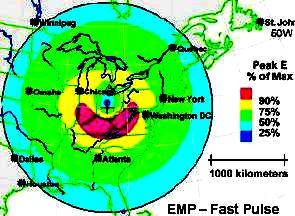
An electromagnetic pulse starts with a short, intense burst of gamma rays produced from nuclear detonation. The gamma rays interact with the atoms in air molecules through a process called the Compton effect, wherein electrons are scattered at high energies, thus ionizing the atmosphere and generating a powerful electrical field. The strength of the EMP depends highly on the altitude at which it is released. At altitudes above 30,000m, it is the strongest. It is also significant at surface or low altitude bursts, but is not as effective between the two extremes. _EMPTerror
Image Source
Modern societies base much of their economies and affluence on the ability to manipulate electricity. Each American has the equivalent of dozens of "energy slaves" working for him. How easy would it be for an antagonist to turn off the power -- to a town, to a region, to a nation, to a continent?

This posting deals with EMP - electromagnetic pulse. EMP is a side effect of the detonation of a nuclear weapon, but it can also be produced by conventional methods. The "lights out" effect of a nuclear detonation can travel well over a thousand miles -- effectively transporting large areas of a continent into a "dark age".

All modern societies that are reliant upon plentiful electricity for their way of life are vulnerable. Research into portable, conventional EMP weapons, has produced effective emp's from hand grenade size weapons.
"They" are electro-magnetic grenades -- not something you'll find in the typical armory but apparently something that could soon be in the hands of GIs.

"EMP grenade technology is out there, but I've never had my hands on one," said Col. Laurie Buckhout, chief of the newly formed Electronic Warfare Division, Army Operations, Readiness and Mobilization, during a bloggers roundtable Tuesday from the Pentagon. _DefenseTech_via_NextBigFuture
It seems that such light-weight electromagnetic radiation burst weapons are available that are capable of knocking out the power for a college campus, a small town, or a central part of Washington DC. Larger weapons, that could knock out power for large cities and entire states or provinces, would be easier to produce. But they require transport by truck, rail, barge, or ship. These are conventional EMP weapons, not detectable by radiation or hazmat detectors. Your next-door neighbor may be storing one in his garage. (:-0

The US could be knocked backward into a quasi-dark age in just a few seconds. Orbiting nuclear weapons, for example, could detonate in space without killing anyone on the surface via blast effect, radiation, thermal effects, or radioactive fallout. The EMP from the detonations would knock out power on the ground, and destroy scores of sensitive communications satellites in orbit. Airplanes and helicopters would drop like hail from the sky. Large bloody pile-ups would occur on countless freeways. Trains would crash into each other without warning. Hospital power supplies and backup power would fail, and many patients would die. Thousands would be stuck between floors on elevators, that for some would become their tombs. Trillions of dollars of electronic wealth would vanish in a flash.

It is difficult for most psychologically neotenous, academically lobotomised incompetent perpetual adolescents to come to grips with a nation where all cities are simultaneously rendered powerless. Where almost all emergency services and law enforcement services were suddenly helpless.

The online novel, Lights Out, is one man's look at a community in middle America trying to survive after such a surprise EMP attack. Or check out this blurb about a similar book in the stores:
New York Times best selling author William R. Forstchen now brings us a story which can be all too terrifyingly real...a story in which one man struggles to save his family and his small North Carolina town after America loses a war, in one second, a war that will send America back to the Dark Ages...A war based upon a weapon, an Electro Magnetic Pulse (EMP). A weapon that may already be in the hands of our enemies. _Macmillan
Go here for a longer excerpt.

We are at multiple points of bifurcation. The world we know could cease to exist in the blink of an eye, with another -- much harsher -- world taking its place. Such a rapid transition could happen many different ways, but there are only a few ways a society could recover from such transitions. The best way to recover is to have been prepared ahead of time.

EMP is only one easy way for an antagonist to finish off an Obama-weakened US. There are multiple biological, chemical, nuclear (dirty bomb) -- and soon nanotechnological -- ways to knock America flat on its back. And this America is not the same country that bounced back from the 1930s/1940s depression.

Modern america is split into tribes warring among themselves. Many of the newer American tribes are fresh from the third world, with no idea how to run a technological society, and no allegiances to the rule of law or the US Constitution.

America is still rich, still powerful despite its economic problems and current run of bad governmental decision-making. But America and all the western nations, Japan, South Korea, Taiwan, Singapore, etc. are all extremely vulnerable to the new would-be hegemons and would-be world caliphates. Weapons that could separate the thin threads that bind western societies together are becoming less expensive and more widely available.

Much more on the EMP threat

Hope for the best, prepare for the worst.

Labels: , ,

Bookmark and Share

23 January 2009

Red Alert! Full Power to Shields, Scotty

Despite the coming of Obama-messiah, the world is becoming a more dangerous place. As fundamentalist Islam spreads its tentacles of jihad to Europe we can expect the spirit of Gaza to spread to Muslim ghettos of London, Amsterdam, Brussels, Marseilles, and Hamburg. We will need to learn how to protect ourselves from IEDs, car bombs, suicide pedestrian bombs, and other forms of explosive terror.

We can add thick armour to our vehicles, try to make ourselves invisible, or just hide inside our homes and workplaces. But if our homes and workplaces are to be made less vulnerable to explosive attack, we will need better materials. Enter bomb-resistant concrete:
The fibre-reinforced concrete was found to absorb a thousand times more energy than plain concrete and could therefore be used for bomb-proof litter bins and protection barriers. Although not yet used in the UK the concrete has been utilised in Australia in the design of slender footbridges and in the roofs of government buildings to strengthen them against mortar attack.

...The Ultra High Performance Fibre Reinforced Concrete (UHPFRC) resisted the high explosion blast without any disintegration from the back of the panels causing shrapnel. This is important in the use of protection barriers designed to shield people from bomb blasts.

Professor Steve Millard said: “Many of London’s tourist landmarks are surrounded by concrete to protect against terrorist attacks. However, the material does not absorb sufficient energy to prevent the creation of shrapnel which is one of the most lethal consequences of a bomb blast. UHPFRC is different because needle-thin steel fibres are added into the concrete mix instead of steel reinforcing bars to increase its tensile strength. _AtoZMaterials
More detailed information on UHPFRC here

In the not so distant future, we will not only need protection against explosive blasts, we will also need protection against radiation from dirty bombs, and against bio-chem hazard. Unless a way is found to contain the rapid expansion of militant fundamentalist Islam into Europe, South America, and South/Southeast Asia, there will be very little safety in public places around the world. Will we be "confined to base", communicating via telepresence and virtual reality, for our own safety?

Think about the world in the film "Twelve Monkeys," where civilisation has been driven underground into air-locked shelters by the eco-terrorist release of a deadly plague. This is a world well within our grasp. All we need to do is behave like the European Union and the government of the Netherlands. Persecute everyone who points out the dangers inherent in the unchecked spread of militant Islam. The Human Rights courts in Canada have made moves in that direction recently, and President Obama seems to be up for it.

To pre-emptively protect yourself, consider an underground concrete home built with explosion resistant concrete.
Underground concrete shelters provide the ultimate in security and protection from unexpected disasters. State of the art technology is implemented in the design and construction of these facilities, offering a wide range of protection possibilities. This differs from conventional construction as our facilities are engineered for an average of 15 to 20 PSI of external overpressure and Total Rems in Shelter rating (TRS) averaging 2. The structures are impervious to water penetration using the most advanced waterproofing systems available. The interior of these shelters can be furnished with many of the creature comforts of a modern home, making it as comfortable an environment as possible for the duration of any transitional period that you and your family may be required to sustain. All shelters are custom built and designed according to each client's particular needs. Factors such as: number of occupants, location and level of desired protection must all be taken into consideration when designing your shelter. _UndergroundShelter
Incorporate an airlock or two. Place a number of truck-bomb barriers to prevent close approach by vehicle bombs. Better yet, make your new "shelter-home" invisible to outside observers. Make all access via tunnel.

You ask, "Is all this really necessary?" No, of course not. Not this year, not next year, probably not for a decade or more. Then again, two years ago, did you expect the current recession and election of Obama-messiah?

Think it over. After Obama / Pelosi destroy the energy infrastructure of the US, and finish off the US economy, your choices will be reduced in number. After widespread bombings, radiation plumes, and a plague of engineered viruses and toxins, there may not be many people left to worry about these things anyway.

Labels: ,

Bookmark and Share

10 January 2009

The Fallout Could Cover Half the United States . . . .

A drop in global temperatures of just a few degrees may not sound catastrophic but would have far-reaching consequences. The 1883 eruption of the Indonesian volcano Krakatau sparked a ten-year period of global crop failures. And compared to the Yellowstone super volcano, Krakatau is what a tea-warmer is to a blast furnace. _radionetherlands
Scientists are wondering whether the Yellowstone super volcano is preparing to erupt.
The super volcano in Yellowstone Park, which includes parts of the states of Wyoming, Idaho and Montana, is making its presence felt. On New Year's Day, the situation was so alarming that geologists called for an immediate evacuation of an area within a radius of 325 kilometres around the national park. At a rate of four tremors per hour, an eruption appeared imminent. The tremors have subsided slightly since 1 January, but it would appear the beast is slowly coming awake. _radionetherlands

How bad would it be?
The eruption of pent-up energy will cover half the United States in ash, in some places up to 3 feet (1 meter) deep. Earth will be plunged into a perpetual winter that would last years. Some plant and animal species will disappear forever.

Even humans could be pushed to the edge of extinction. Anthropologists suggest it won't be the first time. Space


Video courtesy of Watts Up With That

Planes would fall from the sky, automobiles would stall, people would choke on the ash. Skies would go dark, croplands would die, and a cold chill would settle over the entire planet for years or longer. It has happened before -- the Yellowstone super volcano -- and it will happen again, someday. Even now, murmurs of future catastrophe emanate from deep under Yellowstone.

Potential for supervolcano eruptions exist at several spots around the globe. What are you doing to prepare?

Labels: ,

Bookmark and Share

04 January 2009

Modern Survival: EOTWAA vs. TEOTWAWKI

We may not be heading into a "great depression," but a lot of people are beginning to act like something worse is coming. EOTWAA: "End of the world Armageddom Apocalypse" is the extreme viewpoint. TEOTWAWKI: "The end of the world as we know it," is the milder version of the same idea. Both acronyms describe visions of catastrophic cataclysm, and both motivate an increasing number of persons living in the affluent world, to seek out survival information and tools.

It is no longer consider totally insane to think about survival issues. You might even say that "survival" is pushing into the mainstream.
2009 is all about survival. And what better way to prepare than to become a survivalist? Survivalist websites and books were last year’s sleeper hit, no longer the preserve of lone wackos. Barton Biggs, former chief global strategist for Morgan Stanley, rebranded survivalism “sensible”. In his book Wealth, War and Wisdom, he said all right-minded people should “assume the possibility of a breakdown of the civilised infrastructure” and advised the well-off to invest 5 per cent of their income in creating a refuge “well-stocked with seed, fertiliser, canned food and medicine”. A number of self-help books are on the market such as Cody Lundin’s When All Hell Breaks Loose, which instructs readers how to get rid of bodies and feast on rats in the event of disaster.

Jim Rawles tells me traffic to his website, survivalblog.com, increased threefold in the past year: “The demographics of [readers] have noticeably broadened, to include far more left-of-centre and green people ... from a wide range of backgrounds and income levels. In 20 years we may all qualify as survivalists [as] the world seems headed for a deep depression.” _FT
The business of survival has never been so good:
While survivalist offerings expand, consumers often have different ideas of what exactly it means to "be prepared."

"I'll get one potential buyer who will say, 'I want to have a remote location,' and for him that means a house a couple miles out of town," says Moss, the realtor. "Then I'll get the guy who wants to be able only to hike into his location."

...As survivalist businesses grow in uncertain economic times, consumers new to the lifestyle might be overwhelmed by choices. Industry insiders suggest those preparing for the worst do their homework to find companies that put surviving disasters, not profit-making, at the core of their mission. Mr. Lundin estimates that only 5 percent of survivalist businesses are actually committed to living the lifestyle.

For Ritter, of Equipped to Survive, this means that people need to be serious about how they go about purchasing peace of mind. The recession might be cutting into paychecks and cheap survival gear ordered from a slick new website might seem like a great deal, he says, but in a disaster other considerations are more important. "There's a key question," he says. "Are you willing to bet your life on a piece of equipment?" _CSM
For Americans who have grown soft depending upon local and national governments to rescue them in a pinch, the harsh reality of growing governmental incompetence under the narcissist-elect should be enough to shock them into at least considering a slight preparation or two, here and there. Western governments have always had officials with the third world mentality of "bleed the taxpayers and producers, strip the commonwealth bare". With such officials soon achieving full residence in Washington DC, times may look particularly bleak for the hard working person who lives honestly, pays his bills and taxes, and expects no favours from anyone. No wonder people are flocking to survivalblog.com and other survival sites and stores.

Start simple. Water, food, heat, shelter, sanitation, medicines. What are your fallbacks if your current arrangements fall through? What are the fallbacks to your fallbacks? With the spreading insanity in governments, it is only you now, to take care of yourself and people you are responsible for. Think it through.

Labels: , ,

Bookmark and Share

24 November 2008

Bomb Shelter Living, Real and Metaphorical

These days, when someone talks about their bomb shelter you can never be quite sure whether they are speaking metaphorically, or realistically. People who have lost significant amounts of their life savings at the hands of Ivy League Wall Street Wizards may be stunned enough to start looking for fallout shelters.

One community in Switzerland is turning their once-obligatory fallout shelter into a hotel.
Each Swiss community has a nuclear bomb shelter for its residents, built during the days of the Cold War.

With the threat of nuclear confrontation gone with the collapse of communism, the bunkers are viewed by most Swiss towns as nothing more than a deep hole on the municipal budget.

"The town asked us to convert the bunker and we decided to launch the zero star concept," said Frank.

The only condition the town placed on the twin brothers was that they make it available within 24 hours in case of an emergency. _AFP
Cute. The "Zero Star" concept, as in "ground zero" hotel, zero out of five stars. They claim the beds are comfortable, and guarantee a quiet night's sleep--Vladimir Putin and Mahmoud Ahmedinejad willing, of course.

Utah Shelters is one company in Utah that still builds and sells fallout shelters to the general public. Mormons are well known for promoting the storage of food and water for extended emergencies, and the concept of emergency shelter fits well with the "preparedness theme." Interested parties can contact them at www.disastershelters.net.

These days, most buyers of emergency shelters are probably concerned about economic or climatic catastrophe, rather than all-out nuclear war. The current contraction in the financial industry is apt to lead to at least short-term contraction in the larger economy. But unless Obama does what he promised to do, the US and world economies should find their way back. Of course, if Obama does go after the private sector the way he has hinted, promised, and "beat-around-the-bush", the economic downturn may get much harsher and last many multiples of time longer than necessary--like the 1930s depression under FDR. We hope not.

Unfortunately, at this point Obama brings nothing but uncertainty and inexperience, both of which can be murder on the plans of investors, startups, venture capitalists, and potential lenders.

Labels:

Bookmark and Share

09 November 2008

Inflatable Survival Home from Four Foot Cube

Just pop the lever on your 4X4X4 survival cube et voila! An almost-instant inflatable 12 foot high survival home containing "a bed, a couch, freeze-dried food, a 50-gallon water bladder, a first-aid kit, a radio and a cookstove". Not bad for a package you can easily carry on the back of your 4X4 pickup bugout vehicle. You know, the one you always keep fueled up, just in case?
Designed to provide shelter and basic amenities for people in the days and weeks after a disaster, the instant housing will come with a $3,900 price tag, so the company's first market could be wealthy survivalists.

"We need a versatile design that is completely self-contained that gives you instant survival," said Nick Pedersen, business development head of the fledgling startup, based in Santa Barbara, California. "We'll get you through the critical first 72 hours and beyond." _Wired
In the coming Obamanation and Obamaworld, wise persons will take nothing for granted. As new taxes and government regulations swirl like autumn leaves, it may feel as if the ground is shifting under your feet. But stay calm, and continue making plans for likely discontinuities that may occur.

Obama's personal brand of revolution may well come into conflict with the dominant revolutionary ideologies of the Democrats who control congress. Getting such disjoint and counterproductive visions implemented into law may take some time. But do not rely on an extended planning time buffer. These ideologues are of the sort who will not hesitate to destroy the country and the world in order to save them. Make your plans accordingly.

If you already have a viable bugout destination prepared, well and good. But if not, consider your options for quick construction methods, for when you have only limited time to prepare. Make sure your basic needs are covered--water, food, shelter, sanitation, energy....

Once you are assured on that account, it will be time to lay the foundation for a parallel society that may not include or require your country's government in order to function smoothly. Technology is just now supplying us with many of the tools we will need to implement such an alternate world.

Labels: , ,

Bookmark and Share

25 October 2008

The Coming Obama Depression: How to Prepare

Take a look at this and this. Then consider this and this. If you connect the dots, they spell a devastating economic downturn should Obama be elected along with a Democratic Party congressional supermajority. They also hint at a national security disaster of historic proportions. Either one alone -- economic disaster or national security disaster -- would be catastrophic. Both at the same time would be cataclysmic for the 230 year old American Experiment. "A republic, if you can keep it . . ." Franklin said. "If" indeed.

How would a wise person prepare for a potential Obama depression? First of all, don't wait until the election. Start collecting tools and useful items you might have been strongly considering buying anyway, if they fit the scenario.

Get out of debt. Nothing is worse in the middle of economic bad times than to be tossed out on the street or to have your vital transportation confiscated. Cut down on luxuries and accelerate those payments. Build a cash reserve. Have a cache of gold and silver coins, and a supply of trade goods of various value to use in place of money. Also, hone any basic skills you may have which might allow for barter situations.

Make good friends with your neighbors. If too many of your neighbors are unreliable or antagonistic, consider relocating to a more amenable (and defensible) area.

Look to essentials: food, water, sanitation, shelter, heat, power, fuel etc. How would you get the essentials under different scenarios? What do you need to stockpile, and what do you need to find super-reliable sources for? Can you convert to ethanol or biodiesel for transportation and/or generator fuel?

Once you account for most of the basic needs of yourself and your family, what about others in your inner circle? Are they thinking about worst cases? What can you do to help them?

Do you have a bugout kit and destination? Those precautions are for when things are soon to be falling apart around you at your current location, and you must get out now if you get out at all. A bugout destination is a fallback position. It can be an intermediate fallback position or your final "do or die" location. Best to consider every location an intermediate fallback but be prepared to defend it if it comes to "d or d."

Guns, lots of guns and ammunition--if you know how to use them and care for them. Otherwise, you may want to make friends with loyal and reliable people who have that expertise.

There are many other things to consider. Check out the survival category on the Al Fin sidebar as a possible starting point. Survival Blog is good. Customize your planning for your particular situation.

Perhaps you think I am overstating the problem? If so, you may wish to do more research on Obama's background and his network of "associates." If you are at all sympathetic to the US Constitution and its aims, you should begin to understand the problem.

Or you may want to read the PDF Civil War 2, that projects a US split into three dominant fragments in the not-so-distant future. Much of the message sounds parochial and dated from the 1990s, but it makes some important points that an intelligent person should be able to update mentally to our current situation. The graphic maps in the PDF are also interesting. Always remember that the barbarians are at the gate. Any weakness inside will be exploited by strength outside. Any scenario that restricts itself to players within US borders -- in case of civil breakdown -- is unrealistically simplistic and less than useful.

Added Bonus: A Tutorial on Obamanomics
H/T Small Dead Animals

Labels: , , , ,

Bookmark and Share

06 April 2008

...Trapped in the City with Millions of Other People Needing Food, Power and Everything Else

You know that survivalism is in neverland when the New York Times posts a piece on it. Survivalism is not just for right wing crazies anymore. With the frenzy over "peak oil", "global warming", and "overpopulation", now left wing crazies can feel justified when indulging in the survival instinct.
...interest in the survivalist movement “is experiencing its largest growth since the late 1970s,” Mr. Rawles said in an e-mail, adding that traffic at his blog has more than doubled in the past 11 months, with more than 67,000 unique visitors per week. And its base is growing.

“Our core readership is still solidly conservative,” he said. “But in recent months I’ve noticed an increasing number of stridently green and left-of-center readers.”

...“The ‘where do we land when climate change gets crazy?’ question seems to be an increasingly common one,” said Mr. Steffen in an e-mail message, adding that such questions have “really gone mainstream.”

Many of the new, nontraditional preparedness converts are “Peakniks,” Mr. Rawles said, referring to adherents of the “Peak Oil” theory. This concept holds that the world will soon, or has already, reached a peak in oil production, and that coming supply shortages might threaten society. While the theory is still disputed by many industry analysts and executives, it has inched toward the mainstream in the last two years, as oil prices have nearly doubled, surpassing $100 a barrel.

...Some middle-class preparedness converts, like Val Vontourne, a musician and paralegal in Olympia, Wash., recoil at the term “survivalist,” even as they stock their homes with food, gasoline and water.

“I think of survivalists as being an extreme case of preparedness,” said Ms. Vontourne, 44, “people who stockpile guns and weapons, anticipating extreme aggression. Whereas what I’m doing, I think of as something responsible people do.

“I now think of storing extra food, water, medicine and gasoline in the same way I think of buying health insurance and putting money in my 401k,” she said. “It just makes sense.” __NYT

Think of it as "survivalist chic" or "survival lite." Once you wrap your mind around the idea that survival is now politically correct, it gets easier.

The harsher reality is that it will actually take a village--an enclave--to survive, if just half the things the catastrophists of global warming, peak oil, and overpopulation are predicting actually come to pass. If the nouveaux survivalists truly could organise in all seriousness, and in the numbers required for long term survival, it is unlikely the disasters that haunt their dreams would ever come to pass.

Of course, if "environmental" policies prevent nuclear power plants from being built, stop oil refineries from being constructed and operating, and obstruct large oil deposits from being tapped, you can actually create some of the very catastrophes you are pretending to prepare yourself for--if you really try hard enough.

The type of discipline and foresight needed to survive the type of devastation dreamed of by witless hacks like Kunstler and Al Gore, or by skilled writers like Cormac McCarthy, is exactly the type of disciplined foresight that would prevent most of these legislated and artificial disasters from occurring in the first place.

But let me be the last person to discourage anyone from stocking food, water, fuel, and power supplies in case of natural or man-made disaster. I do recommend taking care of who your neighbors are going to be, if such a situation actually crops up. Avoid most university professors, journalists, political activists, lawyers, faux environmentalists, and serial killers. Seek out surgeons and ER docs, former special forces and marines, farmers, ranchers, engineers, good cooks, mechanics, builders, and craftsmen of all kinds.

Labels: , , ,

Bookmark and Share

03 April 2008

The Demise of Civilisation: Inevitable? Eventually

Every civilisation meets its end eventually. The recent article in New Scientist "Why the Demise of Civilisation May be Inevitable" was meant to answer the question in a more immediate timeframe than "eventually."
Doomsday scenarios typically feature a knockout blow: a massive asteroid, all-out nuclear war or a catastrophic pandemic (see "The end of civilisation"). Yet there is another chilling possibility: what if the very nature of civilisation means that ours, like all the others, is destined to collapse sooner or later?

A few researchers have been making such claims for years. Disturbingly, recent insights from fields such as complexity theory suggest that they are right. It appears that once a society develops beyond a certain level of complexity it becomes increasingly fragile. Eventually, it reaches a point at which even a relatively minor disturbance can bring everything crashing down.

Some say we have already reached this point, and that it is time to start thinking about how we might manage collapse. Others insist it is not yet too late, and that we can - we must - act now to keep disaster at bay. ___NewScientist
Well, every civilisation that has had its day, has also had its night--its end. Sumeria, Egypt, Greece, Rome, Inca, Maya, Aztec, and so on. What might be the Achilles' heel for our civilisation? And no, the answer is not Peak Oil, Global Warming, Armageddon, or any of the other religious and quasi-religious dime a dozen doomsdays that are floating around. The answer is much more interesting--and more real.
To keep growing, societies must keep solving problems as they arise. Yet each problem solved means more complexity. Success generates a larger population, more kinds of specialists, more resources to manage, more information to juggle - and, ultimately, less bang for your buck.

Eventually, says Tainter, the point is reached when all the energy and resources available to a society are required just to maintain its existing level of complexity. Then when the climate changes or barbarians invade, overstretched institutions break down and civil order collapses. What emerges is a less complex society, which is organised on a smaller scale or has been taken over by another group.

Tainter sees diminishing returns as the underlying reason for the collapse of all ancient civilisations, from the early Chinese dynasties to the Greek city state of Mycenae. These civilisations relied on the solar energy that could be harvested from food, fodder and wood, and from wind. When this had been stretched to its limit, things fell apart. ___NS
So modern western civilisation has gotten bigger in every way than any previous civilisation, and more complex. We have computers and nuclear reactors and skies full of people at 30,000 feet traveling above 500 miles per hour. We furnish our homes and refrigerators with products from every part of the globe. We have one manned space station, with plans for more--and more ambitious plans to go to Mars and beyond.

Have we bitten off more than our monkey brains can chew?
"To run a hierarchy, managers cannot be less complex than the system they are managing," Bar-Yam says. As complexity increases, societies add ever more layers of management but, ultimately in a hierarchy, one individual has to try and get their head around the whole thing, and this starts to become impossible. At that point, hierarchies give way to networks in which decision-making is distributed. We are at this point.

This shift to decentralised networks has led to a widespread belief that modern society is more resilient than the old hierarchical systems. "I don't foresee a collapse in society because of increased complexity," says futurologist and industry consultant Ray Hammond. "Our strength is in our highly distributed decision making." This, he says, makes modern western societies more resilient than those like the old Soviet Union, in which decision making was centralised. ___NS
So we are a networked civilisation, and that makes us more resilient? Some "experts" disagree. They say that when interconnection reaches a certain level--particularly in financial networks--that a loss of one part can bring everything down.
Scientists in other fields are also warning that complex systems are prone to collapse. Similar ideas have emerged from the study of natural cycles in ecosystems, based on the work of ecologist Buzz Holling, now at the University of Florida, Gainesville. Some ecosystems become steadily more complex over time: as a patch of new forest grows and matures, specialist species may replace more generalist species, biomass builds up and the trees, beetles and bacteria form an increasingly rigid and ever more tightly coupled system.

"It becomes an extremely efficient system for remaining constant in the face of the normal range of conditions," says Homer-Dixon. But unusual conditions - an insect outbreak, fire or drought - can trigger dramatic changes as the impact cascades through the system. The end result may be the collapse of the old ecosystem and its replacement by a newer, simpler one.

Globalisation is resulting in the same tight coupling and fine-tuning of our systems to a narrow range of conditions, he says. Redundancy is being systematically eliminated as companies maximise profits. Some products are produced by only one factory worldwide. Financially, it makes sense, as mass production maximises efficiency. Unfortunately, it also minimises resilience. "We need to be more selective about increasing the connectivity and speed of our critical systems," says Homer-Dixon. "Sometimes the costs outweigh the benefits."

Tainter is not convinced that even new technology will save civilisation in the long run. "I sometimes think of this as a 'faith-based' approach to the future," he says. Even a society reinvigorated by cheap new energy sources will eventually face the problem of diminishing returns once more. Innovation itself might be subject to diminishing returns, or perhaps absolute limits.

Studies of the way cities grow by Luis Bettencourt of the Los Alamos National Laboratory, New Mexico, support this idea. His team's work suggests that an ever-faster rate of innovation is required to keep cities growing and prevent stagnation or collapse, and in the long run this cannot be sustainable.

The stakes are high. Historically, collapse always led to a fall in population. "Today's population levels depend on fossil fuels and industrial agriculture," says Tainter. "Take those away and there would be a reduction in the Earth's population that is too gruesome to think about."

If industrialised civilisation does fall, the urban masses - half the world's population - will be most vulnerable. Much of our hard-won knowledge could be lost, too. "The people with the least to lose are subsistence farmers," Bar-Yam observes, and for some who survive, conditions might actually improve. Perhaps the meek really will inherit the Earth.
Complexity of systems is a fairly young field of study. Most of the people quoted in the article do not actually know what they are talking about, not really. They are speaking in abstract terms about theoretical problems that may or may not occur. Academics and think tank scholars--like journalists and politicians--are of limited use in dealing with real world problems. If they were competent and effective in the real world, most of them would probably be doing something else. Still, a wise person looks for ideas in a wide array of places.

It is fairly obvious that our complex electronic global financial systems are vulnerable to disruption. In fact, in the next large scale war, one of the first casualties of large nations will be their financial and communications networks. Satellites will be lost, landlines and seafloor cables will be cut, and computer centers will be sabotaged. Yes, there are backups and redundant systems and databases. But access will be a problem for large numbers. For monkey-brained humans, large scale panic sets in fairly easily.

An abrupt cutoff of fuel for ground, rail, and air transportation could likewise lead to large scale hardship and civil disturbances. A loss of electrical power would leave tens or hundreds of millions in complete turmoil. Most cities have only a few days worth of food inside their borders. Rather than confronting these important vulnerabilities, most leaders tend to obscure them and steer public discussion away to other topics.

It was fairly easy for two handfuls of young religious fanatics to shut down the North American air system for several days in September of 2001. It would be just as easy today.

Modern laboratory tools for biology and chemistry provide many ways to turn an open, trusting society into a shut-down, quivering, fearful society. Soon nanotechnological tools will make even more devastatingly deadly--and invisible--weapons readily available. It is easy to send modern western media-centered societies into paralytic states of fear.

We do not need to think about what Apophis may do in 2036 to understand that our societies are vulnerable. But our civilisation? Not so much. We may have to give up some of our openness in the public sphere for a while. We may have to put up with far more intrusive security measures, temporarily, than the worst schemes ever considered by Bush and Cheney. But the civilisation would survive.

The greatest threat to our civilisation is also the greatest promise--the possibility that something better will be devised. That better civilisation will have its vulnerabilities, yes. But the participants in the next level should have some important upgrades to their monkey-brains which will allow them to consider more contingencies, and devise better ways to deal with them.

Even our best thinkers can be quite slipshod at times. We have computers to help us with that, but some problems of pompous overreach cannot be compensated or corrected by computers. We can use human-level AI, certainly. But we need to become smarter, more than our machines. If we put our fate trustingly into the hands of machines that we can never understand, have we not just traded up to an even more dangerous vulnerability?

Full ArticleQuoted Above

Labels: , , , ,

Bookmark and Share
Older Posts
Al Fin Main Page
Enter your Email


Powered by FeedBlitz
Google
WWW AL FIN

Powered by
Blogger

``