09 October 2011

On Banning Women from the South Pole Research Station

South Pole Station NSF (viaNewsDiscover)

During certain times of the year, travel to and from the South Pole Station is incredibly dangerous. That is why everyone who works there over the southern winter has to accept a long winter's confinement to a lonely duty, when they sign on to the South Pole Station.

Currently, South Pole Station site manager Renee-Nicole Douceur is at her wit's end, demanding immediate evacuation from the station. She says that she is just hanging around, looking out her window, and sees no reason why she cannot be evacuated, one and half months after she claims she suffered a "stroke."

Officials of the National Science Foundation and Raytheon, the entities that run the base, are stating that only life-threatening conditions warrant evacuation under the conditions that are currently present.
The manager of the U.S. South Pole station wants to be evacuated, saying she suffered a stroke more than a month ago. But U.S. polar officials say she'll have to wait until special ski-equipped airplanes can land at the frozen base several weeks from now.

The dispute between site manager Renee-Nicole Douceur, the National Science Foundation and the operator of the base, Raytheon Polar Services, has been simmering since Douceur said she suffered a stroke on Aug. 27. The physician at the U.S.-run Amundsen-Scott South Pole Station recommended her immediate evacuation. But consulting doctors hired by Raytheon and the NSF disagreed.

...In a phone interview with Discovery News, Douceur said she suffers from blurry vision and is worried about long-term effects to her health. She says she can't wait another few weeks.

"I'm just hanging in there and I'm looking out my window and it's nice and clear bright and sunny," Douceur said. I'm saying to myself why isn't there a plane here to get me out of here today or even yesterday?"

Douceur said she worried that she may have had an aneurysm or a blood clot to the brain. The base doesn't have MRI or other scanning equipment to do make that diagnosis.

"I have not been treated fairly here," Douceur said. "They have been making decisions based on budgets. Isn't a stroke a serious thing?"

Representatives of the NSF and Raytheon say a medical evacuation over the Antarctic continent is risky and only attempted if there's a life-threatening condition.

In 1999, for example, base doctor Jerri Nielson was airlifted evacuated in mid-October after treating herself for breast cancer over winter. She died in 2009. In August 2001, another base doctor, Ron Shemenski, was evacuated to Chile after he was diagnosed with potentially life-threatening pancreatitis.

NSF officials in Washington said they are checking in daily on Douceur.

"In considering whether to attempt a very risky emergency medical evacuation during the challenging winter season in Antarctica, NSF must always balance the patient's condition with the possibility for injury or the loss of life of the patient, the flight crew and personnel on the ground at South Pole against the potential benefits to the patient," an NSF spokeswoman said in an e-mailed statement.

"We are continuing to monitor the patient's condition closely and are prepared to consider alternative courses of action if merited by a change in condition, as determined by medical experts." _NewsDiscover

The physician at the station "recommended immediate evacuation," but such a recommendation could be based upon a multitude of reasons -- including psychological reasons. It could also be made to placate the base manager, with the doctor knowing that higher officials are likely to overrule the recommendation.

The concept of "having to make do where you are," being beyond immediate evacuation to civilisation, is foreign to many modern westerners, but has long been a factor for sailors on long voyages, expeditioners on long and remote expeditions, military units on long campaigns, and so on. But the participants of such expeditions, campaigns, and voyages have historically been men, for the most part.

Colonisation, where entire families were transported permanently, far from civilised amenities, required a tougher breed of woman and child than modern westerners are accustomed to seeing.

Typically, women have been protected and kept from dangerous occupations and situations as much as possible, in the western world. A woman's (or a child's) call for help triggers a powerful response in most men, leading them to drop whatever they are doing in order to provide whatever help they can.

But the feminist world in which we live demands that women be provided every opportunity that men are offered, disregarding the problems which such mandates may cause. Modern children are pampered and sheltered throughout most of childhood and adolescence -- often well into adulthood. There is generally no "rite of passage" into adulthood or adult responsiblity before the assumption of occupational duties and responsibilities.

Military physicians are well acquainted with the phenomenon of female service members intentionally getting pregnant so as to be relieved of duties, and often discharged. It is an easy out, when one changes her mind, much like a no-fault divorce. Under such rules, one does not truly have to think about a decision before making it, since backing out can be so painless.

But imagine an expedition to Mars or beyond, where outside help is truly unavailable, and evacuation is out of the question. Will women be allowed to participate in such expeditions, and if so, what sort of "informed consent" will be required?

At this point, no one knows how serious the site manager's condition truly is, since modern diagnostic equipment is not available at the South Pole Station. But the information in the article is not describing an immediate life or death situation. And the circus surrounding her demands for evacuation seem so sterotypically female, that one is forced to wonder if operators of the station are making a mistake by allowing women to take on positions of responsibility in such a remote location.

Certainly the selection procedures should be called into question, and political correctness be damned. ;-)

Labels: ,

Bookmark and Share

17 February 2009

Alien Spaceship? Or Antarctic Research Station?

Actually, it is a solar panel covered research station operated by tiny Belgium, of all countries.
Constructed on stilts on top of a ridge just north of the Soer Rondane Mountains, the base will focus on analyzing nearby deep ice shelves.


Teams of scientists, including glaciologists, are already at work there from Belgium, Japan, France, Britain and the United States.


Belgian Defense Minister Pieter De Crem and other government officials inaugurated the station on Sunday.


De Crem told VRT television from Antarctica: "It is really important that as a small country we can show our participation in large international efforts here in Antarctica."


"The base is in an isolated area where there has been little research done," said Maaike Van Cauwenbergh, from the Belgian Science Policy Office.


She said the steel-encased station is located in a vast 600-mile zone between the Russian and Japanese research stations.


The Princess Elisabeth uses microorganisms and decomposition that allows scientists to re-use shower and toilet water up to five times before discarding it down a crevasse.


Wind turbines on the Utsteinen mountain ridge provide the station with power, while solar panels on the bug-like, three-story building ensure the base has hot water. _RedOrbit
It is important that humans learn to live in polar conditions, given the inevitability of another global ice age in the coming future. It is also important to collect environmental and climate data from more points within the Antarctic continent, to avoid the type of pseudo-science recently perpetrated by Steig and Mann.

The problem of sustainable power supply in a polar winter has still not been solved. Solar panels are clearly worthless during the sunless and minimal sun months. Conventional wind turbines are unreliable, and easily overcome by severe winter conditions. In Antarctica, enhanced geothermal energy makes sense. Nuclear energy is, of course, the most sensible approach -- once reactors that allow many decades between refuelings are perfected.

For Pykrete structures floating on/in Arctic sea ice, a cold cycle form of OTEC has been proposed (as suggested in comments previously by a reader, and mentioned in Wikipedia).

Labels: , ,

Bookmark and Share

31 December 2008

Abandoned Outposts Disappearing into Time

From the glacial Greenland interior to the Antarctic wastes, once active and thriving human outposts lie abandoned.

Growing ice in Greenland is reclaiming the old Dye-2 and Dye-3 early warning radar sites, abandoned in 1990/91.
In looking back at the time the sites were abandoned, one console operator lamented “We were very busy during this time and I was sad to see it end. I remember thinking of all the waste,” he said. The site is slowly disappearing into the snow. Its outbuildings are no longer visible and drifting snow will consume it completely one day, but that day appears to be decades away.” _Source
Across Antarctica and on circa-Antarctic islands, multiple exploratory outposts and settlements have been abandoned over the decades, for reclamation by the growing ice fields.
The most famous and disturbingly well-preserved of these [abandoned] places is the camp built by Robert Scott and his party on Ross Island in 1911. The seaweed-insulated wooden cabin and its outbuildings were supposed to be the team’s shelter when they returned from their attempt to be the first people to visit the South Pole. _DarkRoastedBlend_via_GrimReviews_via_DepressedMetabolism
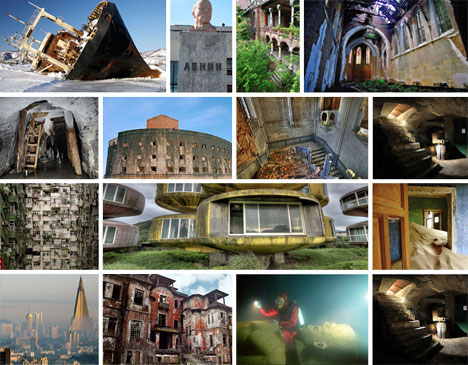
Be sure to view this array of photos of abandoned Antarctic sites.

Depressed Metabolism has posted several articles dealing with abandoned sites at this posting, including abandoned mines in Sardinia and abandoned underground stations in London.

Here is an amazing guide to abandoned places from WebUrbanist.

Abandoned buildings and installations are treasures for exploration, particularly for young boys. Older boys such as myself can find their hearts beating a little faster contemplating an expedition to such abandoned sites -- ghost towns and outposts waiting for living souls to haunt.

New Year's Eve may be the best of times for the contemplation such places, a sober devotional to auld lang syne, as anodyne to the hedonistic excesses of the evening.

Happy New Year and beyond. Be sure to do your best this year to grasp the big picture view, in dynamic supersensivision. Look for all the poetry and treasure that washes up on your shore.

Labels: ,

Bookmark and Share

26 May 2008

Seasteading on Pykrete, and Other Novel Uses

I first learned about the material called Pykrete while reading the blog "Colonize Antarctica." Pykrete is a mixture of wood fibre and ice, a combination that is very hard, very tough, floats, and is very slow to melt. Structures built of Pykrete would be ideal in a polar environment, such as a polar city pictured above.

2 Million Ton Pykrete Aircraft Carrier In WW2
More exotic uses of Pykrete would be to build a large ship, a floating island city, or floating arcology. Pykrete was made famous by wealthy industrialist and financier eccentric, Geoffrey Pike. Sir Winston Churchill was one of the earliest promoters of using Pykrete for building large ships in WWII. The hull for a giant Pykrete aircraft carrier would have been 40 feet thick or more, and almost impossible to penetrate with the torpedoes of the day. Even without refrigeration, such thick Pykrete walls would have taken years to melt in a temperate climate. The video below demonstrates the ballistic resistance of a 14% wood fibre Pykrete. A 50% fibre Pykrete would be much tougher, and slower to melt.

A modern Pykrete seastead would incorporate built-in refrigeration to keep the walls frozen even in tropical seas. A floating breakwater made of Pykrete would keep a more fragile inner-seastead safe from rogue waves and the pounding of normal storm swell. Besides the interior refrigeration tubing, the exterior walls of the Pykrete would need to be insulated via highly reflective/insulating coating materials.

The walls could be built hundreds of feet thick, if necessary, and in any conceivable shape. The fibre content could vary from as little as 14% to as much as 50% or more, for greater toughness. It would be necessary to experiment with coating materials for maximum longevity and minimum energy cost for refrigeration--even in tropical waters.

What we are talking about, is a custom-built, reinforced iceberg, of incredible strength and toughness. In a polar environment, the structure should last almost indefinitely, with minimal loss to melting and sublimation. In a temperate environment, a large Pykrete structure could last for decades or more, with minimal shading, insulation, and interior refrigeration.

A large Pykrete castle on land--with battlements, turrets, an inner keep, and drawbridge, could be quite affordable if built during a very cold winter. Pykrete structures with foundations that extended down into permafrost should also enjoy good longevity.

Labels: , , , , ,

Bookmark and Share

30 January 2008

Antarctic Colony Update: Colonize Antarctica

Antarctic Bases: Map Courtesy of 70South

The new blog, Colonize Antarctica, has some recent postings dealing with housing and building materials for the extreme frigid environment of Antarctica.
Building anything in Antarctica is difficult. The lack of conventional resources such as timber and the remoteness of the continent alone make traditional construction a challenge. This post aims to outline alternative methods of construction that may produce buildings suitable for an Antarctic colony.
Most of the structures built in Antarctica today are not well enough designed to serve a permanent colony. One fundamental flaw is they are built above ground and thus are subject to the forces of the wind and extreme cold. In addition to this most structures leak out heat through windows and doorways further increasing the energy required to heat them.

The easiest way to combat this would be to build structures underground. The permafrost in Antarctica would provide a temperature stable environment year round. I have been unable to locate reliable sub-surface temperate data for Antarctic permafrost at various depths. So, for the following example I will use estimates. If anyone has that temperature data please send it in or post it in the comments section here.___Colonize Antarctica
Using a custom designed mix of fibrous cement with a high insulation value may be a viable option for Antarctic construction. Some of the most well known mixes such as the ill fated Asbestos filled Fibro and the lesser known Papercrete likely wouldn't preform well in Antarctica. However, using a different fibrous material, such as hemp fibers combined with other insulating material may yield stronger and more well insulated structures. Standard rebar reinforced concrete could be used for load bearing walls and support columns.

Hemp fibers could be initially imported and later grown locally in large underground hydroponics bays. If a small cement factory could also be established, that would reduce the reliance on imports and make a partially self-sufficient Antarctic construction industry.

Fibrous cement is an amazingly versatile material and can be used for building everything from insulating shells for underground tunnels, interior walls, water pipes, to furniture and even novelty items. Certain mixes of fibrous cement can even be worked and sculpted like clay. Blocks or bricks can be poured in standardized sizes. Custom sized blocked can also be produced fairly easily. Entire walls can be poured into place if need be.
____Colonize Antarctica
There is more detail in the two articles linked above, on building methods and materials. Obviously, Antarctica is an unforgiving environment. Even with the best of planning, things can still go wrong--sometimes fatally wrong. There is little margin for error.
Other than undersea habitats, there is no other fixed habitat on Earth that offers the type of challenges that polar habitats offer. There is no better preparation for the type of vigilance required to survive in space, than living in an extreme Earth environment habitat or colony.

For humans to provide their own best chance of long-term survival, they must learn to live in extreme environments. It is a rite of passage--a necessary pathway to the future.

Labels: , , ,

Bookmark and Share

03 January 2008

If You Were to Colonise Antarctica, How Would You Do It?


Antarctica is as challenging an environment for a sustainable human colony as any land on Earth. The beautiful video above, revealing Antarctica in all four seasons, comes via Colonize Antarctica, a new website.

In yesterday's posting, Colonize Antarctica looked at energy supplies for the proposed colony. In my opinion, the list provided was much too short.

Geothermal and wind are certainly both good choices. Nuclear fission power--particularly newer, safer, cleaner modular designs would seem to be custom made for an Antarctic colony. Certainly if anything comes of Bussard's electrostatic confinement fusion project, such a device might very well serve as the nucleus of a well-rounded power system.

Remember, there is no sunlight for at least 4 months out of the year. It gets very cold in Antarctica--despite what Al Gore and James Hansen might have you believe. If you lose power in Antarctic winter, you are human popsicle. How would you start?
;-)

Labels: , , ,

Bookmark and Share

24 November 2007

Record Antarctic Sea Ice Sinks Cruise Ship

The southern hemisphere winter of 2007 was particularly cold and harsh. Antarctic sea ice was the highest ever recorded--and MS Explorer out of Toronto has paid the ultimate price for underestimating the ice.
A Canadian cruise ship struck submerged ice off Antarctica and began sinking Friday, but all 154 people on board, including Americans and Britons, took to lifeboats and were plucked to safety by another cruise liner. The Explorer struck submerged ice and began taking on water through its cracked hull. Photos released by the Chilean navy showed the ship later lying nearly on its side, surrounded by floating blocks of ice. Passenger and crew were picked up by a passing Norwegian cruise ship, the Nordnorge, after several hours in eight semi-rigid lifeboats and four life rafts.

Icecap

G.A.P. Adventures of Toronto owns the stricken MS Explorer. Company representative Susan Hayes revealed the reasoning behind the ship's dauntless charge into the ice hazard: "...it's highly unusual . . ." When the world is supposedly in the grip of "global warming" a ship's captain might be excused for not believing his own eyes, and supposing his small ship might get away with a little game of "dodge the ice." The captain of the Titanic felt the same way, though the northern hemisphere was barely out of the "Little Ice Age" at the time.

Earth's southern hemisphere has failed to show the same small bit of warming that has been seen in the northern hemisphere. Natural climate cycles depend upon solar effects and other cyclic weather phenomenon caused by the interaction of Earth's atmosphere, oceans, and land masses with naturally varying incoming solar radiation. CO2's heat trapping effect should extend over the entire planet almost uniformly, although other non-anthropogenic climate forcings are distributed unequally over the globe.

Interestingly, while much was made of the 2007 northern summer sea ice, the media is largely silent about the record 2007 southern winter sea ice. Any ideas?

Labels: , , ,

Bookmark and Share
Older Posts
Al Fin Main Page
Enter your Email


Powered by FeedBlitz
Google
WWW AL FIN

Powered by
Blogger

``