29 February 2012

English Speaking Nations Well Positioned Demographically ....

Wiki Anglosphere

If demography is destiny, then the Anglospheric nations appear to be well positioned for the next few decades.
Between 1980 and 2010, the U.S., Canada, and Australia saw big population surges: the U.S.’s expanded by 75 million, to more than 300 million; Canada’s nearly doubled, from 18 million to 34 million; and Australia’s increased from 13 million to 22 million. By contrast, in some European countries, such as Germany, population has remained stagnant, while Russia and Japan have watched their populations begin to shrink.

...Germany already has 33 elderly people for every 100 of working age—up from only 21 in 1985. By 2030, this figure will rise to 48, meaning that there will be barely two working Germans per retiree. The numbers are even worse in Japan, which currently has 35 seniors per 100 working-age people, a dramatic change from 1985, when the country had just 15. By 2030, the ratio is expected to rise to 53 per 100. _CityJournal
CityJournal
Other countries, such as Brazil and Iran, face similar scenarios. These countries, without social safety nets of the kinds developed in Europe or Japan, may get old before they can get rich.

These figures will have an impact on the growth of the global workforce. Between 2000 and 2050, for example, the U.S. workforce is projected to grow by 37 percent, while China’s shrinks by 10 percent, the EU’s decreases by 21 percent, and, most strikingly, Japan’s falls by as much as 40 percent.

In this respect, immigration presents the most important long-term advantage for the Anglosphere, which has excelled at incorporating citizens from other cultures. A remarkable 14 million people immigrated to Anglosphere countries over the last decade. _CityJournal
It’s indisputable that the Anglosphere no longer enjoys the overwhelming global dominance that it once had. What was once a globe-spanning empire is now best understood as a union of language, culture, and shared values. Yet what declinists overlook is that despite its current economic problems, the Anglosphere’s fundamental assets—economic, political, demographic, and cultural—are likely to drive its continued global leadership. The Anglosphere future is brighter than commonly believed. _CityJournal
CityJournal
But beyond mere demographics and current economic rankings, the Anglosphere is sitting on a tonne of energy -- which can be used to provide a bridge between the hydrocarbon age and the nuclear / electrical age.
...the US, Canada and Britain, are re-appraising domestic energy policies to take advantage of vast hydrocarbon resources; although President Obama is certainly doing his best to slow down the impact fossil fuels could have on the US domestic economy.

The impact of US shale gas – and prospectively shale oil – on domestic energy prices and in pegging back global prices, has already been nothing short of a revolution. Canada is not hanging around waiting for its southern neighbor to re-think its Keystone Pipeline strategy, but is already looking to sell much of its vast oil sands resource on the Asian market. Both the US and Canadian markets have also seen significant investment in their domestic energy markets, not least from cash-rich Chinese energy companies.

In Britain, North Sea oil and gas is a resource that just refuses to quit. Indeed, inward investment into Britain’s North Sea energy industries for 2012 already stands at a record breaking £7.5 billion. But Britain now appears to have a world class shale gas resource that could match, or even eclipse, its entire North Sea resource. Add to this the fact that oil prospects in the Falklands Basin are set to triple the country’s reserves, and Britain’s commitment to developing domestic resources leaves the rest of Europe cold (perhaps literally). _EnergyTribune
Meanwhile, Australia has significant supplies of coal and the world's largest resource of uranium.

In many ways, the English language is the Anglosphere's greatest resource, providing a common economic, cultural, and scientific link for the global machine.

Of course, politics and bloated governments are the weakest link, as always. Corrupt rent seeking bureaucrats, politicians, lobbies, and hangers-on, are always a threat to a prosperous future. Witness the US Obama administration and its policy of energy starvation, for example. If not for the persistence of a few stubborn entrepreneurs in the shale energy game, energy prices in the US would be in the stratosphere -- exactly where Obama had planned for them to be.

Fortunately, the bellicose crown prince of dysfunctional government has been forced to backtrack on several of his anti-energy stances. Not nearly far enough, but if the pompous monarch of arrogant ineptitude can be unseated in November, a great deal of promise can still be salvaged for the US and Anglospheric future.

Governments in Australia and the UK have pushed for similarly self-destructive energy policies, and have been forced to backtrack to variable degrees, as well. Canada's provincial governments are quite a mixed bag, but the federal government appears to be relatively pro-energy for now.

The most important purpose of the Anglosphere is to provide a stable environment for the evolution of next level humans. Once that transition moves into a self-sustaining mode, things will begin happening so quickly that ordinary political and governmental classifications will no longer signify to any great extent. But in the meantime, a significant stability and relative prosperity will be very important.

More: An Australian look at the death of peak oil

California's Monterey shale may contain 500 billion barrels of shale oil crude. North Dakota's Bakken is likely to contain a similar amount.

The US shale gas explosion produced so much natural gas that it resulted in a methane glut and a price slump for methane in the US, and we are beginning to see the same in Canada. Will the same thing happen in the UK? Or in Australia, due to coal seam methane? Abundant energy is crucial for industrial production and commercial activity. Let us hope that the people of the Anglosphere never allow their politicians to do what Obama, Rudd, and Cameron were apparently trying to do -- shut down fossil fuels and starve their nations of energy.

Labels: , ,

Bookmark and Share

29 September 2009

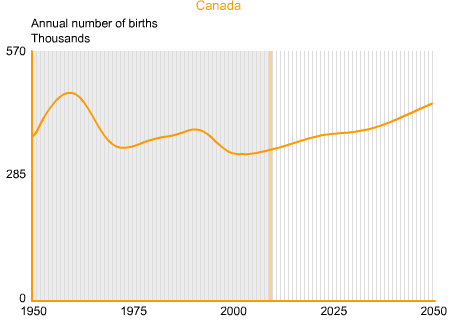
Canada vs. Europe: A Demographic Future

Image from Seeking Alpha
Canada's population is projected to grow over the next few decades, at a slow and sustainable rate. Europe, on the other hand, is slated to go the way of Japan and Russia: a steady shrinking into oblivion.

The contrast between the two regions is stark on many levels. Canada is rich in natural resources, and is seen as a desirable immigration location worldwide. Canada's economic future looks bright:
As an affluent, high-tech industrial society in the trillion-dollar class, Canada resembles the US in its market-oriented economic system, pattern of production, and affluent living standards. Since World War II, the impressive growth of the manufacturing, mining, and service sectors has transformed the nation from a largely rural economy into one primarily industrial and urban. The 1989 US-Canada Free Trade Agreement (FTA) and the 1994 North American Free Trade Agreement (NAFTA) (which includes Mexico) touched off a dramatic increase in trade and economic integration with the US, its principle trading partner. Canada enjoys a substantial trade surplus with the US, which absorbs nearly 80% of Canadian exports each year.

Canada is the US's largest foreign supplier of energy, including oil, gas, uranium, and electric power. Given its great natural resources, skilled labor force, and modern capital plant, Canada has enjoyed solid economic growth, and prudent fiscal management has produced consecutive balanced budgets from 1997 to 2007. In 2008, growth slowed sharply as a result of the global economic downturn, US housing slump, plunging US car sales, and drop in world commodity prices. Public finances, too, are set to deteriorate for the first time in a decade. Tight global credit conditions have further restrained business and housing investment, despite the conservative lending practices and strong capitalization that made Canada's major banks among the strongest in the world. _SA [Be sure to look over the first comment at the end of the article __ AF]
Europe does not share most of Canada's strengths, and exhibits a larger demographic weakness.
EUROPE...has the lowest fertility rate and the most elderly population in the world, and this population will soon start to shrink. All this makes it a front runner in a demographic trend that sooner or later will reach most of the world.

.....Economists are already fretting over the problem of how social security systems will cope when the post-war baby boomers start collecting their pensions in 2015. In hyper-ageing countries like Italy and Germany, where 1 in 7 people will be over 80 in 2050, it is unclear how a shrinking group of young people can generate the wealth needed to support the growing cohort of elderly citizens. Europe's competitiveness could fall behind younger and growing populations in other world regions. _NS
Australia is another far-flung member of the Anglosphere with fairly bright prospects -- if it can avoid Keven Rudd's Obamaesque energy starvation policies. Australia is rich in natural resources, and is seen as a very attractive immigration destination.

New Zealand is yet another Anglospheric nation that has enormous potential -- if its government can resist the stagnant influences of hyper-statism that have dogged Europe for so long.

The picture for the US is more mixed, depending upon region and state. The more bloated the governmental bureaucracy, the more difficult it will be to regain prosperity, after the global recession eases. The election of Obama in 2008 was an enormous setback for the US. But some regions of the US will thrive despite Obama reich fascism, corruption, and energy starvation.

Labels: , ,

Bookmark and Share

06 January 2009

Sick, Dying Cultures of Europe, Japan, Russia

It is perfectly possible for entire peoples to live only for their own pleasure and feel nothing for their prospective obliteration. How else should we explain fertility rates in Europe and Japan at barely half of replacement? _Spengler
Europe, Japan, Russia. Modern cultures without a future. Russia is fading the fastest due to the lethal combination of high death rates with low birth rates. Europe and Japan have healthier economic prospects than Russia, but low birthrates doom them to ghost cultures, certain to have their lands overrun and occupied by others.
"The peoples of the world foresee a time when their land with its rivers and mountains still lies under Heaven as it does today, but other people dwell there; when their language is entombed in books, and their laws and customers have lost their living power." _Rosenzweig as quoted by Spengler
No amount of decadent excess, or of saber rattling will hold back the forces of demographics and history.

The Anglosphere (US, UK, Canada, Australia, New Zealand), China, and India are three "empires" on one side of the future. Islamist supremacist globalist states are arrayed on the other. Where will Europe, Russia, and Japan align among the four supernational arrays? Europe and Russia are likely to be overrun by the Islamist strain, with the far east of Russia going to China. Pockets of resistance inside Europe may align with the Anglosphere.

Japan will likely align with China, and begin accepting Chinese immigrants, while maintaining trading ties with India and the Anglosphere. Africa stands to be parceled out yet again, to the great powers. Latin America may maintain some neutrality (Argentina, parts of Brazil, Uruguay), although parts may go to China, India, or the Islamic alliance. The Anglosphere may eventually grow strong threads into Central America, and as far into South America as Colombia or even Chile.

Nuclear weapons currently in Russia and Europe will be captured by Islamist groups and used against the various perceived enemies of the rising Caliphate. Wars will be fought for territory at the borders of the great empires. Thailand will be torn between the Chinese, Indian, and Islamic empires. Singapore will likewise be coveted by those three, while trying to maintain its ties to the Anglosphere.

Read Spengler's article linked above. Then take a long look at a map of the world. Puzzle it out. Which cultures will live, and which will die? How will the survivor's align themselves? The future is dynamic and unpredictable, but current social and demographic trends suggest some possible "chaotic attractor" scenarios.

Labels: ,

Bookmark and Share

05 December 2008

America is Last in the Race to the Bottom

Russia is a poor country with a rapidly aging population and a bleak future. The productivity of Russian workers is lower than that of workers in Botswana. Russian experts project that over the next 15 years, Russia’s working-age population could collapse by 14 percent to 25 percent. _American.com_via_StaticNoise
Multi-talented blogger, writer, artist, IT guy, philosopher and proto-human renaissance man Craig Wilms, discusses the growing sense of malaise in the US. Is America declining? Is there hope for the future?
Even when you consider that we have huge and looming problems as a nation our starting point as compared to the rest of the world is our ace in the whole. It has been said that when America catches a cold the rest of the world gets pneumonia. I think this is mostly true considering that the subprime mortgage disaster that set off this economic tailspin occurred in the U.S. and has now affected the entire global economy. Amazingly America has prospered despite everything the Congress, the unions and big business has done to neuter our competitiveness with our foreign rivals. Of course there is only so much even the remarkable resilience of the American backbone can withstand. We may be buckling, but so is the rest of the world. _StaticNoise
It may be cold comfort to tell ourselves that we are doing well--at least compared to the rest of the world. But cold comfort is better than no comfort at all. Seriously, Craig is correct. The US founding fathers, and the US Constitution gave the upstart colonies a "rule of law", opportunity society that produced the most economically dynamic nation the world has ever seen. Like a wildfire, Capitalism naturally generates its own "weather." There will always be ups and downs -- sometimes in very dramatic turns.

The trick is not to cripple your capitalist dynamos, so that your economy can recover from the downturns naturally. Europe has made the critical mistake of crippling its own capitalism almost beyond recovery. Canada, Australia, and New Zealand have been flirting with the same "point of no return," only to step back from the brink time and again. With the election of the Obama / Pelosi reich, the US has embarked upon the same quasi-suicidal course as most of the developed world. The US under Obama / Pelosi is threatening to starve itself of energy, and to cripple its capitalist and innovative energies beyond repair.

Demographically, the US may look better than Europe, Russia, China, Japan, and the rest. Economically, the US starts from a superior position, and has much farther to fall. But with the election of Obama / Pelosi, the US has taken a huge downward lunge that threatens to make up much of the difference.

The resilience of democracies lies in their ability to vote out dysfunctional politicians and governments. But the weak spot of democracies is when the electorate becomes "dumbed down" in a sinking spiral. The US media, and US educational institutions have been "dumbed down" for decades, and have exerted a considerable dumbing down influence on recent generations of students and the public. It is impossible to build a solid structure out of crumbling concrete, rotted timbers and corroded steel (as China is also discovering).

If the downward freefall of the US (Canada, NZ, Australia also) lags somewhat behind the fall of other developed nations, it is possible that immigration of productive persons from the rest of the doomed, previously developed nations into the Anglospheric diaspora, will help maintain the superior productivity of the Anglosphere. In addition, at least 10% of children inside the US (and Anglosphere) are being given solid academic, emotional, and ethical foundations which will allow them to use the neo-technological tools of productivity to sustain their societies.

Kurzweil looks for the Singularity to save society. Drexler and others look for salvation in nanotechnology. Venter looks to synthetic biology. Some look to space, and space resources.

Here at Al Fin, we believe that it is the maturation and enhancement of the human mind that will create the circumstances that will allow the rest of the cornucopian and quasi-utopian expectations of The Next Level to come to pass.

Is America doomed? Perhaps. Perhaps all nation-states as such are doomed. A collapse of nations such as is described in Neal Stephenson's novel The Diamond Age, may come to pass within the next few decades. The possibility looks more real with each passing year.

In the meantime, pay attention. Recent events in Mumbai (Bombay) suggest that it is easier to cause extended critical disruptions in civil society than many people may have thought. The chaos of the third world will not remain there. Chaos and violence have a busy travel schedule planned, around the world. No nation will be immune. In the race to the bottom, it is the loser who wins.

Labels: , , ,

Bookmark and Share

09 September 2008

The Wealth of Nations

Why are some nations rich and some poor? From Adam Smith to Jared Diamond, authors have tried to explain the discrepancy. Now Gregory Clark takes his turn--with a new book, A Farewell to Alms: A Brief Economic History of the World, to explain the difference that makes a difference in the wealth and poverty of nations. The following excerpts of a review of Clark's book provide a small glimpse into the ambitious work:
In this quantitative, long-term economic history, Clark seemingly rejects the ‘institutional development theory.’ ‘Despite the dominant role that institutions and institutional analysis have played in economics and economic history since the time of Adam Smith,’ he writes, ‘institutions play at best a minor role in the story of the Industrial Revolution told here, and in the account of economic performance since then’ (10). He tells us that ‘economists, and the institutions they inhabit, such as the World Bank and the International Monetary Fund, have adopted a false picture of preindustrial societies, and of the eventual causes of modern growth’ (ix). (2)

Clark writes that institutions alone are not sufficient to trigger a takeoff into economic growth. Indeed, do-gooders such as the Melinda and Bill Gates Foundation, the World Bank, and UN peacekeepers all too easily cause only misery.....Clark attacks the authors of various widely accepted theories about the Industrial Revolution, and indirectly confronts many economic develop-ment theories, including institutional ones. He dismisses theories as varied as Gary Becker’s (that fewer children were being endowed with better human capital), Douglas North’s (that property rights and free markets after the Glorious Revo-lution got modern capitalism going), and Kenneth Pomeranz’s (that scale economies in a big, compact population facilitated modernisation).

....We must acknowledge that not all people are the same when it comes to fulfilling the requirements of modern economic prowess. Many societies around the world today are far behind where western Europeans were in their basic cultural attitudes in the sixteenth century (or the Chinese and Japanese in the early nineteenth). The slapdash work ethic of Indian textile workers is still a hindrance to competitiveness, and complex modern production processes require a more disciplined workforce and social climate than can be found in many parts of the third world. Recently, we were again reminded of the importance of fundamental internal institutions when the Kenyan flower export industry, once extolled as an outstanding African success, collapsed and quickly shifted elsewhere after the outbreak of tribal strife. We must therefore guard against the illusions that all third-world societies will now find it easy to transit from the Malthusian fraternity into the world’s expanding growth league, and that outside aid can do much to produce the all-important cultural changes.

...Clark has taken the magnifying glass to contemporary ‘institutional development theories,’ which have proven fruitful and influential. He shows to my satisfaction that it is naive merely to ‘export’ formal institutions such as property rights legislation, transparency compacts, and democracy to underdeveloped societies. To do so now is almost as unsophisticated as it was fifty years ago to simply send capital goods to ports in less developed countries. What really matters is the populace’s receptiveness to freedom, which is based on deep-seated cultural institutions and attitudes, and which does not grow overnight. By overlooking the cultural foundations of prosperity, development optimists and freedom apostles in Washington and Canberra are wasting resources. Do-gooders who simply offer alms may indeed cause harm if they entrench dependency and a claimant mentality among people trapped in the ‘Malthusian mindset.’ _Source
The last paragraph of the excerpt sums up the basic take-home message from the reviewer's reading of Clark's book. Quite provocative, in the light of conventional wisdom on the topic.

There seems to be at least a grain of truth in most of the "wealth and poverty of nations" hypotheses. Certainly division of labour in modern societies allows a greater productivity. But we must keep in mind that while legal and economic freedoms are important to prosperity, if the underlying society is not "prepared" to use those freedoms constructively and cooperatively, the same political and economic liberalisation that has so helped the Anglosphere to prosper, may be a deadly curse to other societies.

Finally, it is very important to understand that culture and genetics are intimately tied together. For a society to evolve from a "Malthusian" to a "Prosperity" culture, it must have the genetic wherewithal to do so. I suspect that such potential limitations to societal evolution may be more than just a step beyond what today's politically correct, post-modern, faux multi-cultural academics and think tankers are willing to brave.

Labels: , ,

Bookmark and Share

13 January 2008

National Wealth and Poverty In the Age of Knowledge

Richard Lynn and Tatu Vanhanen imply in Intelligence and the Wealth and Poverty of Nations, that nations whose average population IQs were less than 90 IQ points could not prosper in a high technology world. This idea was a clear divergence from Adam Smith's Wealth of Nations concept based on division of labour.Lynn and Vanhanen's ideas appear to be backed up by the graphic above, and by The Smart Fraction Theory of IQ and the Wealth of Nations. Still, as important as human capital is to a nation's wealth, there is more to human capital than a nation's population average IQ.
In Knowledge and the Wealth of Nations, David Warsh puts a new twist on long-standing pillars of economics:
Thus instead of land, labor and capital -- the traditional inputs of economic theory -- it was "people, ideas and things" that mattered, driving technological change and entrepreneurial creativity. "No longer were the advantages of technical superiority to be understood as a case of 'market failure,'" Mr. Warsh writes. "They were part of the rules of the game." Such superiority was by its nature temporary -- i.e., nonmonopolistic. New knowledge constantly trumped old, and the law (rightly) gave ideas only limited property-protection.

More and more, economists came to see that it was knowledge that made the difference in modern societies -- e.g., in software, drugs, industrial processes, biotechnology and other parts of the economy where the upfront costs were large, the payoffs enormous and the benefits widespread. Economists inevitably turned their attention to the institutions or invisible structures -- constitutions, customs, property rights, cultural sentiments (like trust) -- that help to generate knowledge and sustain its effects.

In his admirably compelling account of economic thinking over time -- from Adam Smith to the present day -- Mr. Warsh shows a certain partiality to abstract mathematical theory. He might have given more credit to the thinkers such as Friedrich Hayek, the great philosopher of freedom and opponent of central planning; or to historians such as Joel Mokyr, who has chronicled the effects (as the subtitle of one of his books has it) of "technological creativity and economic progress"; or to popularizers such as George Gilder, who has documented (and celebrated) the role of knowledge in economic growth, especially in our computer age.
Source
If knowledge determines the wealth of nations in the global economy, why does GDP correlate so well with population average IQ (with a few easily explained outliers)? Clearly, knowledge and IQ are highly inter-correlated themselves.

Still, when you look at nations with GDPs well above what would be predicted from average population IQ, an important truth about "knowledge and the wealth of nations" jumps out. Nations that economically outperform their population average IQ have a market dominant minority to thank.
According to Chua, other examples of ethnic market-dominant minorities include Chinese people in Southeast Asia; "whites" in Latin America; Jews in Russia; Croats in the former Yugoslavia; and Ibos, Kikuyus, Tutsis, Indians and Lebanese, among others, in Africa

It is suggested that the USA (and to an extent the Anglosphere, Europe, and Japan) constitutes a global "market dominant minority" in the sense of setting the economic rules, providing the market infrastructure, and militarily protecting the trading routes of the world so the market can function.

An even more intriguing twist to this dynamic: if executive function (EF) is indeed more important to the success of individuals than their IQ, and if EF can be taught (unlike IQ), is it not possible that EF can be taught to entire nations of children, thus increasing the future prosperity of the entire nation? I suspect this possiblity is real.

This concept of a minority providing extensive unacknowledged benefits to the majority can help a larger audience begin to understand how a next level civilisation would benefit the much larger between-levels civilisation with which it would co-exist on the planet. The accelerated outpouring of revolutionary scientific discoveries and technological inventions from a next level civilisation would benefit the between-levels by creating a cleaner, healthier, more affluent environment for everyone.

The same idea holds in principle for a singularity civilisation guided by a "friendly artificial intelligence." The abundance created by a FAI would be there to be enjoyed by the masses, in theory. Even without FAI's, a world where abundant nano-assemblers can efficiently and economically produce essentially unlimited numbers of consumer goods and vital infrastructure, is a world unrecognizable to modern doomseekers of Peak Oil, CAGW, population crisis, and other neo-Malthusian congregations of Luddites.

Labels: , , , , , ,

Bookmark and Share

10 January 2008

Humans Still Evolving: No One Knows Where

Recent research on human genomes from several continents shows that distinct human breeding populations are still evolving away from each other. But is this a good thing? Even in countries such as Canada--where several tribes of humans coexist--the tribes appear to be evolving apart. Fragments of homo multiculturalis.

Humans are ingenious primates. Within Europe--for a time the center of world invention and science--evolution seems to have led to homo welfarensis. To make sure Europeans never regress to the atavistic state, European educational systems have instituted a brutal mind-warping indoctrination of its children away from economic freedoms, toward economic authoritarianism.

In many muslim countries, evolution seems to have been striving toward the apex of producing the perfect suicide bomber. Evidence suggests this evolutionary path has neared its goal.

In South America, evolved human ingenuity is largely applied to better ways of producing and smuggling illegal drugs.

Russia appears to have evolved an allergy to procreation--with a rapidly shrinking population unable to man its crumbling civil and military infrastructure. Simultaneously, the evolved Russian tendency to grab any land in sight has mutated to include a grabbing of large areas of seabed. This Russian grab is stimulating a worldwide rush to exploit the arctic.

In China, farmlands are shrinking, the quality of existing food cannot be guaranteed, and many are wondering about the wisdom of locating the 2008 Olympics Summer Games in Beijing.

While hugely important scientific advances are taking place constantly--particularly in the Anglosphere, Europe, and East Asia--human evolution has not been all to the good.

In fact, anyone who is exposed to the mainstream media at all cannot help but wonder how humans can possibly survive as a species? Humans are certainly "glitched", and in many ways a total "kludge." But they do not have to remain that way.

That concern is one reason for the Al Fin blog, and the Al Fin sidebar resource. Every writer at Al Fin wishes for the human species to evolve into a wiser, more intelligent, happier, longer-lived, healthier and more accomplished primate. We share that concern with participants at the Lifeboat Foundation.

If you share that concern, browse the Al Fin sidebar and the resources over at the Lifeboat Foundation. From there, you will find an electronic universe of others who share at least some of your attitudes and concerns. You may even find a partial solution to work on.

Labels: , ,

Bookmark and Share

26 January 2006

Science and the Wealth of Nations


J McCormick at Anglosphere.com/weblog reports on the connection between a nation's wealth and its scientific output. Logically, this can fit with the concept of a connection between a nation's wealth and its mean IQ. Links were provided to a pdf report entitled "The Scientific Impact of Nations", and an earlier pdf article from Science entitled "The Scientific Wealth of Nations.

Both articles are worth looking over, after reading the post at Anglosphere.com.

Gene Expression's Godless also posted on this topic. The graphic from the 2004 pdf linked above comes from the gnxp.com article. Gene Expression is one of the relatively fearless blogs that is not afraid to flout the PC Thought Police whenever necessary.

Labels: ,

Bookmark and Share
Older Posts
Al Fin Main Page
Enter your Email


Powered by FeedBlitz
Google
WWW AL FIN

Powered by
Blogger

``