14 December 2012

Extreme Bugout Vehicle: Carry Your Survival Colony With You Anywhere

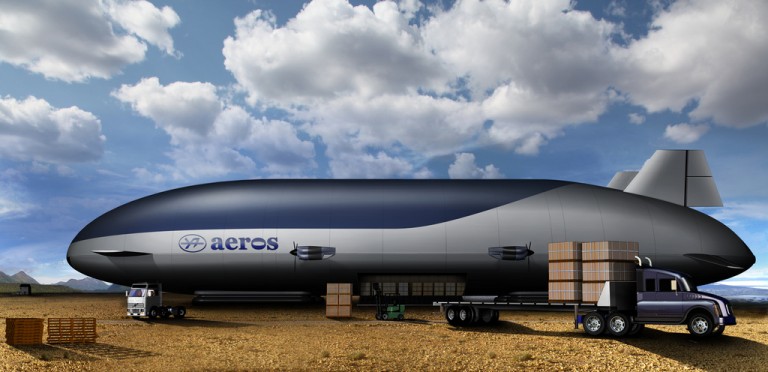
The Aeros rigid body airship uses a novel buoyancy management system to provide the ability to carry up to 66 tons of freight or passengers, with a range of 3,000 nautical miles, and the ability to land and take off vertically from any flat surface. Cruising speed is 110 knots, with better fuel economy than other aircraft with heavy lift capability.

The company has built a half-size prototype, and is working with the US FAA on legal-technical-regulatory aspects of the craft before building a full-sized version.

If the vehicle operates to specifications, it would be an ideal method of building an "instant community" in the middle of nowhere. Such a capacity would be invaluable to militaries, as well as to survivalists, colonists, "new nation activists," and others who wished to be able to quickly install a sophisticated infrastructure in a remote location using pre-fabricated and pre-packaged materials and equipment. Example: Intershelter Popup Dome Shelters are lightweight and assume compact form for shipping.

The airship should also allow for fairly quick and massive relief and re-supply in disaster situations.
Aeroscraft

The commercial models will have a cruising speed of 110 knots over a range of 3000 nautical miles.

“It is the speed that the market and customers need,’’ he [Aeros CEO Igor Pasternak] says.

One of the keys to the new platform is its buoyancy management system. This allows the weight of the vehicle to be adjusted to suit conditions and operational needs. It is completely different from a "blimp" or something like the Hindenburg which needed a hitching post. With the Aeroscraft, there is a gas envelope above a freight chamber which reduces the buoyancy until the craft is 50 feet above the ground. Then you land it as you would a helicopter.

“The concept of the operation is absolutely new. When it comes in for a landing, say 100 feet or 50 feet and it touches the ground, at this moment you become heavier than air,’’ he says.

“From the structure stand point, all of us are familiar with the Hindenburg and Zeppelin designs, continues Pasternak. “This is different. We built a space frame that sits inside of the vehicle and around the frame we built a rigid cell. The function of the rigid cell is to have it work with the aerodynamic laws. It’s a very simple approach. _Gizmag
The video below provides a graphic animation of the Aeros buoyancy management system, which allows the craft to land and take off vertically, and to pick up and deliver up to 66 tons of cargo or passengers from most locations -- regardless of how far it is to the nearest airport.


The military applications are apt to catch on, if the craft can operate at high enough altitudes out of range of most ground fire. Remote piloting capability would also be an ideal feature for military use.

This is an airship buoyancy concept that has been thrown around at the Al Fin Aerospace Institute for a number of years, but the Institute is not likely to submit any prior claims to the idea. ;-)

Labels: ,

Bookmark and Share

27 October 2011

Escaping the Zombie Apocalypse By Air

Zombie Safe House Contest

The above entry in the "Zombie Safe House Contest" presents a way of being above it all, sustainably. The project even utilises zombies as an energy and fuel source.
Slashgear
In the image above, you can see a mass airborne exodus from the zombie zone, enabled by the massive 3,000 passenger nuclear mother-ship. The advantage of the nuclear mothership is its ability to stay airborne for years at a time, acting as a shuttle between zombie-safe zones. Lesser aircraft are able to land on the deck of the mothership, dropping off and picking up passengers to and from safe landing zones.
Here you see a large airship arriving at a safe zone, far from the zombie infested cities. It is ready to discharge freight and passengers, in preparation for another rescue mission to the danger zone.
Here you see a smaller escape vehicle, meant for both personal and family escape. It can also be used as a short and intermediate range scouting craft, to provide advance warning to the safe zones, in case of possible zombie incursions.
Here you see the Eurocopter flying car, currently only available to upper level EU officials, for rapid zombie escape. The EU hopes to be able to make the escape vehicle available to ordinary Europeans before it is too late.

Originally published on Al Fin Potpourri

Labels: , , ,

Bookmark and Share

07 January 2011

Using Near Space as a Waystation to Orbit

Skycat via Brian Wang

The Lockheed P791 can provide an observational platform at 20,000 feet for 3 week time periods. It is similar to the Skycat hybrid aircraft, which due to its buoyancy is able to take off and land vertically and saves 75% of fuel costs over conventional aircraft.
Lockheed P791 via Brian Wang

At 20,000 feet, you would need a well-insulated pressurised cabin to survive. But who wants to stay at low altitudes like 20,000 feet for only 3 weeks, when they could be living high at 50,000 feet?
Flying City for 5,000 Residents
Stratospheric flying cities provide a novel living environment for scientists or adventurous vacationers willing to accept a bit more risk for more excitement.

High altitude stations such as the JP Aerospace Stratostation (or Dark Sky Station) will provide permanently manned transfer stations for those going farther up and out.
JP Aerospace Dark Sky Station PDF
JP Aerospace is developing the technology to fly a balloon or more accurately, their relative, the airship directly to orbit.

Flying an airship directly from the ground to orbit is not practical. An airship large enough to reach orbit would not survive the winds near the surface of the Earth. Conversely, an airship that could fly from the ground to upper atmosphere would not be light enough to reach space. The resulting configuration is a three-part architecture for using lighter-than-air vehicles to reach space.

The first part is an atmospheric airship. It will travel from the surface of the Earth to 140,000 feet. The vehicle is operated by a crew of three and can be configured for cargo or passengers. This airship is a hybrid vehicle using a combination of buoyancy and aerodynamic lift to fly. It is driven by propellers designed to operate in near vacuum.

The second part of the architecture is a suborbital space station. This is a permanent, crewed facility parked at 140,000 feet. These facilities, called Dark Sky Stations (DSS), act as the way stations to space. The DSS is the destination of the atmospheric airship and the departure port for the orbital airship. Initially, the DSS will be the construction facility for the large orbital vehicle.

The third part of the architecture is an airship/dynamic vehicle that flies directly to orbit. In order to utilize the few molecules of gas at extreme altitudes, this craft is big. The initial test vehicle is 6,000 feet (over a mile) long. The airship uses buoyancy to climb to 200,000 feet. From there it uses electric propulsion to slowly accelerate. As it accelerate it dynamically climbs. Over several days it reaches orbital velocity. _JPAerospace PDF
The large orbital airship pictured above is over 1 mile long, and takes several days to reach orbital velocity after departing the Dark Sky Station with its payload.
Other approaches to space which pass through "near space" include the space elevator, an inflatable space tower, Josh Hall's 100 km tall space pier (pictured above), the highly imaginative "Bridge to Space" described in Mike Comb's fictional account, suborbital flights, and sub-orbital ++, among other ideas.

Most of the same competencies and precautions required to survive in orbital space are also required for life in the stratosphere. Precautions against very low atmospheric pressure and high radiation levels will be mandatory. Only competent persons need apply for working positions.

One advantage of a stratospheric habitat is that a person in an insulated pressure suit (with a parachute) can simply jump away from the structure for an invigorating free fall to the surface, with a fair to good possiblity of survival. Attempting the same thing from an orbiting habitat without a re-entry pod would certainly be fatal.

Humans have been slow to establish a permanent presence in space. There are many reasons for this hesitancy -- including economic costs and health risks -- but eventually these barely advanced apes will find a way to answer the siren's call, and thus safeguard the future of the race -- or whatever it is to evolve into.

Labels: , ,

Bookmark and Share

08 October 2007

Unusual Luxury Getaway Vehicles for Air and Sea

This luxury airship is a rigid design that gets 70% of its lift via helium and 30% of its lift from its unique wing design. It should perform better in bad weather than typical lighter than air ships, with better maneuverability.
The Aeroscraft ML866 is a buoyancy assisted air vehicle with a rigid structure and gas cells. It uses Aeros’ proprietary Full Authority Direct Organic Lift Control (FADOLC) - a dynamic buoyancy management system that provides the low speed control capability. While 70% of the aerodynamic lift comes from helium, the remaining 30% is derived from its innovative “wing” shape. As well as being able to hover the aircraft will be capable of speeds up to 138 mph (0-222 kmh) and will operate at altitudes of up to 12,000 ft (3,657 m). and the massive 210 ft (64 m) long by 118 ft (36 m) wide by 56 ft (17 m) high structure will deliver a roomy 5000+ square feet of cabin space.
Source

This floating habitat features multiple levels connected by spiral staircase. The lowest level features panoramic undersea views.
The top level is 5.6 metres above the sea level and has been kept for study rooms. The next lower level is situated at 3.5 metres above the sea level and contains the night time zone while the next lower level at 1.4 metres contains the daytime zone with a kitchen and bathrooms. The lowest living level at 0.8 metres above the sea level is semi-submerged and has been kept for the guest room, bathroom and technical spaces.

The acrylic viewport globe situated at -3.00 mts above the sea level allows the occupants conmplete enjoyment of the submarine world.
Source
Powered by solar panels, presumably the Jellyfish would have the ability to move about on the water's surface using either a tugboat or optional self-power, such as sail or electric motor.

Labels: ,

Bookmark and Share
Older Posts
Al Fin Main Page
Enter your Email


Powered by FeedBlitz
Google
WWW AL FIN

Powered by
Blogger

``