17 November 2010

Corn Cob Gasoline @ $1 / Gallon? GE Energy Wants In
GCC

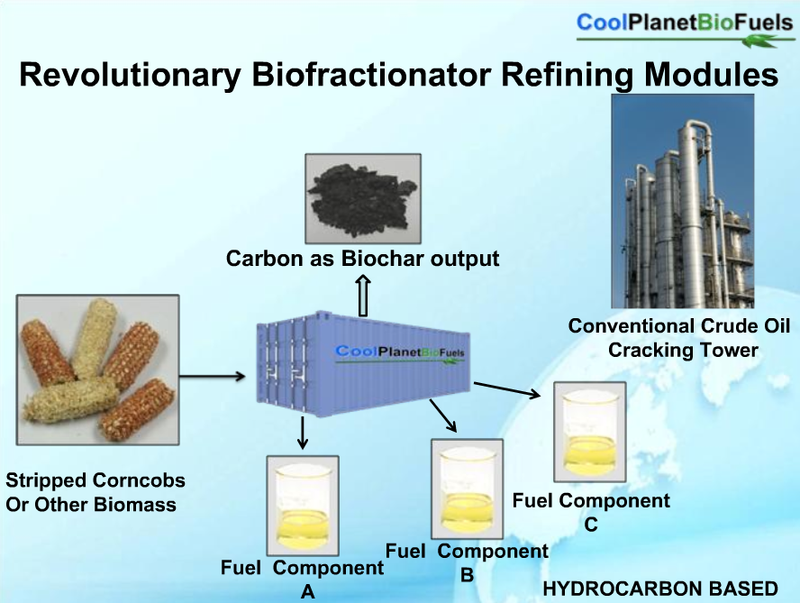
GE Energy, a GE subsidiary, has jumped into the advanced biofuels race by throwing in $8 million with the startup CoolPlanetBiofuels. The startup claims to be able to produce a bio-gasoline from rough biomass for about $1 a gallon. Here is more from GreenCarCongress:
$8-million funding round for CoolPlanetBioFuels, a start-up company developing a technology that converts low-grade biomass into high-grade fuels, including gasoline, and carbon that can be sequestered. This venture capital investment was led by North Bridge Venture Partners, which had also led CoolPlanet’s financing round last year. Additional financial details were not disclosed. CoolPlanet’s research and development facilities are located in Camarillo, CA.

CoolPlanetBioFuels is developing modular thermal/mechanical processors which directly input raw biomass such as woodchips, crop residue, and algae and produces multiple distinct gas streams for catalytic upgrading to conventional fuel components.

In support of the biomass fractionator, the company is also developing a range of one-step catalytic conversion processes which mate with the fractionator’s output gas streams to produce products such as eBTX (high octane gasoline), synthetic diesel and proprietary ultra-high crop yield “super” fuels.

At the GoingGreen Silicon Valley 2010 conference in October, Mike Rocke, CoolPlanetBiofuels VP Business Development, said that the startup could produce carbon-neutral gasoline from biomass for less than $1.00/gallon US.

Biomass throughput time in the biomass fractionator is minutes, Rocke said earlier at a conference at Stanford. Two fractionators in a module can produce one million gallons of gasoline per year, with capex of $0.50/gallon to install—i.e., $0.10/gallon over a five year life. _GCC

The image above shows a comparison of product between conventional Shell 87 octane gasoline and the Cool Planet BioFuels drop-in product from biomass, by gas chromatograph.

Whether the information provided to investors is accurate or not, if the company is able to produce high quality drop-in bio-gasoline from biomass technology already developed, increasing efficiencies and yields, and decreasing costs, may make the product competitive within a matter of 5 or 10 years.

The problem with biomass is its low energy density, and its diffuse nature. It takes a lot of energy to gather biomass together, densify it for transport, and to transport large amounts to a central processing facility such as CoolPlanetBioFuels'. It is clear that those energy costs were not figured into the amounts quoted to investors.

Thermochemical production of biofuels via pyrolysis and gasification have a natural head start on microbial fuels -- due to prior work done on other feedstocks. But if the thermochemical approach is to achieve a foothold -- and critical scale-up -- it cannot dally about while people such as Craig Venter are working feverishly to genetically engineer microbes to achieve the same thing at far lower energy cost.

Cross-posted at Al Fin Energy

Labels: , ,

Bookmark and Share

16 December 2008

Peak Oil: Meet Cellulosic Biofuels 2030!

German researchers have published a study revealing that by 2030 cellulosic biofuels using pyrolysis and gasification can provide transportation fuels to meet global needs using land not suitable for growing food.
According to Prof. Jürgen O. Metzger from Carl von Ossietzky Universität Oldenburg, and Prof. Aloys Hüttermann from the Universität Göttingen, a global energy supply based on biomass grown to generate electricity and produce fuel is both a sustainable and economical scenario, contrary to some other current research. Their findings are published online this week in the journal Naturwissenschaften.

The solution, according to Metzger and Hüttermann, is to plant fast-growing trees on degraded areas, and harvest the biomass for energy usage. This afforestation would not compete with the need for arable land for food production. The authors argue that the investment required for afforestation and transformation of the biomass to electrical energy, heat, fuels and chemical feedstock is actually sustainable and not more, probably even less, than what would need to be invested in infrastructure for non-sustainable fossil energy.

For their global overall estimations for transportation fuels, the two used the conversion of the lignocellulosic biomass to biooil (“bioslurry”) via pyrolysis and its subsequent gasification to a syngas followed by Fischer–Tropsch synthesis (biomass-to-liquids, BTL). _GCC
These conclusions suggest that there is no "food vs fuels" issue, and that current technology can solve the global transportation fuels demand in the intermediate future.

Al Fin feels that this study did not go far enough, since huge areas Earth's surface can be used to grow ocean biomass and haplophytic organisms on salty soil. In addition, the potential for growing abundant algae in desert areas using saltwater will multiply potential biofuels much more.

Further development of plant genetics, chemical catalysts, other synthetic and separation technologies, etc. will be helpful--but not necessary for biofuels to play a huge role in the future energy menu.

Previously published at Al Fin Energy

Labels: , , , ,

Bookmark and Share

21 February 2008

Biomass-->Pyrolysis-->Biocrude

Forget about burning food. Any kind of biomass--including garbage--can produce biocrude. Biocrude is similar to crude oil. It can be refined to the desired hydrocarbon product.
Pyrolysis is a process in which organic materials - any type of biomass - are heated in absence of air in a reactor (schematic, click to enlarge). Under these conditions, organic vapours, pyrolysis gases and charcoal are produced. Depending on the residence time and the temperature to which the biomass is exposed, varying amounts of these products are obtained.... Under fast pyrolysis (temperatures of 450 - 600 °C), the vapours are condensed to bio-oil and typically, 70-75 wt.% of the feedstock is converted into this oil (also known as 'biocrude' or 'pyrolysis oil').__Biopact
Biocrude projects are proceeding at full speed in Europe, Australia, and North America. The main problem remaining to be solved, is the wide dispersal of biomass. It costs energy to collect and concentrate biomass--to bring it to the central pyrolysis station.

Fortunately, pyrolysis is a scalable process. The pyrolysis infrastructure can be built closer to the source of biomass, and the resulting oil can be transported in bulk via pipeline, river barge, or rail, to refineries.

Currently, political obstructionists have prevented construction of refineries. The bottleneck in hydrocarbon refining keeps costs high to end consumers. We can hope that the obstructionists who prevent energy refining and new energy exploration, will relent in the case of biomass to biocrude to bio-refinery.

Labels: , , , ,

Bookmark and Share

08 February 2008

Biofuels Triumphant--The Folly of Pessimism

Biofuels have a magnificent future, in terms of replacing liquid petro-fuels for transportation, agriculture, heavy machinery, etc. It is important to keep in mind the rapid progress being made in the new science and technology of biofuels, when looking at research showing that [old methods of producing] biofuels are inefficient.
Several recent studies about the carbon balance of first-generation biofuels, including two analyses published in Science, are based on assessments of current land use practises. These studies are important, but the conclusions drawn from them are often seriously flawed. Moreover, if these conclusions are placed in a neo-malthusian perspective on population and natural resources, they cannot be taken seriously at all because there is no credible basis for neo-malthusianism in the first place.

...all these analyses are based on existing, primitive land use practises and on first-generation, inefficient biofuels made from crops like corn or soybeans. They do not take into account new energy crops (e.g. crops that yield far more biomass and are engineered to store far more CO2 than ordinary crops), the use of plantation residues, new bioconversion technologies, and the radical option of capturing and storing carbon from bioenergy production.

Those who use current studies about the carbon balance of today's incredibly inefficient biofuels to conclude that all biofuels are incapable of reducing emissions are making a grave mistake....Decentralised biofuel production plants that can be located close to the land to be cleared are already here. These plants draw on a process called fast-pyrolysis. It transforms any type of biomass into bio-oil, which can be further upgraded into transport fuels or used in power plants....The process works as follows: original biomass (e.g. a woodland) is used for the production of a biofuel such as pyrolysis oil....The fuel is then sent to a facility where it is used for the production of either electricity and heat, a fully decarbonized biofuel (such as biohydrogen) or a low-carbon biofuel....

...Current biofuel crops like corn or soybeans are truly inefficient because biofuels made from them only utilize a fraction of the biomass grown, that is, easily extractible starch or oil. These first-generation biofuels have no future and are no longer of interest to the bioenergy community....A large number of plant biologists and bio-engineers has already developed new crops that either yield far more biomass (which immediately clears much of the carbon debt), or that store far more CO2 than ordinary crops, or that contain in them codes for easy bioconversion.

...an area in which huge potential can be found is in the utilization of plantation and processing residues from existing agricultural operations and biofuel operations. Recently, we referred to the potential for the production of biohydrogen from palm oil residues. A palm plantation yields farm more biomass than is currently used in the form of oil. If these vast amounts of residues are used productively instead of burned or dumped as waste, the carbon balance of biofuels from the oil is seriously improved (previous post). There is similar potential is virtually all agricultural operations today. The same process can be applied in biofuel operations, where residues and byproducts (such as glycerine in biodiesel) is used as a feedstock for a myriad of green products that replace oil, coal and gas.
___Source

The fact is, the people who do studies such as the ones in Science, cannot possibly keep up with the rapidly advancing technology in biofuels. By the time they publish, their results are hopelessly out of date. While the energy return to energy invested ratio is only 1.5 for maize ethanol, for advanced ethanol and biodiesel production methods, the return can be over 10 to 15 times the energy invested.

Many advocates of biofuels favour them for the prospect of reducing carbon dioxide emissions. We at Al Fin see that rationale as trivial and unimportant. Increased energy independence and sustainability are far more important reasons to develop advanced biofuels. The payoff will be most significant.

Labels: , ,

Bookmark and Share

04 February 2008

Peak Oil: Meet Australian Biocrude

Nature took millions of years to turn plant cells into petro-crude. Short-lived human beings are in more of a hurry. Australian researchers have developed a form of bio-crude from ligno-cellulose that is more stable than all previous versions.
The bio-crude oil, also known as bio-oil, can be used to produce high value chemicals and biofuels, including both petrol and diesel replacement fuels. The breakthrough removes one of the major obstacles holding back the development of decentralised production concepts, as the stability of the oil is important in the logistical chain.

Bio-crude oil or bio-oil is a next-generation biofuel obtained from the fast pyrolysis of any type of biomass including waste. Fast pyrolysis is a process in which the organic materials are rapidly heated to 450 - 600 °C at atmospheric pressure in the absence of air. Under these conditions, organic vapours, pyrolysis gases and charcoal are produced. The vapours are condensed to bio-oil. Typically, 70-75 wt.% of the feedstock is converted into oil.

....Dr Steven Loffler of CSIRO Forest Biosciences says his team made changes to the chemical process, which allowed it to create a concentrated bio-crude which is much more stable than that achieved elsewhere in the world. This makes it practical and economical to produce bio-crude in local areas for transport to a central refinery, overcoming the high costs and greenhouse gas emissions otherwise involved in transporting bulky green wastes over long distances (previous post, here and here).____Biopace

Biocrude can be made from trees, plant waste, or any organic material--including the dead bodies of politicians who keep insisting on using your tax money to pay for ethanol from maize (corn).

Labels: , , ,

Bookmark and Share
Older Posts
Al Fin Main Page
Enter your Email


Powered by FeedBlitz
Google
WWW AL FIN

Powered by
Blogger

``