11 July 2007

Climate Quest: The Mysterious Missing Carbon Sink--A Multi-Billion Dollar Quest for a Phantom Grail of IPCC Climate "Science"

First of all, how long does CO2 stay in the atmosphere?
Until recently, the world of science was near-unanimous that CO2 couldn't stay in the atmosphere for more than about five to 10 years because of the oceans' near-limitless ability to absorb CO2.

"This time period has been established by measurements based on natural carbon-14 and also from readings of carbon-14 from nuclear weapons testing, it has been established by radon-222 measurements, it has been established by measurements of the solubility of atmospheric gases in the oceans, it has been established by comparing the isotope mass balance, it has been established through other mechanisms, too, and over many decades, and by many scientists in many disciplines," says Prof. Segalstad, whose work has often relied upon such measurements.
Why is it important to IPCC modelers to have CO2 stay in the atmosphere longer?
Climate change scientists began creating carbon cycle models to explain what they thought must be an excess of carbon dioxide in the atmosphere. These computer models calculated a long life for carbon dioxide.

Amazingly, the hypothetical results from climate models have trumped the real world measurements of carbon dioxide's longevity in the atmosphere. Those who claim that CO2 lasts decades or centuries have no such measurements or other physical evidence to support their claims.

Neither can they demonstrate that the various forms of measurement are erroneous.

"They don't even try," says Prof. Segalstad. "They simply dismiss evidence that is, for all intents and purposes, irrefutable. Instead, they substitute their faith, constructing a kind of science fiction or fantasy world in the process."
Very Curious. What happens if the IPPC modelers' blind faith is misplaced?
In the real world, as measurable by science, CO2 in the atmosphere and in the ocean reach a stable balance when the oceans contain 50 times as much CO2 as the atmosphere. "The IPCC postulates an atmospheric doubling of CO2, meaning that the oceans would need to receive 50 times more CO2 to obtain chemical equilibrium," explains Prof. Segalstad. "This total of 51 times the present amount of carbon in atmospheric CO2 exceeds the known reserves of fossil carbon-- it represents more carbon than exists in all the coal, gas, and oil that we can exploit anywhere in the world."
But that would defy logic, would it not?
Also in the real world, Prof. Segalstad's isotope mass balance calculations -- a standard technique in science -- show that if CO2 in the atmosphere had a lifetime of 50 to 200 years, as claimed by IPCC scientists, the atmosphere would necessarily have half of its current CO2 mass. Because this is a nonsensical outcome, the IPCC model postulates that half of the CO2 must be hiding somewhere, in "a missing sink." Many studies have sought this missing sink -- a Holy Grail of climate science research-- without success.

"It is a search for a mythical CO2 sink to explain an immeasurable CO2 lifetime to fit a hypothetical CO2 computer model that purports to show that an impossible amount of fossil fuel burning is heating the atmosphere," Prof. Segalstad concludes.

"It is all a fiction."

Source

If it is all a fiction, it is a very high-priced fiction--taking in many billions of dollars a year in its support and propagation.

Or is it possible that a mysterious missing carbon sink is out there, just waiting for the right model, the right number of billions of dollars, the right political has-been crusader to find and display in triumph? Stay tuned.

Hat tip Green Watch.

Labels: ,

Bookmark and Share

08 July 2007

Rethinking Climate Forecasts: IPCC Climate Models Take Hit in Credibility

Here is a fascinating Wharton Business School audit of the reliability of climate forecasting by GCM models. The image of climate modelers becomes more tarnished, the closer one looks at their methods, apparently.
In apparent contradiction to claims by some climate experts that the IPCC provides “projections” and not “forecasts, the word “forecast” and its derivatives occurred 37 times, and “predict” and its derivatives occur 90 times in the body of Chapter 8. Recall also that most of our respondents (29 of whom were IPCC authors or reviewers) nominated the IPCC report as the most credible source of forecasts (not projections) of global average temperature.

....Global climate is complex. Scientific evidence on many key relationships is weak or absent; e.g., does increased CO2 in the atmosphere cause high temperatures or do high temperatures increase CO2 (e.g. Jaworowski 2007)? Measurements of key variables such as local temperatures and a representative global temperature are contentious in the case of modern measurements, because of possible artifacts such as the urban heat island effect, and often speculative in the case of ancient ones, such as those climate proxies derived from tree ring and ice-core data (Carter 2007). Finally, it is difficult to forecast the causal variables.
The already high level of uncertainty rises rapidly as the forecast horizon increases.

While the authors of Chapter 8 claim that the forecasts of global mean temperature are well-founded, their language is imprecise and relies heavily on such words as “generally,” “reasonable well,” “widely,” and “relatively” [to what?]. The report makes many explicit references to uncertainty. For example, the phrases “. . . it is not yet possible to determine which estimates of the climate change cloud feedbacks are the most reliable” and “Despite advances since the TAR, substantial uncertainty remains in the magnitude of cryospheric feedbacks within AOGCMs” appear on p. 593. In discussing the modeling of temperature, the authors wrote, “The extent to which these systematic model errors affect a model’s response to external perturbations is unknown, but may be significant” (p. 608), and, “The diurnal temperature range… is generally too small in the models, in many regions by as much as 50%” (p. 609), and “It is not yet known why models generally underestimate the diurnal temperature range.” The following words and phrases appear at least once in the Chapter: unknown, uncertain, unclear, not clear, disagreement, uncertain, not fully understood, appears, not well observed, variability, variety, difference, unresolved, not resolved, and poorly understood.
Given the high uncertainty, the naïve method for this situation would be the “no-change” model. Remarkably, nowhere does the IPCC Report address the issue of forecastability. It should have been addressed prior to spending enormous sums on complex forecasting models.

In effect, given the current state of uncertainty regarding climate, prior evidence on forecasting methods suggests that attempts to improve upon the naïve model might increase forecast error. To reverse this conclusion, one would have to produce validated evidence in favor of certain methods. Such evidence is not provided in Chapter 8 of the IPCC report.

....It is not clear to what extent the models produced by the IPCC are either based on, or have been tested against, sound empirical data. However, some statements were made about the ability of the models described in Chapter 8 to fit historical data, after tweaking of their parameters. Extensive research has shown that the ability of models to fit historical data has little relationship to forecast accuracy (See “Evaluating Methods” in Armstrong 2001.) It is well known that fit can be improved by making the model more complex. The consequence of increasing complexity to improve fit, however, is to decrease the accuracy of forecasts. The 12 authors of Chapter 8 appeared to be unaware of this principle.

....A list of the 72 violations of forecasting principles by the authors of IPCC Chapter 8 is provided on the Public Policy Special Interest Group Page at forecastingprinciples.com. The many violations provide further evidence that the authors were unaware of evidence-based principles for forecasting. If they were aware of them, it would have been incumbent on them to present evidence to justify their departures from best forecasting practice. They did not do so. We conclude that because the forecasting processes described in the Chapter overlook scientific evidence on forecasting, the IPCC forecasts of climate change are not scientific.

...History is filled with the poor treatment of those who attempt to introduce science into arenas where emotions are high and vested interests are threatened. Galileo springs to mind. Scientists in the West at least no longer face death when presenting their findings. Nevertheless, the scientific review system currently acts to prevent the publication of research findings that conflict with commonly held beliefs (for a review of research on this matter, see Armstrong 1997).
We recommend the use of objective evidence-based (scientific) procedures to assess the validity of global warming forecasts. Our belief is that science will win out in the long run. The problem is that we may waste enormous resources over a short-run that might last for the next few decades.
Read much more at the Source

For a closer look at this audit of the recent IPCC report, and for a particularly lively discussion in comments, go here.

None of this incriminating information is news to those who follow the more credible climate sites, such as Climate Science and Climate Audit. But for those who pliantly believe that RealClimate.org is the final word on all things climate, the future is rife with disillusionment. Many billions of dollars are at stake, in research grants, carbon credits, Al Gore movies and rock concerts, and other areas.

This is not a time to place your faith in another corrupt UN agency. Although most recent university graduates (last 10 to 15 years) are academically lobotomised, thus compromised in their ability to think independently, this is definitely a time to think for yourself.

Labels: , , , ,

Bookmark and Share

15 June 2007

Trusting the IPCC, and Other Things a Chump Might Do

The IPCC has made a lot of false claims that have been swallowed hook, line, and sinker by the mainstream media, and those who trust the media. But some intelligent people are beginning to look at the IPCC a bit more skeptically.
Although the media often reports that the IPCC conclusion is based on the “consensus of 2500 world experts,” there are perhaps not more than a few hundred genuine climatologists in the world.

....In the present modeling, natural changes of unknown causes, including the Big Ice Ages, the interglacial periods, Medieval warming, the Little Ice Age and some multi-decadal changes, are mostly beyond the consideration of many participating meteorologists and modelers. Even if they knew all the forcing functions, their positive or negative feedback processes may be too complex to comprehend in applying them to the Earth system.

I am aware that many climatologists and geologists are deeply concerned about the present trend in the study of global warming, since they are aware of many known climate changes with unknown causes. However, they can contribute little to the discussion of present warming, because they cannot offer concrete forcing functions, other than changes in the Earth’s orbital path around the sun, so that many remain as a silent minority.

....A serious defect of the present IPCC approach is that it does not pay much attention to the possible presence of natural changes, which are so obvious as one examines climate changes even during the last several hundred years. This is simply because, by training, the participating meteorologists do not know how to deal with forcing functions of unknown natural causes; some of them may believe that all the forcing functions are well understood. Nature is far more complex than they seem to be willing to admit.

Unfortunately, most meteorologists and modelers tend to concentrate only on details of the known forcing functions. Indeed, most of them are concerned only with the greenhouse effect during the last 100 years, since the physics of the greenhouse effect is well established and aerosol effects may be dealt with. As a result, they do not examine previous climate change, even as recently as during the last several hundred years. They are also afraid of dealing with ‘low quality’ data in the past or of taking too much effort to gather them (compared with satellite data). However, these are what climatologists have to face.

....Even a casual study of climate change during the last few hundred years, based on the well-known literature, shows that there is a possibility that the Earth is still recovering from the Little Ice Age. This recovery may explain much warming due to unknown causes that has occurred even during the present interglacial period; the warming rate of this recovery may be as much as 0.5°C/100 years from about 1700 to the present*. This is comparable with the rate of 0.6°-0.7°C/100 years, which the IPCC claims to be due to the greenhouse effect. The cause of the Little Ice Age is not known; in consequence, the cause of the temperature rebound is also not known. Therefore, it cannot be included as a forcing function. Nevertheless, it exists. Many glaciers in the world began to recede starting about 1700, and sea ice in the Arctic Ocean began to recede starting in 1800, so these phenomena began long before 1940 when CO2 began to increase rapidly.

...For these reasons, it may be said that the present state of global warming study is not advanced enough to become the basis of global policy-making based on the temperature rise by 2100 that is predicted by the IPCC.

There are many clear and serious reasons to reduce the usage of energy in the future, completely aside from the IPCC’s incomplete and alarming reasons.
Source


The IPCC has been riding a runaway bandwagon of CAGW for several years now. Although most journalists have been taken in, journalists are not very intelligent. Politicians who accept what journalists write at face value, are likewise not very intelligent--but there are a lot of them, and many wield a lot of budgetary influence in their governments.

But just like Mike Nifong--of the infamous Duke Lacrosse Team lynchings--the IPCC will eventually be called to account for its excesses and abuse of power. When that happens, most of us will be too busy having a life to say "I told you so" to the chumps who fell for the IPCC gag.

Labels: ,

Bookmark and Share

04 June 2007

Still No Consensus on Climate

Somewhere along the way, I stopped believing that a scientific consensus exists on climate change. Certainly there is no consensus at the very top echelons of scientists -- the ranks from which I have been drawing my subjects -- and certainly there is no consensus among astrophysicists and other solar scientists, several of whom I have profiled. If anything, the majority view among these subsets of the scientific community may run in the opposite direction. Not only do most of my interviewees either discount or disparage the conventional wisdom as represented by the IPCC, many say their peers generally consider it to have little or no credibility. In one case, a top scientist told me that, to his knowledge, no respected scientist in his field accepts the IPCC position.
Source

The series


Statistics needed -- The Deniers Part I
Warming is real -- and has benefits -- The Deniers Part II

The hurricane expert who stood up to UN junk science -- The Deniers Part III

Polar scientists on thin ice -- The Deniers Part IV

The original denier: into the cold -- The Deniers Part V

The sun moves climate change -- The Deniers Part VI


Will the sun cool us? -- The Deniers Part VII

The limits of predictability -- The Deniers Part VIII
Look to Mars for the truth on global warming -- The Deniers Part IX

Limited role for C02 -- the Deniers Part X

End the chill -- The Deniers Part XI

Clouded research -- The Deniers Part XII

Allegre's second thoughts -- The Deniers XIII

The heat's in the sun -- The Deniers XIV
Unsettled Science -- The Deniers XV
Bitten by the IPCC -- The Deniers XVI
Little ice age is still within us -- The Deniers XVII
Fighting climate 'fluff' -- The Deniers XVIII

Science, not politics -- The Deniers XIX
Gore's guru disagreed -- The Deniers XX
The ice-core man -- The Deniers XXI
Some restraint in Rome -- The Deniers XXII
Discounting logic -- The Deniers XXIII


Labels: , ,

Bookmark and Share

25 May 2007

Inconvenient Truths for Climate Modelers

Common wisdom states that it is easier to predict long-range climate than long-range weather. It isn't true, of course. But after 50 to 100 years, who is going to be around to rub it in your face?
A climate model, in contrast, must model more processes than in a weather model (such as biogeochemistry of vegetation on land and plants in the ocean; sea ice dynamics; aerosol processes; ocean circulation; ground freezing and thawing; snow accumulation and melt and sublimation, etc. - see). For some of these climate processes (which involve physics, biology and chemistry) they are modeled, as with a weather model, by a dynamical core and by parameterizations. These include sea ice dynamics and ocean circulation, which both have advection, pressure gradient and gravitational parts, as well as the parameterization of other effects (such as turbulence, phase changes of water). Some of the climate processes, such as biogeochemistry and biogeography have no dynamical core, and are completely parameterized models.

Thus, a climate model involves more parameterizations with their tunable components than for a weather model, as well as additional new state variables (such as salinity, ice, snow, vegetation type and its root depth etc) for which initial conditions are required for all of these variables.

The climate model also has no real world constraint such as supplied by real-world initial conditions (and for a regional model lateral boundary conditions). This real-world data constrains its predictions. Instead, the state variables required for the dynamic core of each component of the climate model (i.e. the state variables for the atmosphere, land, ocean and continental ice) must be generated from the parameterizations!

The claim by the IPCC that an imposed climate forcing (such as added atmospheric concentrations of CO2) can work through the parameterizations involved in the atmospheric, land, ocean and continental ice sheet components of the climate model to create skillful global and regional forecasts decades from now is a remarkable statement. That the IPCC states that this is a “much more easily solved problem than forecasting weather patterns just weeks from now” is clearly a ridiculous scientific claim. As compared with a weather model, with a multi-decadal climate model prediction there are more state variables, more parameterizations, and a lack of constraint from real-world observed values of the state variables.
Source

Climate science is in its infancy. But having been adopted by politicians in the IPCC and EU, and by journalists in the mainstream media, computer modelers who use woefully inadequate GCM's as tools, are as bold as any Grand Inquisition. When you see yourself as part of a holy crusade--a movement of exquisite purity--there is no need to bother with normal standards of rigour. Momentum trumps science--for now.

Labels: , ,

Bookmark and Share

27 April 2007

Climatology: Finally Becoming a Science?


New research has the potential to bring climatology up from a religion to a science. First, NASA's AIM satellite was successfully launched.
NASA's Aeronomy of Ice in the Mesosphere (AIM) spacecraft, the first mission dedicated to the exploration of mysterious ice clouds that dot the edge of space in Earth's polar regions, successfully launched from Vandenberg Air Force Base, Calif., at 1:26 p.m. PDT on Wednesday, April 25.

The mission will study clouds that are noctilucent, meaning they can be seen from the ground only at night, when they are illuminated by sunlight no longer visible from the Earth's surface.

Noctilucent clouds are increasing in number, becoming brighter and are occurring at lower latitudes than ever before. "Such variations suggest a connection with global change," said Russell.
Source
Clouds strongly affect the amount of radiant heat that is admitted to the atmosphere and allowed to leave the atmosphere. Climatologists generally have no clue about the effect of clouds, and water vapour, on the climate.

Second, better studies of ocean carbon dioxide are filling in some huge gaps in knowledge of the earth's carbon cycle.
the new study, detailed in the April 27 issue of the journal Science, finds that not all of this carbon makes it past the region of the ocean known as the mesopelagic or “the twilight zone”—roughly 300 to 3,000 feet below the surface where there isn’t enough light for photosynthesis—which acts as a gateway to the deep ocean below.

Animals and bacteria in the twilight zone often consume and further decompose the sinking marine snow, converting the carbon into dissolved organic and inorganic forms that can find their way back to the surface and then the atmosphere.
Source

And then there are the many excellent studies highlighted in Climate Science Blog which vastly enlarge the scope of investigation into climate change.

It is expected that accounts of studies will be spun to emphasize the likelihood of anthropogenic greenhouse gas influences on climate. But more intelligent persons will read between the lines, even when reading the original studies.

Fortunately, more objective and informed volunteers are serving as climate auditors, to point out the many excesses and deficiencies of the current climate religion-trying-to-become-a-science.

CAGW is a fad in science funding that brings in a lot of grant money. IPCC reports are polished odes to ignorance, largely influenced by political aims.

But science is not content to stop asking questions. Science is all about debate. The debate is just beginning.

Labels: , , ,

Bookmark and Share

13 February 2007

Complexity: When Computer Models Simply Will Not Do

Biological systems are too complex to be well-modeled by computers, currently. Medical personnel are on the front lines, saving lives. Society requires a far higher level of certainty of results from medical research than can be achieved by today's computer models.

Most biological models make use of lab animals such as mice or rats. But increasingly, acellular models are used. A fascinating type of biochip that allows placing various cellular components on a silicon dioxide surface--connecting them by microfluidic channels--promises to provide increasingly ingenious acellular models for biomedical research.
Now, in a major breakthrough, a group of researchers at the Weizmann Institute of Science in Israel, led by Roy Bar-Ziv, in collaboration with Margherita Morpurgo from the University of Padova in Italy, have designed a molecule affectionately called the “daisy” that is able to bind genes onto chips in miniature patterned arrays.

Bar-Ziv and co-workers have been able to use the daisy to pattern tiny regions of double-stranded DNA onto silicon dioxide surfaces. Indeed, these immobilized genes are able to conduct their business on patterned silicon substrates without the need for living cells. These biochips can act as protein microtraps, selectively trapping specific proteins from crude cell extracts with high spatial resolution. Moreover, the gene sequences immobilized on the biochips can be used for the on-chip production of proteins by transcription/translation processes such as those occurring within cells.

Bar-Ziv and his colleagues have also demonstrated the integration of these systems with microfluidics. Integration with flow systems is of interest for the fabrication of miniature assembly lines on chips, wherein proteins can be synthesized on the chips and transported to their final destinations through microfluidic channels.

In a remarkable demonstration of the utility of the daisy approach, the researchers have patterned two different genes as alternating stripes on a biochip. The protein synthesized on one stripe diffuses to the second stripe where it regulates the synthesis of a second protein. More complex artificial gene circuits can be envisioned by extending this protocol, and thus the biochips may be able to carry out complex cascaded information-processing functions, mimicking those in living organisms.
Source.


While computer modeling may be sufficient for political organisations such as the IPCC and Greenpeace to predict an apocalyptic future for the earth, for down-to-earth bio-researchers who absolutely must provide reliable results, computers are simply not good enough. But bio-engineers, bio-physicists, and molecular biologists working with nanotechnologists are growing increasingly clever in designing useful models that do not use lab animals.

It will be many years before biomedical research no longer needs to sacrifice large numbers of lab animals for the saving of human life. But it is encouraging to see the creation of "artificial cells" on silicon, and it is fascinating to contemplate the possibilities they offer.

Labels: , , ,

Bookmark and Share

10 February 2007

Burning the Heretics Part II

"The debate is over, let the trials begin":
With the debate now settled, what are we to do with those scientific heretics (deniers is a much too mild a term for these dangerous individuals) who continue in their error and refuse to accept the teachings of the UN's ecumenical council of scientists. David Roberts has already called for climate change heretics to be put on trial, but he goes too far as he appears to want to punish people for heretical statements they made prior to the issuance of the latest UN writ. After all, as the earlier pronouncements from the UN's ecumenical council were not as definitive as the current one and the debate not yet closed, these unfortunate souls must be given a chance to repent from their errors before they are punished.

Following enlightened historical precedence (see Galileo), I humbly suggest that the UN create an office to be known as the Permanent Tribunal of Universal Inquiry to investigate into the views of scientists on climate change. Those who publicly repent from their errors would be given leniency, but those who maintain their heretical positions should be handed over to civil authorities for proper punishment. In times past the penalty for the crime of heresy was burning at the stake but, regretfully, this would release too many greenhouse gases, so another form of punishment must be found.

Lord Monckton should be one of the first of the heretics to be brought in front of the tribunal of inquiry. I cite his recent critique of the IPCC report only as evidence with which he condemns himself. He has had the audacity to continue to publish his heretical views even after he was duly informed that the debate was officially over. His critique of the IPCC report is comprehensive and it could cause weaker minds to question the infallibility of the IPCC.

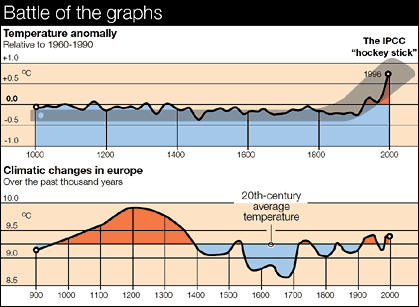
....[and there is] Dr. Edward Wegman, professor at the Centre for Computational Statistics at George Mason University and chairman of the National Academy of Sciences' Committee on Applied and Theoretical Statistics. Dr. Wegman's crime is that he verified the McIntyre and McKitrick critique of Michael Mann's famous "hockey stick" graph, and has also complained that climate change scientists have routinely made basic statistical errors and insists that climate scientists actually consult with professional statisticians when using statistics in their work. I do note that the IPCC, quietly and without comment, has dropped the use of Dr. Mann's graph from its latest report. The IPCC's current global temperature graph, which only starts in 1850, will hopefully stop all the embarrassing distractions on the Medieval Warm Period and the Little Ice Age.

Then there is Dr. Henrik Svensmark, director of the Centre for Sun-Climate Research at the Danish Space Research Institute. Dr. Svensmark presents an alternate theory on climate change that involves the sun's magnetic field, cosmic rays and cloud formation. Dr. Svensmark has even conducted experimentation to support his theory. As the IPCC report concedes that cloud formation and feedback remains a major source of uncertainty and its discussion of the role of the sun is limited to solar irradiance, it is clear that an alternative theory that attacks the weakest parts of the IPCC dogma must be silenced.

An what are we to do about Dr. Habibullo Abdussamatov, head of the Russian Academies of Sciences' Pulkovo Astronomical Observatory in St. Petersburg and head of the International Space Station's Astrometry project? He comes to the puzzling conclusion that the simultaneous global warming on Mars, where there are no man-made (or martian-made) greenhouse gases, shows shows that the sun rather than man's industrial activity, is the main cause of warming on the Earth. The very fact that the IPCC report did not address Mars warming shows how irrelevant this argument is for global warming on the Earth. Another of his heresies is that the IPCC has the cause and effect backwards, that it is the Earth's warming that causing the release of CO2 from the world's oceans, rather than rising CO2 causing the warming. He also points out the surface layers of the world's oceans are actually cooling. Allowing the dissemination of such information will only cause confusion.
Source.

Another interesting skeptical look at the recent IPCC political summary for policy makers comes from the erudite President of the Czech Republic, Vaclav Klaus.
Indeed, I never measure the thickness of ice in Antarctica. I really don't know how to do it and don't plan to learn it. However, as a scientifically oriented person, I know how to read science reports about these questions, for example about ice in Antarctica. I don't have to be a climate scientist myself to read them. And inside the papers I have read, the conclusions we may see in the media simply don't appear. But let me promise you something: this topic troubles me which is why I started to write an article about it last Christmas. The article expanded and became a book. In a couple of months, it will be published. One chapter out of seven will organize my opinions about the climate change.
Source.

Whether by burning, banishment, or simply ignoring what they say--it is simply too important an issue to allow the heretics to speak out publicly. The high inquisition of the climate orthodoxy simply cannot allow it.

Labels: , , , ,

Bookmark and Share

07 February 2007

Burning the Heretics

Unbelievable.

Also, see this perspective.

Labels: , ,

Bookmark and Share

03 February 2007

Geologist Giegenback: I Voted For Al Gore, Not His Documentary!

U Penn's Bob Giegenback has been a respected geologist specialising in climate change for almost 50 years. His career has spanned the "global cooling" scare of the 1960's and 70's, and the current "climate change catastrophe" scare of modern times. He has viewed Al Gore's documentary, and he is not amused.

...Giegengack tells his students they might want to consider that “natural” climatic temperature cycles control carbon dioxide levels, not the other way around. That’s the crux of his argument with Gore’s view of global warming — he says carbon dioxide doesn’t control global temperature, and certainly not in a direct, linear way.

Gieg has lots more slides to show. He points out that within his lifetime, there was a three-decade period of unusually low temperatures that culminated in the popular consciousness with the awful winter of 1976-77. Back then, scientists started sounding the alarm about a new ice age.

....“Sea level is rising,” Giegengack agrees, switching off the sound. But, he explains, it’s been rising ever since warming set in 18,000 years ago. The rate of rise has been pretty slow — only about 400 feet so far. And recently — meaning in the thousands of years — the rate has slowed even more. The Earth’s global ocean level is only going up 1.8 millimeters per year. That’s less than the thickness of one nickel.

...“At the present rate of sea-level rise,” Gieg says, “it’s going to take 3,500 years to get up there. So if for some reason this warming process that melts ice is cutting loose and accelerating, sea level doesn’t know it. And sea level, we think, is the best indicator of global warming.”

....If we somehow cut our CO2 emissions in half, you wouldn’t be able to measure the difference because of the role played by India and China.

It’s over. If CO2 is the problem, we’ve already lost.”

When Gieg gets to this point in his argument, as he often does when talking about global warming, he gets a little frustrated. “I always get sidetracked because, first of all, the science isn’t good. Second, there are all these other interpretations for what we see. Third, it doesn’t make any difference, and fourth, it’s distracting us from environmental problems that really matter.” Among those, Gieg says, are the millions of people a year who die from smoking and two million people a year who die because they don’t have access to clean water.

Source.
Professor Giegenback is not the most vocal of the skeptical mainstream scientists who are trying to head off the lemming-like stampede over the cliff. He is just an ordinary and conscientious geologist who has studied the issue for most of his life, and has come to several inconvenient conclusions honestly.

The release of the recent IPCC political summary for policymakers should be the stimulus for scientists from all fields that impact climate studies to be heard--in all their diversity of opinions. The totalitarian orthodoxy of apocalyptic climatologic catastrophe has been allowed to exercise rigid control of this debate for far too long.

Labels: , ,

Bookmark and Share

05 November 2006

Climate Catastrophe Bandwagon: Morons Get Free Admission

The Catastrophic Anthropogenic Global Warming (CAGW) bandwagon is shifting into overdrive. Powered largely by speculative models often based upon poor methodology, this bandwagon is expansible enough to carry as many mental conformists and followers as wish to board. More intelligent people are having second thoughts.

In 1988, James Hansen, a climatologist, told the US Congress that temperature would rise 0.3C by the end of the century (it rose 0.1C), and that sea level would rise several feet (no, one inch). The UN set up a transnational bureaucracy, the Intergovernmental Panel on Climate Change (IPCC). The UK taxpayer unwittingly meets the entire cost of its scientific team, which, in 2001, produced the Third Assessment Report, a Bible-length document presenting apocalyptic conclusions well beyond previous reports.

....First, the UN implies that carbon dioxide ended the last four ice ages. It displays two 450,000-year graphs: a sawtooth curve of temperature and a sawtooth of airborne CO2 that's scaled to look similar. Usually, similar curves are superimposed for comparison. The UN didn't do that. If it had, the truth would have shown: the changes in temperature preceded the changes in CO2 levels.

Next, the UN abolished the medieval warm period (the global warming at the end of the First Millennium AD). In 1995, David Deming, a geoscientist at the University of Oklahoma, had written an article reconstructing 150 years of North American temperatures from borehole data. He later wrote: "With the publication of the article in Science, I gained significant credibility in the community of scientists working on climate change. They thought I was one of them, someone who would pervert science in the service of social and political causes. One of them let his guard down. A major person working in the area of climate change and global warming sent me an astonishing email that said: 'We have to get rid of the Medieval Warm Period.' "

So they did. The UN's second assessment report, in 1996, showed a 1,000-year graph demonstrating that temperature in the Middle Ages was warmer than today. But the 2001 report contained a new graph showing no medieval warm period. It wrongly concluded that the 20th century was the warmest for 1,000 years.
Souce.

Even the leaders in the climate change movement are being attacked by the catastrophists for not being "catastrophic" enough! Mike Hulme, director of the Tyndall Centre for Climate Change Research is one of the sober climate players being condemned for his sobriety.

It seems that mere "climate change" was not going to be bad enough, and so now it must be "catastrophic" to be worthy of attention.

The increasing use of this pejorative term - and its bedfellow qualifiers "chaotic", "irreversible", "rapid" - has altered the public discourse around climate change.

This discourse is now characterised by phrases such as "climate change is worse than we thought", that we are approaching "irreversible tipping in the Earth's climate", and that we are "at the point of no return".

It seems that we, the professional climate scientists, who are now the (catastrophe) sceptics

I have found myself increasingly chastised by climate change campaigners when my public statements and lectures on climate change have not satisfied their thirst for environmental drama and exaggerated rhetoric.

It seems that it is we, the professional climate scientists, who are now the (catastrophe) sceptics. How the wheel turns.

Some recent examples of the catastrophists include Tony Blair, who a few weeks back warned in an open letter to EU head of states: "We have a window of only 10-15 years to take the steps we need to avoid crossing a catastrophic tipping point."

Today, a mass demonstration in Trafalgar Square will protest, aiming to "stop climate chaos" - the name for a coalition of environmental activists and faith-based organisations.

The BBC broadcast in May its Climate Chaos season of programmes. There is even a publicly-funded science research project called Rapid.

Why is it not just campaigners, but politicians and scientists too, who are openly confusing the language of fear, terror and disaster with the observable physical reality of climate change, actively ignoring the careful hedging which surrounds science's predictions?

....What has pushed the debate between climate change scientists and climate sceptics to now being between climate change scientists and climate alarmists?

I believe there are three factors now at work.

First, the discourse of catastrophe is a campaigning device being mobilised in the context of failing UK and Kyoto Protocol targets to reduce emissions of carbon dioxide.

The signatories to this UN protocol will not deliver on their obligations. This bursting of the campaigning bubble requires a determined reaction to raise the stakes - the language of climate catastrophe nicely fits the bill.

Hence we now have the militancy of the Stop Climate Chaos activists and the megaphone journalism of the Independent newspaper, with supporting rhetoric from the prime minister and senior government scientists.

Others suggest that the sleeping giants of the Gaian Earth system are being roused from their millennia of slumber to wreck havoc on humanity.

Second, the discourse of catastrophe is a political and rhetorical device to change the frame of reference for the emerging negotiations around what happens when the Kyoto Protocol runs out after 2012.

The Exeter conference of February 2005 on "Avoiding Dangerous Climate Change" served the government's purposes of softening-up the G8 Gleneagles summit through a frenzied week of "climate change is worse than we thought" news reporting and group-think.

By stage-managing the new language of catastrophe, the conference itself became a tipping point in the way that climate change is discussed in public.

Third, the discourse of catastrophe allows some space for the retrenchment of science budgets.

It is a short step from claiming these catastrophic risks have physical reality, saliency and are imminent, to implying that one more "big push" of funding will allow science to quantify them objectively.

....The language of catastrophe is not the language of science. It will not be visible in next year's global assessment from the world authority of the Intergovernmental Panel on Climate Change (IPCC).

To state that climate change will be "catastrophic" hides a cascade of value-laden assumptions which do not emerge from empirical or theoretical science.

Is any amount of climate change catastrophic? Catastrophic for whom, for where, and by when? What index is being used to measure the catastrophe?

The language of fear and terror operates as an ever-weakening vehicle for effective communication or inducement for behavioural change.
Source.

It is incredibly difficult for me to hold back the profanity when discussing the way the media has allied with the alarmists to jack up the intensity of this climate circus. Schoolchildren around the world have been lassooed into believing false claims and impossible predictions. This fiasco has gone beyond the absurd to the totally farcical. It is not a question of whether the world is presently "warming."
It is more a question of looking at the larger picture more intelligently.

Hat tip Climate Audit.

Labels: , ,

Bookmark and Share

28 September 2006

Global Warming--Not Just an Orthodoxy, It's An Adventure!

The theory of Catastrophic Anthropogenic Global Warming (CAGW) has become accepted orthodoxy by much of the general public, also by those whose income is based on the orthodoxy (think high priests), and other politicians.

But something interesting happened on the way to the anthropogenic climatic end of the world. The oceans started to cool. The satellite readings of tropospheric temperature trends diverged from surface temperature measurements. And people who are savvy in mathematics and statistics started looking closely at the sloppy methodology of the GCM multi-decadal trend climate modelers. That is what is happening over at Climate Audit blog right now. They are having a raucous--no, an adventurous--debate over the methodology of James Hansen's recent "rushed to press to beat the elections" paper in PNAC.

If you really want to think about the underpinnings of CAGW, and not simply go along with the crowd, go here and here, and read the articles and comments. If you just want to believe what everyone else believes, do not bother. It will not be worth your time and mental distress.

But if you believe that science should be a mental adventure, as I do, the issue is far from settled. In fact, the debate is only just beginning. Follow the links to Climate Science and Climate Audit and you will find fascinating discussions--the back and forth of genuine debate--that has been lost from more mainstream discussions of orthodox political views of climate.

If you browse the sidebar of Al Fin blog, you will find several other links to unorthodox views of the climate. True believer sites like realclimate etc. are a dime a dozen, and censor their comments closely to shut out heretics and infidels. If you are a special type of person who enjoys a rowdy debate the way science was meant to be, try something different.

Here is one of the reasons Hansen felt he needed to convince his friends to publish his rather confused article so hastily: storm clouds on the horizon.


The “hockey stick” was completely and thoroughly broken once and for all in 2006. Several years ago, two Canadian researchers tore apart the statistical foundation for the hockey stick. In 2006, both the National Academy of Sciences and an independent researcher further refuted the foundation of the “hockey stick.” http://epw.senate.gov/pressitem.cfm?party=rep&id=257697

The National Academy of Sciences report reaffirmed the existence of the Medieval Warm Period from about 900 AD to 1300 AD and the Little Ice Age from about 1500 to 1850. Both of these periods occurred long before the invention of the SUV or human industrial activity could have possibly impacted the Earth’s climate. In fact, scientists believe the Earth was warmer than today during the Medieval Warm Period, when the Vikings grew crops in Greenland.

Climate alarmists have been attempting to erase the inconvenient Medieval Warm Period from the Earth’s climate history for at least a decade. David Deming, an assistant professor at the University of Oklahoma’s College of Geosciences, can testify first hand about this effort. Dr. Deming was welcomed into the close-knit group of global warming believers after he published a paper in 1995 that noted some warming in the 20th century. Deming says he was subsequently contacted by a prominent global warming alarmist and told point blank “We have to get rid of the Medieval Warm Period.” When the “Hockey Stick” first appeared in 1998, it did just that.

....One of the ways alarmists have pounded this mantra of “consensus” on global warming into our pop culture is through the use of computer models which project future calamity. But the science is simply not there to place so much faith in scary computer model scenarios which extrapolate the current and projected buildup of greenhouse gases in the atmosphere and conclude that the planet faces certain doom.

Dr. Vincent Gray, a research scientist and a 2001 reviewer with the UN’s Intergovernmental Panel on Climate Change (IPCC) has noted, “The effects of aerosols, and their uncertainties, are such as to nullify completely the reliability of any of the climate models.”

Earlier this year, the director of the International Arctic Research Center in Fairbanks Alaska, testified to Congress that highly publicized climate models showing a disappearing Arctic were nothing more than “science fiction.” In fact, after years of hearing about the computer generated scary scenarios about the future of our planet, I now believe that the greatest climate threat we face may be coming from alarmist computer models.

This threat is originating from the software installed on the hard drives of the publicity seeking climate modelers.

It is long past the time for us to separate climate change fact from hysteria.

....Here is a quote from Newsweek magazine:

“There are ominous signs that the Earth’s weather patterns have begun to change dramatically and that these changes may portend a drastic decline in food production– with serious political implications for just about every nation on Earth.”

A headline in the New York Times reads: “Climate Changes Endanger World’s Food Output.” Here is a quote from Time Magazine:

“As they review the bizarre and unpredictable weather pattern of the past several years, a growing number of scientists are beginning to suspect that many seemingly contradictory meteorological fluctuations are actually part of a global climatic upheaval.”

All of this sounds very ominous. That is, until you realize that the three quotes I just read were from articles in 1975 editions of Newsweek Magazine and The New York Times, and Time Magazine in 1974. http://time-proxy.yaga.com/time/archive/printout/0,23657,944914,00.html

They weren’t referring to global warming; they were warning of a coming ice age.

Let me repeat, all three of those quotes were published in the 1970’s and warned of a coming ice age.

In addition to global cooling fears, Time Magazine has also reported on global warming. Here is an example:

“[Those] who claim that winters were harder when they were boys are quite right… weathermen have no doubt that the world at least for the time being is growing warmer.”

Before you think that this is just another example of the media promoting Vice President Gore’s movie, you need to know that the quote I just read you from Time Magazine was not a recent quote; it was from January 2, 1939.

Yes, in 1939. Nine years before Vice President Gore was born and over three decades before Time Magazine began hyping a coming ice age and almost five decades before they returned to hyping global warming.

Time Magazine in 1951 pointed to receding permafrost in Russia as proof that the planet was warming.

In 1952, the New York Times noted that the “trump card” of global warming “has been the melting glaciers.”

BUT MEDIA COULD NOT DECIDE BETWEEN WARMING OR COOLING SCARES

There are many more examples of the media and scientists flip-flopping between warming and cooling scares.

Here is a quote from the New York Times reporting on fears of an approaching ice age.

“Geologists Think the World May be Frozen Up Again.”

That sentence appeared over 100 years ago in the February 24, 1895 edition of the New York Times.

Let me repeat. 1895, not 1995.

A front page article in the October 7, 1912 New York Times, just a few months after the Titanic struck an iceberg and sank, declared that a prominent professor “Warns Us of an Encroaching Ice Age.”

The very same day in 1912, the Los Angeles Times ran an article warning that the “Human race will have to fight for its existence against cold.” An August 10, 1923 Washington Post article declared: “Ice Age Coming Here.”

By the 1930’s, the media took a break from reporting on the coming ice age and instead switched gears to promoting global warming:

“America in Longest Warm Spell Since 1776; Temperature Line Records a 25-year Rise” stated an article in the New York Times on March 27, 1933. The media of yesteryear was also not above injecting large amounts of fear and alarmism into their climate articles.

An August 9, 1923 front page article in the Chicago Tribune declared:

“Scientist Says Arctic Ice Will Wipe Out Canada.” The article quoted a Yale University professor who predicted that large parts of Europe and Asia would be “wiped out” and Switzerland would be “entirely obliterated.”

A December 29, 1974 New York Times article on global cooling reported that climatologists believed “the facts of the present climate change are such that the most optimistic experts would assign near certainty to major crop failure in a decade.”

The article also warned that unless government officials reacted to the coming catastrophe, “mass deaths by starvation and probably in anarchy and violence” would result. In 1975, the New York Times reported that “A major cooling [was] widely considered to be inevitable.” These past predictions of doom have a familiar ring, don’t they? They sound strikingly similar to our modern media promotion of former Vice president’s brand of climate alarmism.

After more than a century of alternating between global cooling and warming, one would think that this media history would serve a cautionary tale for today’s voices in the media and scientific community who are promoting yet another round of eco-doom.

Much of the 100-year media history on climate change that I have documented here today can be found in a publication titled “Fire and Ice” from the Business and Media Institute. http://www.businessandmedia.org/specialreports/2006/fireandice/fireandice_timeswarns.asp

MEDIA COVERAGE IN 2006

Which raises the question: Has this embarrassing 100-year documented legacy of coverage on what turned out to be trendy climate science theories made the media more skeptical of today’s sensational promoters of global warming?

You be the judge.

On February 19th of this year, CBS News’s “60 Minutes” produced a segment on the North Pole. The segment was a completely one-sided report, alleging rapid and unprecedented melting at the polar cap. http://www.cbsnews.com/stories/2006/02/16/60minutes/main1323169.shtml

It even featured correspondent Scott Pelley claiming that the ice in Greenland was melting so fast, that he barely got off an ice-berg before it collapsed into the water.

“60 Minutes” failed to inform its viewers that a 2005 study by a scientist named Ola Johannessen and his colleagues showing that the interior of Greenland is gaining ice and mass and that according to scientists, the Arctic was warmer in the 1930’s than today.

On March 19th of this year “60 Minutes” profiled NASA scientist and alarmist James Hansen, who was once again making allegations of being censored by the Bush administration. http://www.cbsnews.com/stories/2006/03/17/60minutes/main1415985.shtml

In this segment, objectivity and balance were again tossed aside in favor of a one-sided glowing profile of Hansen.

The “60 Minutes” segment made no mention of Hansen’s partisan ties to former Democrat Vice President Al Gore or Hansen’s receiving of a grant of a quarter of a million dollars from the left-wing Heinz Foundation run by Teresa Heinz Kerry. There was also no mention of Hansen’s subsequent endorsement of her husband John Kerry for President in 2004. http://www.columbia.edu/~jeh1/dai_complete.pdf

Many in the media dwell on any industry support given to so-called climate skeptics, but the same media completely fail to note Hansen’s huge grant from the left-wing Heinz Foundation. http://www.heinzawards.net/speechDetail.asp?speechID=6

The foundation’s money originated from the Heinz family ketchup fortune. So it appears that the media makes a distinction between oil money and ketchup money.

“60 Minutes” also did not inform viewers that Hansen appeared to concede in a 2003 issue of Natural Science that the use of “extreme scenarios" to dramatize climate change “may have been appropriate at one time” to drive the public's attention to the issue. http://naturalscience.com/ns/articles/01-16/ns_jeh6.html

Why would “60 Minutes” ignore the basic tenets of journalism, which call for objectivity and balance in sourcing, and do such one-sided segments? The answer was provided by correspondent Scott Pelley. Pelley told the CBS News website that he justified excluding scientists skeptical of global warming alarmism from his segments because he considers skeptics to be the equivalent of “Holocaust deniers.” http://www.cbsnews.com/blogs/2006/03/22/publiceye/entry1431768.shtml

This year also saw a New York Times reporter write a children’s book entitled” The North Pole Was Here.” The author of the book, New York Times reporter Andrew Revkin, wrote that it may someday be “easier to sail to than stand on” the North Pole in summer. So here we have a very prominent environmental reporter for the New York Times who is promoting aspects of global warming alarmism in a book aimed at children. And so on.


Why is the media in the catastrophe business? Would not reporting the news be enough? Apparently not. Reporting the news does not provide the media insiders enough clout. They have decided to shade the news a bit--okay, a lot. Expect a lot more of this type of thing from the media, until things start going more the way they like politically.

Labels: , , ,

Bookmark and Share

27 July 2006

Is Climate Science Finally Growing Up?


Too often, climate modeling approximates the scientific accuracy of a voodoo priestess throwing "dem bones." When mathematical models are based upon poor proxy data, and sloppy, incomplete models, the famous rule of "GIGO" takes center stage.

Fortunately, two things are occurring to improve the validity of the infant science of climatology. First, better satellite observations are able to take account of the aerosol and water vapour effect, and the heat island effect of urban centers. Second, more climate scientists are slowly coming out of the woodwork to contest the erroneous image of consensus in approaches and axioms in climate science.

The more exhaust we spew, the more temperatures will go up. But when you get into the details, as Chylek is quick to tell you, you find that climate science is not a monolith:

Could changes in the sun be responsible for some of the warming?

While scientists obsess over greenhouse gases, are they missing other things that could be having equally large effects on the climate?

Are the thermometer records that show warming as good as scientists think they are?

Contrary to the common perception of textbooks filled with fixedknowledge, real science is a tangled process fraught with uncertainties, and such debates are common in any field.

“Science,” said Texas A&M climate scientist Andrew Dessler, “is this turbulent interface between what we know and what we don’t know.”

But if all science is turbulent, then climate science, because of its political dimensions, is all the more so.

Chylek placed that turbulence center stage last week, inviting more than a hundred scientists from around the world to Santa Fe for the 2nd International Conference on Global Warming, to discuss what scientists know and don’t know about our changing climate.

.... The range of views held by working climate scientists does not show up in the political version of the debate, according to Roger Pielke Jr., a University of Colorado political scientist who studies the politics of climate science.

The science becomes caricatured, according to Pielke, dichotomized into “skeptics versus alarmists … even though it does not do justice
to the complexities of the science debate.”

....Pielke Sr. thinks greenhouse gases are not the whole story. Massive human land-use changes? wholesale shifts from forest to agriculture, for example? are also important but are being given short shrift because of the emphasis on greenhouse gases.

Pielke Sr. also thinks global temperature data, the backbone of global warming claims, are fraught with uncertainties. And he is skeptical of the computer climate simulations used to forecast future climate change.

All of those legitimate scientific questions are lost in the simplified black-and-white version of climate science that shows up in
public discourse, Pielke Sr. believes.
More at source.

Up until now, climate science has lacked the data to adequately take into account aerosols, water vapour in the atmosphere, and the urban heat island effect--not to mention land use changes and solar variation. Better earth monitoring satellite and solar astronomic data over the next ten years should improve that facility.

The IPCC also misrepresents what a "doubling" of CO2 would mean in climate terms, given the logarithmic nature of the thermal response involved. Showing a layperson curves for exponential and logarithmic curves and explaining the difference would be more honest than the approach the IPCC has taken up until now.

Global warming is far more complex than the media and the political hucksters portray it. It is in the interest of the media to portray climate change as a human caused catastrophe. The story sells better if you can portray a story as devastating, and have someone real to blame. Concocting a faux consensus only helps in convincing the reader that he knows more about the topic than he actually does.

It is a good thing for climatology to grow out of its infancy and adopt better tools.

Labels: , ,

Bookmark and Share
Older Posts
Al Fin Main Page
Enter your Email


Powered by FeedBlitz
Google
WWW AL FIN

Powered by
Blogger

``