26 March 2008

Sleeping Through the Singularity

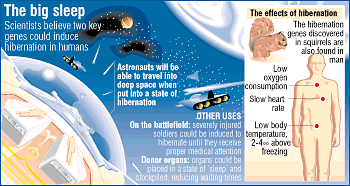
What are the prospects for human hibernation? When will human medicine be able to put techniques of suspended animation to good use for lifesaving and organ transplantation? Better yet, when will we see hibernation pods such as in the movie "2001". Recent research in mice at Mass General Hospital in Boston, may provide a few vague clues.
Low doses of the toxic gas responsible for the unpleasant odor of rotten eggs can safely and reversibly depress both metabolism and aspects of cardiovascular function in mice, producing a suspended-animation-like state. In the April 2008 issue of the journal Anesthesiology, Massachusetts General Hospital (MGH) reseachers report that effects seen in earlier studies of hydrogen sulfide do not depend on a reduction in body temperature and include a substantial decrease in heart rate without a drop in blood pressure.

“Hydrogen sulfide is the stinky gas that can kill workers who encounter it in sewers; but when adminstered to mice in small, controlled doses, within minutes it produces what appears to be totally reversible metabolic suppression,” says Warren Zapol, MD, chief of Anesthesia and Critical Care at MGH and senior author of the Anesthesiology study. “This is as close to instant suspended animation as you can get, and the preservation of cardiac contraction, blood pressure and organ perfusion is remarkable.” ___Eurekalert
Other research in sheep suggests that hydrogen sulfide may not work as well in larger mammals, such as humans. We can learn from the research in mice, but we will probably have to devise more sophisticated ways to trigger human hibernation than inhaled hydrogen sulfide.

Something interesting is going on in the bodies of hibernating animals such as arctic ground squirrels (PDF) that allows them to survive sub-freezing temperatures. Similar factors protect some species of fish and amphibians, which survive below freezing body temperatures. Insect eggs and larvae freeze solid for months, then revive in warm weather.

The best prospect for long-term human stasis (months, years, decades) probably will come from technology that allows the body to be frozen while preventing ice formation in tissues--vitrification. Still, being able to lower metabolic rates chemically--as with hydrogen sulfide--would provide many short-term benefits of hibernation for medical purposes such as trauma surgery and recovery, recovery from stroke, heart attack and hypoxia, and delicate heart and brain surgery.

The research on mice needs to be expanded to larger rodents, and small dogs and cats if possible. By studying the cell signaling processes at work, scientists should be able to devise multi-faceted treatments more suitable to large mammals.

More on cryonic preservation of tissues

Labels:

Bookmark and Share

28 August 2007

Hibernation Weight Loss Diets--The Next Big Thing?

Dr. Cheng Chi Lee at UT Houston Medical School, hopes that patenting this novel weight loss method will bring him good fortune.
The idea comes on the back of his team's discovery that the chemical 5-adenosine monophosphate, or 5-AMP, induces a state of torpor in mice, which do not usually hibernate. Lee says that a capsule or injection of 5-AMP could induce a similar state in humans, and the accompanying metabolic changes could help treat a range of conditions associated with obesity, such as diabetes, high blood pressure and eating disorders.
Impact Lab
Subcutaneous implants of 5-AMP might be priced according to the length of time the person would hibernate, with discount pricing for longer sleeps. A $5,000 sleep (to lose 50#) may last for six months, while to sleep ten years (to lose 500# or more) may cost as little as $30,000 or more. A flexible payment plan would facilitate paying out of pocket. The cost of long term care would be additional, of course.

A loving husband or wife might give a spouse the gift of hibernation--the more the spouse is loved, the longer the hibernation.

Why take the risk of undergoing bariatric surgery, when sleep--the most natural state in the world--will work as well, given time? Losing weight is often referred to as hard work, so many employers may choose to pay a person's regular salary while they are hibernating. In many cases, the employee's work output may not change. Or the employer may choose to pay for hibernation in lieu of fighting a costly wrongful termination lawsuit.

Humans have been curious about hibernating animals ever since becoming aware of the phenomenon. Soon, they may have a good reason to live the experience first hand.

Labels:

Bookmark and Share

06 April 2006

Hibernation Hormone and How to Stop the Bleeding


First, this newsfeature about a hibernation hormone in chipmunks, and what we might learn from it. The paper appears in the April 7 Cell.

"One of the most curious biological phenomena in mammals is their ability to hibernate circannually, which allows them to survive unusually low body temperatures at or near freezing," said study author Takashi Ohtsu of Kanagawa Academy of Science and Technology in Japan. Scientists have attempted for decades to identify substances responsible for hibernation in the blood and organs of hibernating animals but have met with little success, the researchers said.

"Although the functions of HP remain to be clarified, the current observations lead us to propose the involvement of the protein complex in the regulation of energy metabolism and/or biological defenses during hibernation--crucial events for adapting to the severe physiological state," Ohtsu said.

In the current study, the researchers first demonstrated that hibernation in chipmunks is strictly controlled by an individual's internal circannual rhythm even under conditions of constant cold. In 20 hibernators examined throughout their lives, concentrations of HPc in the blood started to decrease prior to hibernation and remained low throughout the inactive state. Hibernation ended after blood HPc levels rose.

Further study revealed an inverse relationship between HPc levels in the blood and brain. While HPc levels dipped in blood, the putative hormone rose dramatically in cerebral spinal fluid, they reported. Likewise, HPc levels decreased abruptly in spinal fluid when hibernation terminated.

The researchers also found that blocking the activity of one of the HP complex proteins in the brain with antibody greatly decreased the hibernation time during which the chipmunks maintained a lowered body temperature, suggesting its critical role in the brain's capacity for dormancy.
Story source.

Second, we learn about carbon monoxide's (CO) role in traumatic bleeding, and how blockers of CO might be useful in the trauma setting.

The study of CO in the tissues -- including its role in diabetes, cardiac dysfunction, hypertension and asthma -- has become the subject of increasing interest for researchers. However, this is the first time scientists are looking at its role in soft tissue trauma, said lead researcher Mary E. McCarty, who presented the study at an APS session at Experimental Biology 2006.

Small amounts of CO exist in the tissues, the result of the breakdown of a blood component known as heme. Carbon monoxide helps control blood pressure by dilating blood vessels, McCarty said. Her team reasoned that blocking the dilating action of CO would cause injured blood vessels to constrict, limiting bleeding and maintaining adequate blood pressure.

The research is still a long way from use in humans. But if successful, this new line of inquiry could eventually help stanch massive bleeding in instances of soft tissue trauma and help reduce the need for blood transfusions of patients facing lengthy surgery, among other uses.
Source.

Coincidentally, CO is one of the triggers for hibernation, in research studies, along with H2S and total darkness. The search for suspended animation--for purposes of reducing the risks of a difficult surgery, or to stabilise a patient until a definitive procedure can be carried out--is important. Quite a few other uses for human hibernation are conceivable. Present methods of freezing a person--sometimes only the head--are not generally considered efficacious.

Here is a previous Al Fin posting on hibernation.

Labels:

Bookmark and Share

06 February 2006

Suspended Animation--Will it give Terminal Patients more Time?


Animal hibernation has long fascinated humans. Recently, scientists have begun to look into the possibility that humans might be able to use hibernation as a way to cheat death. Persons suffering from terminal illness such as cancer, might choose hibernation--to wait in suspended animation for a cure for their disease. Where is the science now?

From rxpgnews.com comes a story about hibernation, and a metabolic switch that triggers a state of torpor. Researchers at the UT Houston School of Medicine exposed mice to total darkness to look for the metabolic switch that mediates darkness-induced hibernation.

A series of experiments pinpointed 5-prime adenosine monophosphate (5'-AMP) as the key molecular mediator of the constant darkness effect, switching mice from a glucose-burning, fat-storing state to a fat-burning, glucose-conserving lethargy.

Active mammals – a bear foraging for food or a human running a marathon – also undergo a similar switch, burning glucose first to fuel their efforts, and as blood sugar is consumed, their bodies switch to burning fat.

"How does the body know when to switch? 5'-AMP is the signal. I believe it's the same metabolic system, whether we are talking about hibernation or not," said senior author Cheng Chi Lee, Ph.D., professor of biochemistry.

The team started with a basic question: What actually sets off hibernation? "These animals dig deep burrows," said Lee, an expert in circadian rhythms. "They are constantly in the dark. Why not darkness as a switch?"
This research was published in 19 Jan 2006 Nature.

Previous research used hydrogen sulfide and carbon monoxide as hibernation triggers in mice. Another known hibernation trigger in animals is an opioid like substance known as HIT, hibernation inducement trigger.

Cryonics is yet another approach to suspended animation. Freezing mature human cells produces irreparable damage. That may be a solvable problem. Human sperm, human ova, and human embryos are all frozen without damage. Why not adult humans?

What if people could choose suspended animation without any risk? How would society react to that choice? In welfare state societies, with cradle to grave social supports, the extra cost of supporting millions of people in hibernation might tip the economic balance. But if only the wealthy are able to go into a suspended state, to await a cure for terminal disease, how will the lower tiers react?

Biotechnology is not an ethereal, disconnected cognitive exercise. Every exciting discovery has long term repercussions. The future is not for the timid.

Update: Acceleratingtechnology.com points to this Sydney Morning Herald article about MGH Boston surgeon Hasan Alam, who continues to develop a method of inducing profound hypothermia, using pigs.

First he anaesthetises the animal, then cuts a major vein and artery in its abdomen to simulate multiple gunshots to a person's chest and abdomen.
As the pig rapidly loses about half its blood and enters a state of shock, Dr Alam drains its blood and stores it before pumping chilled organ preservation fluid into its system.

The animal's body temperature falls to about 10C until it is in a state of "profound hypothermia" and has no pulse and no electrical activity in its brain.

But after the blood stored earlier is warmed and pumped back into the pig's body its heart starts beating again and it comes back to life.

"It is still pretty awe-inspiring," Dr Alam said. "Once the heart starts beating and the blood starts pumping, voila, you've got another animal that's come back from the other side.

"Technically, I think we can do it in humans."


Dr. Alam is attempting to gain permission to use the technique in human patients who are so critically injured that they would certainly die without this type of heroic intervention. I would not want to be on the ethics committee of Mass General, dealing with this request. Most bioethicists who try to run such committees are not sufficiently seasoned in the real life and death world of trauma medicine, to understand such situations, where seconds can count. Read the entire article and think whether you would approve the procedure.

Labels:

Bookmark and Share
Older Posts
Al Fin Main Page
Enter your Email


Powered by FeedBlitz
Google
WWW AL FIN

Powered by
Blogger

``