04 April 2011

Which Form of Energy is the Safest?

WaPo_via_NextBigFuture

At least a small part of the news media is finally moving away from nuclear hysteria. The Washington Post (via Brian Wang) has decided to break away from the pack and present a more honest look at the dangers associated with the different important forms of power generation.
History suggests that nuclear power rarely kills and causes little illness. That’s also the conclusion engineers reach when they model scenarios for thousands of potential accidents.

Making electricity from nuclear power turns out to be far less damaging to human health than making it from coal, oil or even clean-burning natural gas, according to numerous analyses. That’s even more true if the predicted effects of climate change are thrown in.

Compared with nuclear power, coal is responsible for five times as many worker deaths from accidents, 470 times as many deaths due to air pollution among members of the public, and more than 1,000 times as many cases of serious illness, according to a study of the health effects of electricity generation in Europe _WaPo
Of course, Brian Wang does a better job of explaining the issue than the Washington Post, as you might expect. Brian reveals that even wind, solar, and biomass energy production have killed many more than nuclear power.

The only two deaths associated with the Fukushima reactors incident were caused by the earthquake and tsunami. Compared to 9.0 earthquakes and 50 ft. tsunamis, nuclear power is as safe as a mother's arms.

It is important to point out that the damning statistics aimed at coal are computed by Lancet authors -- a journal which has not compiled the most trustworthy public health stats over the past 10 years. And yet, even if coal deaths are being over-estimated by a factor of 10, they are still significant when compared to nuclear.

Future use of integrated gasification combined cycle (IGCC) coal plants will slash pollution from coal use. And a new method of using waste fly ash from coal -- turning it into a high value, life-saving product -- will cause the informed public to look at even that ugly waste product differently.

Even with 40 year-old reactors, nuclear power is the safest source around by far. Imagine how much safer nuclear could be if Mr. Obama's NRC ever got off its fat, lazy, pompous arse, and did its job?

Cross-posted to Al Fin Energy

Labels: , ,

Bookmark and Share

31 March 2011

The News Media's Curious Slant on the Fukushima Incident

Due to the tragic earthquake and tsunami on March 11, 2011, over 25,000 Japanese are dead or missing. At the Fukushima nuclear reactors, no one has died. Yet the news media has been stuck on full-hysteria mode over the Japanese nuclear reactors. The media is clearly focused on a goal other than reporting the important news of the day. What could it be?
As the situation at Japan's Fukushima Daiichi nuclear powerplant slowly winds down, the salient facts remain the same as they have been throughout: nobody has suffered or will suffer any radiological health consequences. Economic damage and inconvenience resulting from the quake's effects on nuclear power have been significant, but tiny in comparison to all other human activities – the nuclear power plants in the stricken region have suffered less damage and caused less trouble to local residents than anything else that was there.

Despite this background, the details of which are now largely uncontested, hysteria continues to grip large sections of the news media and the internet. _Register
It is natural to be concerned about a disaster which might conceivably affect you or someone you care about. But intelligent people use such natural concerns as motivation to inform themselves on the facts. For a more balanced look at what is going on at the Fukushima reactors:

News roundup from Idaho Samizdat Nuclear Notes

A measured perspective on Fukushima from Brave New Climate

An interesting article published in The Atlantic suggesting that small modular nuclear reactors may receive a boost from higher level bureaucratic and political reaction to Fukushima. (H/T NEI Nuclear Notes)

The post-earthquake, post-tsunami incident at the Fukushima reactors is an economic and energy setback for the Japanese, as well as a public relations nightmare for the Japanese and the nuclear industry in general.

But the reason why the nuclear industry is being tarred so badly is because the world's media has focused its brightest lights on the reactors -- and decided to spew the most radioactively deceptive and misleading "reporting" as possible.

Yes, the world is becoming an Idiocracy -- it doesn't require a genius to see that. Corrupt and dysfunctional government school systems are not entirely to blame, either. Clearly the news and entertainment media play an even greater role in the education and informing of most citizens than the school systems, in the long run. If the media has chosen to dumb down and mislead the public, who will watch the watchers?

Am I saying not to worry about it, that nothing can go wrong? Just the opposite. I am saying to worry about it -- worry about everything. Worry so much that you are prepared for the worst that may come your way. Then hope for the best. Worry is just your brain's way of telling you to get off your lazy arse and learn what you need to learn, do what you need to do, and make whatever preparations you need to make.

No one should need to tell you to be very sceptical of anything you read or hear.

More on how the Fukushima incident may change the direction of the nuclear industry toward more "fail-safe" reactor designs.

Labels: , , ,

Bookmark and Share

21 March 2011

Update on Fukushima Reactors: Situation Stabilising

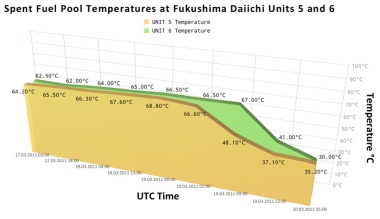
The Seeker Blog provides a good overview of recent updates on the Fukushima nuclear reactor situation. Excerpt below includes links and a useful image:

In the associated WNN report, is the following IAEA graph of unit 5, 6 fuel pond temperatures.

At units 1 and 2, external power has been restored. Tokyo Electric Power Company (Tepco) said it would restore functions in the central control room shared by the units so that accurate readings could again be taken from the reactor system. Next, workers will check the condition of the water supply systems to the reactor and the used fuel pond. With luck these will be able to go back into operation as they had been immediately after the earthquake on 11 March.

External power for units 3 and 4 should be in place ‘in a few days’ time’, said Tepco.

(…) Despite contradictory comments by the US Nuclear Regulatory Commission to US politicians and media, most observers in nuclear industry and regulation consider the measures taken by Japanese authorities to be prudent and appropriate.

At the MIT Nuclear Science and Engineering site, the 20 March status update is encouraging. Included in the report was a note on the actual tsunami heights at the reactor sites:

The Fukushima power plants were required by regulators to withstand a certain height of tsunami. At the Daiichi plant the design basis was 5.7 metres and at Daini this was 5.2 metres.

Tepco has now released tentative assessments of the scale of the tsunami putting it at over 10 metres at Daiichi and over 12 metres at Dainii.

Offsite grid power has been brought to the Daiichi site, and is in the process of connection to each reactors equipment.

Restoration of Grid

Progress has been achieved in restoring external power to the nuclear power plant, although it remains uncertain when full power will be available to all reactors. Off-site electrical power has been connected to an auxiliary transformer and distribution panels at Unit 2. Work continues toward energizing specific equipment within Unit 2.

Here’s an excerpt on radiation measurements:

Radiation levels near Fukushima Daiichi and beyond have elevated since the reactor damage began. However, dose rates in Tokyo and other areas outside the 30-kilometre zone remain below levels which would require any protective action. In other words they are not dangerous to human health.


_Seekerblog

21 March 2011 update from Brave New Climate blog

IAEA 20 March update on Japan Earthquake

Status report from FEPC of Japan (English)

Carnival of Nuclear Energy #44 at CoolHandNuke deals with Fukushima (via BrianWang)

The situation in Japan points out the need for improvement in backup systems and power supplies for nuclear power plants in the face of overwhelming natural disasters. At the same time, it highlights the relative safety of even 30-year-old reactor designs.

Now if only Obama's NRC would get off its pompous, lazy ass and help the US (and the world) move into a newer, safer age of nuclear power by certifying newer, safer reactor designs.

Cross-posted to Al Fin Energy

Labels: ,

Bookmark and Share
Older Posts
Al Fin Main Page
Enter your Email


Powered by FeedBlitz
Google
WWW AL FIN

Powered by
Blogger

``